Monday, July 13, 2015

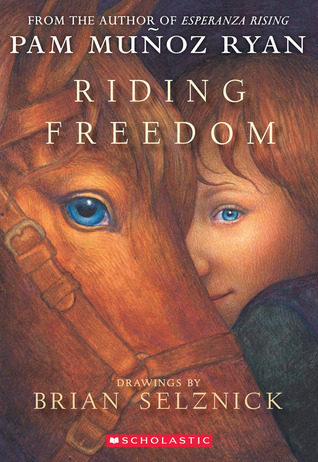
Middle Grade Review: Riding Freedom

1061557


Title: Riding Freedom
Author: Pam Munoz Ryan; illustrated by Brian Selznick
Publisher: first published 1998 by Scholastic, 144 pages. Ebook published 2013; on my Nook it had 75 pages.
Source: library (digital)

Summary:
Based on a real person, Charlotte Parkhurst, this book tells of a girl who disguises herself as a boy to escape a workhouse (masquerading as an orphanage). Unlike most who did that sort of thing (at least in books), she did not resume her female persona. Now known as Charley, Charlotte went on to become an expert stage driver, emigrated to California, and became--50+ years before it was legal--the first woman in the country to vote (so far as we know!). Note: the summaries on Amazon and Goodread talk about her being married and losing husband and baby, then resuming her male role. Nothing in the book suggests any such thing, including the historical note at the end, though there is mention of a time spent in Atlanta which isn't covered in the book.

Charlotte's story is both expanded and compressed. Expanded, because very little is known of her life (for obvious reasons), so the author had to invent small incidents, dialog, and feelings. But it is also compressed, in that the author chose to put all the key events into far fewer years than they actually encompassed for the sake of a more coherent narrative.

Review:
I am a huge fan of historical fiction, and finding a book like this, based on a remarkable real person, is a delight. Though I enjoyed it a great deal, the writing style is not to everyone's taste--it is definitely written in the style of a children's biography, with more "showing" and made-up dialog than an adult book would have, but still with a certain distance and a great deal more "telling" than we consider optimal in a novel. Frankly, I didn't care. The story is compelling, and well-told. Selznick's illustrations only add to the delight.

Like many readers (based on a scan of the reviews), I would have liked to know more about what happened after the book ends. Charlotte had a great friend at the orphanage, Hayward, and she invites him (according to their childhood plan) to join him on the ranch she eventually buys. What becomes of that relationship? I believe that the author does not pursue this because he is not an historical character, but the possibilities are tantalizing.

Recommendation:
This is a book that offers a good look at issues faced by women in the 1800s, as well as being an inspiring story of perseverance in the face of great odds. I recommend it for those who like history and historical fiction, biography, and stories of strong women.

Full Disclosure: I checked Riding Freedom out of my library, and received nothing from the writer or publisher in exchange for my honest review.  The opinions expressed are my own and those of no one else.  I am disclosing this in accordance with the Federal Trade Commission's 16 CFR, Part 255: "Guides Concerning the Use of Endorsements and Testimonials in Advertising."

Thursday, July 9, 2015

Friday Flash: The Power of the Butterfly

This is another Wendig Challenge, a title pulled from a random title generator. The title I actually got was "The Secret of the Butterfly," but by the time I was 4 paragraphs in, I had to make one small change. Thus, in 993 words, I give you....

The Power of the Butterfly

The great rambling house creaked and groaned with age, even on a calm day. On a windy day, it swayed, and made almost as much noise as the wind in the tall trees that surrounded it. Yet to Kiela, the last living member of the household, the noises of the ancient building spoke with a well-loved voice, and she felt no fear when the house rocked her to sleep. It was her home.

Her home, they said, for however much longer she could keep the wolf from the door and the door on the hinges. For forces of entropy and capitalism raced to steal from her the refuge she had kept so long, and which would win was not at all certain. A third force struggled against both and itself: the force of age, a great age that yet would not grow old and die, but instead grew weary of itself.

For Kiela had been an old woman in the house for longer than any could remember, and yet none thought to wonder at her life. The young might call her “witch,” but the old kept silent on what they knew, or thought they knew.

Only a few knew that Kiela had been a slave in that house, a century and more back when slavery was still permitted in the province. A slave accorded rights no other, slave or master, might wield, for she had a gift that would not be gainsaid, and so she outlived everything.

Most thought her gift was healing, and so she wielded it. Many a woman survived a difficult birth because Kiela attended her, and many a child failed to die of a dreaded illness. Only Kiela herself knew what power she bore: the power of the butterfly, a power that went far beyond healing.

And what might be the power of the butterfly? Kiela herself could not answer that question exactly, though it was a power that had left her alive beyond count of years, and beyond the reach of the family that had once believed they owned her, body and soul. Time had shown what that owning amounted to: nothing. They were dust and ashes, and she lived on in the house that spoke to her with the wind.

And now, when Kiela and the house alike might with a sigh of rest and relief have gone down to dust themselves, the power of the butterfly would not allow it. And so the doors clung to rusted hinges, and Kiela peered from windows but would not emerge into the sunlight. And the wealthy landholders waited for both to die, unaware that they were not the first generation of wealth to so wait.

For many years now, Kiela had found she could not leave the house in the day. Only at night, when butterflies slept, could she slip out, to roam the forest for edible herbs, or to lay the snares that captured small animals to clean and cook. At first it hadn’t been much of a burden. She had long since lost the desire to go about among people who knew nothing of her or her time. And they had their own medicine folk now, and no need of her healing.

And, just perhaps, she felt that she no longer had the strength of that healing in her.

In fact, Kiela knew that if she were to simply walk on into the darkness, far enough from the house, she would be free. Free at last to lie down and die. Yet such is the human desire for life, that always, before dawn, before the limits of the forest, she turned back, and reentered the womb. The house.

The cocoon.

For was that not the secret of the butterfly? That it spun itself a cocoon as a crawling thing, and emerged with wings? And in the cocoon, died and was reborn.

As Kiela believed she was. She slept, and awoke no older, and the house held her, nursemaid and prison-guard. And the weight of those unfelt years began to crumple her.

A time came when Kiela did not venture forth in the night. She ceased to eat. And yet the Power held her to life. She looked out the windows at the new houses being built nearly to the bounds of her garden, long since taken by weeds and fast-growing scrubby trees, and wrung her hands. Those hands which had aged to a fine mass of veins and parchment-skin, and then aged no further.

And she said in a whisper only the flies on the window might hear, “I have existed too long. I must go.” And still the power of the butterflies held her, and she could not open the front door nor go out. That day she did not settle to her lace-making—hundreds, thousands of yards of lace of all widths filled basket on basket in neat rolls—but wandered the house, seeking within and without her escape. And finally in the late afternoon, she found herself in the conservatory.

This garden she had tended all these years, after the gardens had gone. The plants were watered and pruned, and bowls of sweet water placed about for the bright-winged creatures that she served in return for their power. And now, in a moment of loathing, she wished to smash the plants, the bowls, the rippled glass of the ancient windows that warmed the room.

She did none of that. But as the sun sank below the horizon and a frozen wind began to blow icy flakes across the glass, she moved as though against a strong stream to the door that led into the outdoor gardens, forced it open, and lay down across the threshold.

A young worker on the houses found her in the morning, but soon all the townsfolk crowded about, to marvel at the ancient corpse, and at the butterflies, frozen to death, as was Kiela.
###

©Rebecca M. Douglass, 2015

Wednesday, July 8, 2015

Middle Grade Review: Stowaway, by Karen Hesse

842131

Title: Stowaway
Author:  Karen Hesse. Read by David Cale
Publisher: Hardcover 2000 by Margaret K. Elderberry Books, 328 pages. Audio 2009 by Listening Library.

Publisher's Summary:
It is known that in the summer of 1768, Captain James Cook sailed from England on H.M.S Endeavour, beginning a three-year voyage around the world on a secret mission to discover an unknown continent at the bottom of the globe. What is less known is that a boy by the name of Nicholas Young was a stowaway on that ship. 

Newbery winner Karen Hesse re-creates Cook's momentous voyage through the eyes of this remarkable boy, creating a fictional journal filled with fierce hurricanes, warring natives, and disease, as Nick discovers new lands, incredible creatures, and lifelong friends.


My Review:
As an engaging means of introducing readers to the explorations of Captain Cook, this book is superb. As a story, it is at times a little thin, but that is more than compensated for by the fact that Cook's voyage around the world is an amazing story in itself. The story is presented as the diary of young Nick, who has stowed away to join the expedition (though without actually knowing what he was getting into).

The narration is beautifully done, though the character isn't entirely convincing as a 10-13 year old (the voyage was long!). Still, I liked the voice and the reading and pronunciations were good. My only reservation about the audio version is that I'm thinking maybe the print book has maps, and maps would be good to have (though a quick look at Amazon's "look inside" feature doesn't reveal any maps). Some places discussed use names we no longer use, so a map that shows both names would be a huge help!

I appreciated that the author used a real person who was aboard Cook's Endeavour as the main character for this book. A brief historical note at the end of the book tells us what was known of the real Nick, which is very little. Hesse created a backstory (revealed beautifully and tantalizingly in brief mentions in the diary, as a boy might actually do) and details of his daily life and friends, but I think every character and incident was real. As noted that puts certain constraints on the development of a story line, but is very good for making the voyage come to life for the reader.

Recommendation:
For anyone (of any age!) interested in Cook's voyages. I wouldn't it recommend for children under 10 or 11 due to a fair bit of death to deal with. Violence is minimally described, and Nick is refreshingly naive about sex, but things do get heavy.

Full Disclosure: I checked Stowaway out of my library, and received nothing from the writer or publisher in exchange for my honest review.  The opinions expressed are my own and those of no one else.  I am disclosing this in accordance with the Federal Trade Commission's 16 CFR, Part 255: "Guides Concerning the Use of Endorsements and Testimonials in Advertising."