Wednesday, March 19, 2014

Progressive Book Club: Writing Short


http://mlswift.me/progressive-book-club-2/pbc-information-and-guidelines/

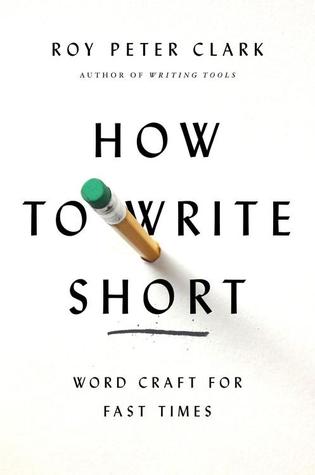
 Time once again for the Progressive Book Club!  I thought I was going to have to punt on my writing-related posts, but thanks to a lot of time sitting in airports, I not only finished reading
16131061


 but I even got a response written and--this is important, as you'll see in a moment--edited.

Title: How to Write Short: Word Craft for Fast Times
Author: Roy Peter Clark
Publisher: Little, Brown, 2013.  272 pages.
Source: Library (ebook)

This thought-provoking little book should be discussed in tweets and haikus.  If I had more time,I would.  Being short of time, I shall pick out a few key ideas and riff on them.  Clark has made this easy by dividing his book into very short chapters, each followed by a set of assignments for the writer to practice brevity.

Clark first really got my attention with Chapter 8, "No Dumping." (Given the brevity of the chapters, this was only minutes into the book.)  The chapter appeals to my possibly somewhat anal conviction that no piece of writing should go out into the world without edits (no, I don't edit my diary.  I don't share it, either).  The rule applies all the more, Clark makes clear, to short writing.  If a piece of writing is both short and unedited, odds are it doesn't make much sense. The goal is to use the fewest possible words to do the job.

Assignment #1 from Clark to me and my readers: "Make a list of the informal texts you would be least likely to revise: emails, tweets, status updates, website feedback, instant messages.  Resolve that for one week you will refrain from dumping these on your readers and will take a few seconds to correct and improve."  Take the vow along with me.

In Chapter 18 Clark discussed the 6-word memoir project*. The obvious assignment #2: write your own.  One of my efforts: "Always wanted to write.  I do."

In Chapter 19, Clark asks us to consider if we are putter-innerspring or a taker-outers.  Do you put in everything including the kitchen sink and then edit out the unnecessary bits, or frame the bare bones and expand?  I vote for both: my stories often draft as bare bones, my sentences have the kitchen sink.  When I rewrite, I often shrink the sentences and expand the stories.  Which are you (or what combo)?

A final assignment: write aphorisms, adages, and epigrams.  Those are among the classic very short forms of writing.  They also strike me as a great use of twitter for an author.  Have fun with it: "I fought the slaw, and the slaw won.  #needcleanshirt"

Oh, yeah: write t-shirt mottos, too.  I almost bought one this weekend at the Book Festival: "Oops.  I accidentally bought another pile of books."

Shakespeare said it best: brevity is the soul of wit. I believe that's wit as in intelligence, as well as humor. Funny that I think of Shakespeare as using a lot of words because really, writing in iambic pentameter constrained him far more than I constrain myself!  And every word he used had to be chosen for meaning and meter.

So there are your PBC assignments.  Feel free to share the results in the comments!

Oh, and since I ended up with some spare time, the haiku review:

Fewer words may serve
Vital communications
Better than you think.

*If you haven't heard of this, Google it.  Check out the NPR Race Card project while you're at it.


Full Disclosure: I borrowed Writing Short: Word Craft for Fast Times  from my (digital) library, and received nothing from the writer or publisher in exchange for my honest review.  The opinions expressed are my own and those of no one else.  I am disclosing this in accordance with the Federal Trade Commission's 16 CFR, Part 255: "Guides Concerning the Use of Endorsements and Testimonials in Advertising."


###########

In related news: only six days left to enter to win a paperback copy of Death By Ice Cream.


Click the link above or in the side-bar!

Monday, March 17, 2014

Kid Lit Blog Hop! Ghosts of Tupelo Landing

http://carpinelloswritingpages.blogspot.com/2014/03/kid-lit-blog-hop-35.html


18079557 

Title: The Ghosts of Tupelo Landing, 352 pp.
Author: Sheila Turnage
Publisher: Kathy Dawson Books (Penguin), 2014

Summary:
Mo LoBeau and her partner Dale are back and their Desperado Detective Agency is taking on their toughest challenge yet: they need to interview a ghost and save the worn-out old Tupelo Inn for Miss Lana and Grandmother Miss Lacy.  They have a lot of motivation: not only will the whole town suffer if someone nasty ends up with the Inn, Mo and Dale need that interview to pass their 6th grade History class.  All our old friends from Three Times Lucky are back, and a few new ones.

Review:
I have to get something off my chest right from the start: I read (and reviewed a couple of weeks ago) another book with a ghost, and I dinged it pretty hard for having a ghost, taken at face value (i.e., presented as a real ghost, seen and believed in by a number of people and no other explanation available).  Well, The Ghosts of Tupelo Landing has just that sort of ghost, and it didn't bother me (very much--I'm a little too rationalistic to be completely happy with it).  This has led me to think a lot about ghosts and how they can or can't fit into stories.  Two things about this book make the ghost work for me: for one, it's set in the South.  That's a place for ghosts, almost as good as ancient castles and baronial piles on the other side of the Atlantic.  And, maybe more important, the whole book is just a shade (uh, no pun intended!) removed from realism in any case--there's a certain over-the-top fun attitude that allows me to accept the unbelievable.

So, the ghost dealt with, did I like the story?  You bet I did!  Almost as much as I liked Three Times Lucky.  The story is fun, the narrator (Mo herself) is witty and as insightful as a 6th grader should be, and the plot is (once ghosts are accepted) logical enough to be convincing.  It zipped along, a fast read that pulled me in and kept me turning pages.  It also had a line that for some reason just doubled me up with giggles, when Miss Lana advises, with regard to ghosts, that Mo and Dale just "live and let. . . whatever."

As with Three Times Lucky, themes of family and familial love run strong in the book, and Mo is gradually settling into an acceptance of the family she has, which really works pretty well, as families go.

Highly recommended, but read the books in order, or you'll spoil the surprises in the first book.


Full Disclosure: I borrowed The Ghosts of Tupelo Landing  from my  library, and received nothing from the writer or publisher in exchange for my honest review.  The opinions expressed are my own and those of no one else.  I am disclosing this in accordance with the Federal Trade Commission's 16 CFR, Part 255: "Guides Concerning the Use of Endorsements and Testimonials in Advertising."

Saturday, March 15, 2014

Tucson Festival of Books!

I wore myself out today at the Tucson Festival of Books (that's Tucson, Arizona, in case there's another one somewhere out there).  I absorbed great blogging advice from Chuck Wendig, who is responsible for so many of the flash fiction challenges I write to, and heard a great talk on the effects of World War I on society, particularly British society. That one featured two of my favorite mystery writers, Jacqueline Winspeare and Rhys Bowen, both of whom have mystery series set in that period.

And I spent two hours in the Children's Author Tent selling and signing books.
 
Yeah, that young man is carrying a parasol.  I wished I'd had one!  Tucson in March is no place for a fair-skinned redhead from San Francisco.
 
 
I brought my Mom with me for moral support, and a good friend from back in our school days to help out (SHE is actually good at marketing and reaching out to people.  My sales were not brisk, but I'm pretty sure most of what I did sell was due to her!  Thanks, Laura!).
 
I'll go back tomorrow for more author talks and workshops.  Then we'll go for a hike.