Monday, March 3, 2014

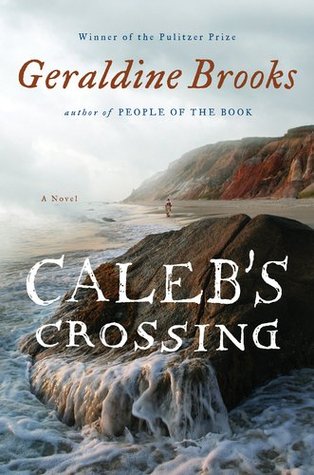
Book Review: Caleb's Crossing, by Geraldine Brooks

9684523


Title: Caleb's Crossing
Author: Geraldine Brooks
Publisher: Viking, 2011.  I listened to the Blackstone Audio version, narrated by Jennifer Ehle.

Summary (From Goodreads--I found this one too complex to neatly summarize.  I would have to say that the publisher did, too): 
The narrator of Caleb's Crossing is Bethia Mayfield, growing up in the tiny settlement of Great Harbor amid a small band of pioneers and Puritans. Restless and curious, she yearns after an education that is closed to her by her sex. As often as she can, she slips away to explore the island's glistening beaches and observe its native Wampanoag inhabitants. At twelve, she encounters Caleb, the young son of a chieftain, and the two forge a tentative secret friendship that draws each into the alien world of the other. Bethia's minister father tries to convert the Wampanoag, awakening the wrath of the tribe's shaman, against whose magic he must test his own beliefs. One of his projects becomes the education of Caleb, and a year later, Caleb is in Cambridge, studying Latin and Greek among the colonial elite. There, Bethia finds herself reluctantly indentured as a housekeeper and can closely observe Caleb's crossing of cultures.

Review: 
As is often the case with audio books, I was somewhat slow to warm to this.  I don't think that reflects on the books, as it happens almost every time (it's probably because the narration is perforce slower than reading, so it take longer to develop a sense of the book).  But this is a fascinating and complex story, and I was soon fully engaged with it.  For me, although the title suggests that the story is about the Wampanoag boy Caleb making the crossing between cultures, it was really about Bethia struggling with issues of faith and the ways faith was presented in her society.

That did set up a conflict for me, as I was continually put off by the restrictions of her society and of her religion, and wanted Bethia to rebel more completely.  Yet I think part of the brilliance of the story is that she does not act as we 21st-Century women want her to, but in keeping with her own time and self.  She can't quite make herself conform, but neither can she reject her God and run off to join the Wampanoag.

An additional narrative device that gave me pause, but in the end worked well (and I think might have been less confusing on paper than in the audio book) was the way in which the narrative is constructed as an account written out by Bethia at various stages of her life, so that her understanding of herself, Caleb, and their world changes through the story--that is, the narrator's understanding, not just that of the girl being narrated.  So the childhood parts are told from the view of the young teen, and later parts are narrated from greater and greater distances and more maturity.  I found myself set up time and again for the story to take a direction that it turned away from when the story was resumed often years later.

Caleb's Crossing is an impressive work of fiction which richly rewards the time spent immersing oneself in it.

Full Disclosure: I borrowed Caleb's Crossing  from my  library, and received nothing from the writer or publisher in exchange for my honest review.  The opinions expressed are my own and those of no one else.  I am disclosing this in accordance with the Federal Trade Commission's 16 CFR, Part 255: "Guides Concerning the Use of Endorsements and Testimonials in Advertising."

Sunday, March 2, 2014

It's Read an eBook Week 2014!

March 2nd to 8th is Read an EBook Week, something I only just learned about--but my books are on board.  It's a big promotion, and a chance to find lots of books free or cheap, but it's much more.  I'm going to send you to the wonderful blogger and writer who tipped me off on this: Jemima Pett.

Go ahead.  Go read her post on ereaders, literacy, and making books (and ereaders) available in poor communities.  She even has links showing how to donate your old kindle or whatever to the non-profit organization Worldreader.


And if you want to get my books, visit my Smashwords page to find them either free or 75% off.  Click through to the individual book to see the coupon code.  And while you're there, pick up Jemima's delightful Princelings of the East series at an equally deep discount!

Thursday, February 27, 2014

Flash Fiction Friday: Have You Seen the Rain?

This week's Wendig Challenge was another song-title prompt.  I went to Pandora, hooked into the Classic Rock station, and took the second song that came up (because the first was, shall I say, inappropriate).  This one made a story leap to mind at once--maybe a little too obvious, in light of the current drought in California (hard for some areas to believe, but while the Eastern US has been hit with a zillion feet of snow, and there's been flooding in England, the US Southwest has been setting records for lack of rain).  It's exactly 1000 words, including the title.


Have You Seen the Rain?


The clank of the well mechanism, delving ever deeper, had been a part of Eleanor’s world since she was born.  It never stopped, unless something broke down.  It had been a quarter of a century since rain had fallen, and only the pumps kept anyone or anything alive in Foothill.

Most people had left Foothill and the other Valley towns for the northern breadbaskets of Washington and British Columbia, shaking the dust of California off their feet with relief.  Eleanor and her father and brother remained.  They scraped a living of a sort from the parched soil, growing what heat-tolerant foods they could with the slightly brackish water the well now provided.

They couldn’t leave because there were no more machines to take them away, and the draft animals had long since died.  They hadn’t gone when the others did, because Eleanor’s father would not go.  Her mother was buried in the cemetery behind the decaying church.  She had died in the 15th year of the drought, when Eleanor was two and Zack was six.  The stock had died before that, unable to tolerate the brackish water, the heat, and the lack of forage.  Temperatures for much of the year stayed in the triple digits, day and night.  Winter was a thing of the past, and Eleanor thought rain was a myth.

The girl stood before their dwelling and watched the brilliant sunset fade in the west.  Though she knew the heat and the dust killed everything sooner or later, she loved the colors of the sunset.  Even the dry air and dust were comfortably familiar, and the setting of the sun brought a sort of freedom.  The sun was their enemy, beating them down with a physical force that made even thought an effort during its reign.  They worked in the night, when slightly lower temperatures and the absence of the brutal sun made it possible to tend their plants. 

“Come on, El!”  Zack called from the pumphouse.  “We need to haul out the water, then pick bugs.”

Eleanor made a face.  She didn’t need her brother to tell her that.  It was what they did every night.  Bugs seemed to be the only things that survived here, probably because of the small garden.  And they needed every bit of every plant, so they picked the bugs off nightly.  And because they needed every bit of protein they could get, they saved the insects.

Everywhere but in their garden the soil was baked so hard it couldn’t be dug.  When Mother had died, they had been forced to spend a week’s water allotment to soften the ground enough to dig a grave.  Zack remembered it.  There were other families then, but that struggle had been the last straw, and when a government transport—the last—arrived, everyone had left but the three of them. 

When the sun began to rise at the end of the short June night, Father climbed down from the ladder he used to repair the shade structure over their garden.  “Time to go in.”

Eleanor glanced to the east.  The bright band that preceded the sun glowed over the Sierra, the mountains Father said had once been called “Nevada.”  Snowy, whatever that meant.  Eleanor had trouble imagining snow.  She took one last look toward the approaching Enemy and followed Father and Zack into the cave they had enlarged and finished, where the temperature remained tolerable even through the middle of the day.  Father turned on the light and began to prepare their meager supper, frying some of the bugs.  The light was a relic of the old days, and ran on solar power, which gave them a few hours of light in the cave before it began to fade.

They ate their dinner in weary silence.  Then Father took up a book and began to read.  A dozen antique books—real, printed books on paper—filled the place of honor along one wall, and the children had learned to read from them, but they loved best to have Father read to them, though they knew them by heart.

“‘The next day the rain poured down in torrents again, and when Mary looked out of her window the moor was almost hidden by gray mist and cloud. . .’” 

 “Father, have you ever seen the rain?” Eleanor asked.

His face grew sad, and he looked at his children with something like pity.  “Yes.  I was about Zack’s age—14—when the rain stopped.  When I was a child, it rained every winter.”

“What was it like?”

For a long time he did not answer.  Then, “Clouds built over the Sierra, which might be white with snow.  They were huge, white towers in the distance at first, but when they drew close and blocked out the sun, they turned dark and blue-black, like Aggie.”  He looked around as though expecting to see the cat, though it had vanished a year before.

“Then what?” Eleanor pressed.

“Right before the rain came, you felt a blast of cool, damp air, and a gust of wind.  Sometimes, though, the storms would play with us, making thunder and lightning and no rain.  We could see it high in the sky, but it evaporated before ever it reached us, and the lightning started fires.”

That was what had happened to the forests that once come down nearly to their town.  They had burned, huge regions at once, as the dead and dying timber yielded to scant rains and caught easily from the strikes.  Dry lightning, with no rain.

“On the best days, the rain came, like in the book, in torrents, soaking everything and filling the air with a smell—I can’t describe it.  Dust and sage, plants and animals reaching for life.  And none of it did any of us any good,” he said as though to himself.  “There will be no more rain.”  His eyes filled with tears.  “My children will never see the rain.”


##

©Rebecca M. Douglass 2014