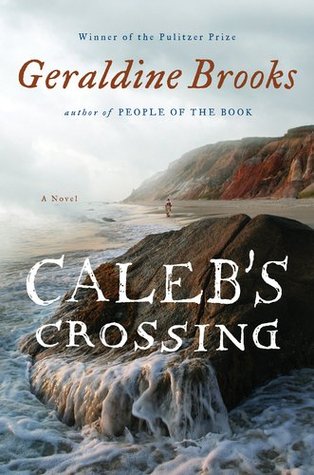
Title: Caleb's Crossing
Author: Geraldine Brooks
Publisher: Viking, 2011. I listened to the Blackstone Audio version, narrated by Jennifer Ehle.
Summary (From Goodreads--I found this one too complex to neatly summarize. I would have to say that the publisher did, too):
The narrator of Caleb's Crossing is Bethia Mayfield, growing up in the tiny settlement of Great Harbor amid a small band of pioneers and Puritans. Restless and curious, she yearns after an education that is closed to her by her sex. As often as she can, she slips away to explore the island's glistening beaches and observe its native Wampanoag inhabitants. At twelve, she encounters Caleb, the young son of a chieftain, and the two forge a tentative secret friendship that draws each into the alien world of the other. Bethia's minister father tries to convert the Wampanoag, awakening the wrath of the tribe's shaman, against whose magic he must test his own beliefs. One of his projects becomes the education of Caleb, and a year later, Caleb is in Cambridge, studying Latin and Greek among the colonial elite. There, Bethia finds herself reluctantly indentured as a housekeeper and can closely observe Caleb's crossing of cultures.
Review:
As is often the case with audio books, I was somewhat slow to warm to this. I don't think that reflects on the books, as it happens almost every time (it's probably because the narration is perforce slower than reading, so it take longer to develop a sense of the book). But this is a fascinating and complex story, and I was soon fully engaged with it. For me, although the title suggests that the story is about the Wampanoag boy Caleb making the crossing between cultures, it was really about Bethia struggling with issues of faith and the ways faith was presented in her society.
That did set up a conflict for me, as I was continually put off by the restrictions of her society and of her religion, and wanted Bethia to rebel more completely. Yet I think part of the brilliance of the story is that she does not act as we 21st-Century women want her to, but in keeping with her own time and self. She can't quite make herself conform, but neither can she reject her God and run off to join the Wampanoag.
An additional narrative device that gave me pause, but in the end worked well (and I think might have been less confusing on paper than in the audio book) was the way in which the narrative is constructed as an account written out by Bethia at various stages of her life, so that her understanding of herself, Caleb, and their world changes through the story--that is, the narrator's understanding, not just that of the girl being narrated. So the childhood parts are told from the view of the young teen, and later parts are narrated from greater and greater distances and more maturity. I found myself set up time and again for the story to take a direction that it turned away from when the story was resumed often years later.
Caleb's Crossing is an impressive work of fiction which richly rewards the time spent immersing oneself in it.
Full Disclosure: I borrowed Caleb's Crossing from my library, and received nothing from the writer or publisher in
exchange for my honest review. The opinions expressed are my own and
those of no one else. I am disclosing this in accordance with the
Federal Trade Commission's 16 CFR, Part 255: "Guides Concerning the Use
of Endorsements and Testimonials in Advertising."
