Showing posts with label poetry. Show all posts

Sunday, March 24, 2019

#Fi50: Whenever

It’s #FictionIn50 time again!  Please consider sharing your own 50-word creations, and join the hop.

Fiction in 50 is a regular feature in the last week of every month and I invite any interested composers of mini-narrative to join in!

fiction in 50   image Fiction in 50 NEW BUTTON

What is #Fi50? In the words of founder Bruce Gargoyle, "Fiction in 50: think of it as the anti-NaNoWriMo experience!" Pack a beginning, middle and end of story into 50 words or less (bonus points for hitting exactly 50 words).

The rules for participation are simple:

1. Create a piece of fictional writing in 50 words or less, ideally using the prompt as title or theme or inspiration.
That’s it!  But for those who wish to challenge themselves further, here’s an additional rule:

2. Post your piece of flash fiction on your blog or (for those poor blog-less souls) add it as a comment on the Ninja Librarian’s post for everyone to enjoy.  
And for those thrill-seekers who really like to go the extra mile (ie: perfectionists):

3. Add the nifty little picture above to your post (credit for which goes entirely to ideflex over at acrossthebored.com) or create your own Fi50 meme pic….
and 4. Link back here so others can jump on the mini-fic bandwagon.
At this time, I haven't been able to find a source for a free linky-list, so it's just comments. I recommend posting your basic blog link below, with the day you post your Fi50 story. You can also add a link on the #Fi50 page. Feel free to Tweet using the #Fi50, though I'll not lie: the Ninja Librarian is a lousy tweeter.

The prompt for March is “Whenever”.  Big thanks to Jemima Pett for the 2019 prompts.


My March offering turned out to be a sort of a poem. Or a wish. Probably mostly a wish, and a sigh, and not very original because we poor humans seem to keep making the wish necessary.

Whenever

Whenever there is hatred, let there be more love.
Whenever there is violence, let there be healing.

I look forward to the day when hatred and violence end 
And people love to accept one another as human
And beautiful
And worthwhile.
Whenever it may happen.
Whenever.

Maybe now?

I wish.


©️ Rebecca M. Douglass, 2019. Use only with permission. Link-backs appreciated.

Wednesday, August 8, 2018

Review: Priestdaddy, by Patricia Lockwood

31920820 


Title:
Priestdaddy: A Memoir
Author: Patricia Lockwood
Publisher: Riverhead Books, 2017. 336 pages (hardback)
Source: Library digital resources

Publisher's Blurb:
The childhood of Patricia Lockwood, the poet dubbed "The Smutty-Metaphor Queen of Lawrence, Kansas" by The New York Times, was unusual in many respects. There was the location: an impoverished, nuclear waste-riddled area of the American Midwest. There was her mother, a woman who speaks almost entirely in strange koans and warnings of impending danger. Above all, there was her gun-toting, guitar-riffing, frequently semi-naked father, who underwent a religious conversion on a submarine and discovered a loophole which saw him approved for the Catholic priesthood by the future Pope Benedict XVI - despite already having a wife and children.

When the expense of a medical procedure forces the 30-year-old Patricia to move back in with her parents, husband in tow, she must learn to live again with her family's simmering madness, and to reckon with the dark side of a childhood spent in the bosom of the Catholic Church. Told with the comic sensibility of a brasher, bluer Waugh or Wodehouse, this is at the same time a lyrical and affecting story of how, having ventured into the underworld, we can emerge with our levity and our sense of justice intact.


My Review: 
I got this book from the library on the recommendation of a friend, and while it was not my usual reading, it was a good recommendation. Lockwood's language is highly visual, and that nick-name in the blurb is justified, but she made me laugh, as well as cringe.
Having to move back home as a married woman of 30 has to be hard for anyone, but it is particularly weird for Lockwood. Her father is a Catholic priest, and (as far as I can tell) a red-necked good-old-boy to the Nth degree. Where many people might just crawl into their shells and mope, or get into endless fights with parents whose belief system is so completely antithetical to their own, Lockwood takes a course that makes total sense to me: she begins to write a memoir of her childhood and her parents, observing and making notes on everything they say and do. It becomes more and more clear over the course of the book that Lockwood is moderately messed up in her own head, and that it's pretty easy to blame her parents. She manages to resist this urge to an admirable degree, and the book is remarkably non-judgemental.
 
You might wonder how the child of such religious parents gets so far out the other end of the spectrum, but I know myself that the children of preachers tend to either become preachers or atheists (we have both in my family), so in a way it makes perfect sense. And maybe it's partly that unreal world she's raised in that makes Lockwood think she can make a living as a poet (a poor bet, though at the time of writing the book she was starting to make progress, and I'm sure the memoir helped the bottom line). Even in her prose, Lockwood's roots as a poet show, and while sometimes the language slips over the top into too-arty (or too dirty), most of the time it works. I kept reading for both the outrageous story and the outrageous language.
My Recommendation:
I will recommend this, but not for the easily offended, either by naughty language or by irreligion. In fact, I think Lockwood treats her parents' Catholicism with a fair level of respect, but there is no denying it's also under scrutiny, and Lockwood doesn't hide her own feelings. The narrow-minded will almost certainly consider some parts of the book blasphemous.


FTC Disclosure: I checked Priestdaddy out of my library, and received nothing from the writer or publisher for my honest review. The opinions expressed are my own and those of no one else. I am disclosing this in accordance with the Federal Trade Commission's 16 CFR, Part 255: "Guides Concerning the Use of Endorsements and Testimonials in Advertising."  

Wednesday, February 18, 2015

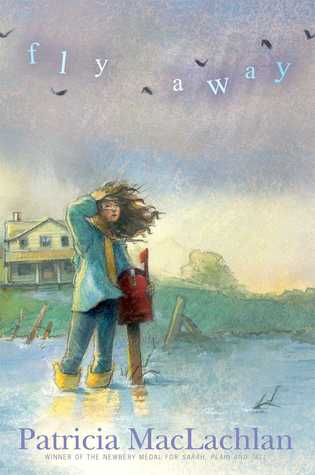
Middle Grade Review: Fly Away by Patricia MacLachlan

17245741


Title: Fly Away
Author: Patricia MacLachlan
Publisher: Margaret K. McElderry Books, 2014.  44 pages.
Source: Library ebook

Summary: 
Lucy is the only one in her family who doesn't sing. Even her baby brother, who can't yet talk, sings to her at night when the others are asleep.  Singing is what the family does, just like they go every year to help out Aunt Frankie. When the river floods Aunt Frankie's farm, everything comes together: family and music and poetry and the river.

Review:
Like most of Patricia MacLachlan's books, Fly Away is very short and deceptively simple. In just 44 pages--about a half hour's reading for me--we are given a family dynamic and a little girl who is trying to figure out where she belongs in a family where everyone sings, but she just wants to be a poet. And in one terrible moment of fear, it all comes together beautifully.

MacLachlan's books is like a poem itself--spare and simple words with a lot said between the lines. When I read a book like this, part of me really wants to read the rest of the book--the party the author didn't write, that fills in all the details of the story. But that's not a bad thing.

Recommendation:
I don't know if this is as as easy a read as it looks. With its brevity and simple writing, it seems like it would be for kids just breaking into chapter books. But, like Sarah, Plain and Tall, which has much more in it than the length and simplicity of the story would suggest, it probably takes an older reader to unpack much of what it is really about. So maybe this is a book for all ages. Certainly an older child who thinks a lot but reads poorly would appreciate the simplicity of the language and the complexity of the story, as did I.

Full Disclosure: I checked Fly Away out of my digital library, and received nothing from the writer or publisher in exchange for my honest review.  The opinions expressed are my own and those of no one else.  I am disclosing this in accordance with the Federal Trade Commission's 16 CFR, Part 255: "Guides Concerning the Use of Endorsements and Testimonials in Advertising."

http://motherdaughterbookreviews.com/kid-lit-blog-hop-54-twitter-linky-party/
Hop over to the Kid Lit Blog Hop for more great blogs about kids' books!

Thursday, May 15, 2014

Flash Fiction Friday! The Power of Poetry

 This week, Chuck Wendig gave us three random phrases to incorporate into whatever story we could come up with.  Fortunately for Xavier Xanthum and Larry the Eyeballs, one of the phrases gave me the idea I needed to rescue them from the fix I left them in last week!  Thanks, Chuck!  I'll let you guess the phrase, or you can cheat and look here.

The Power of Poetry

Xavier Xanthum, Space Explorer, watched the alien ship approach.  He wiped his sweaty palms on his pants and fought panic.  He didn’t care about the fame that might come of making first contact with a new species.  He’d happily let someone else have that fame and go on exploring uninhabited reaches of space.

There were just so many ways this could go wrong.  For one thing, there was the translation module. The TM had been producing translations profane enough to get a person thrown out of the worst dives in the sleaziest spaceports in the system.  At least, Xavier thought it would.  He’d never tested that kind of language, and stayed out of the sleaziest dives.  He avoided conflict.

“Larry, are you sure the TM is going to be okay with this?  First contact is tricky.  And Space only knows what the aliens might make of a foul-mouthed translation.”  He thought a moment.  “How long until we’re out of this gravity well and can make the jump?”

Larry didn’t answer.  Xavier looked around.  He didn’t see the eyeballs that were the computer’s semi-human manifestation.  “Larry?”

“Um, here, Captain?”

Xavier felt a chill.  Not only did Larry call him “captain,” which he did only only when he had bad news, but he had hesitated as though unsure.  This was no time for Larry to turn human.

“What is it, Larry?”

“At the current course and speed we will be ready for the jump in 21.35 minutes.  We contact the alien ship in five point five minutes.   Assuming the TM can handle the alien language, have you considered what you will say?”

“Isn’t there something in your protocols?”  Larry was the AI, for Earth’s sake!  He was supposed to know things.  Xavier wiped his palms again.

“There are several options.  None seems apropos?”  Larry ended on a rising tone, the way an Earth-speaker would, to indicate uncertainty.  Another human trait.  Xavier suppressed a shudder.

“Lay them on me.”

“One.   ‘We come in peace.’”

“That has promise, though I’d rather go in peace.  Next.”

“’Do not approach any closer or we may—‘”

Xavier cut that one off before Larry even finished.  “Definitely not.”  They lacked significant weaponry in any case.

“How about, ‘Greetings?  Do you want a drink?  Are we—‘ Wait, no, that’s for meetings in bars, not first contact.”

“Different kind of contact.  The opener has promise, though.”

“Then there’s this one.  It’s a list of everything of interest in the local space region.”

“Like a tourist brochure.  That might be good.”

Larry had reappeared at last—his eyeballs, that is.  Until now, he’d remained a disembodied voice.  Now he was a disembodied voice and a pair of floating eyeballs.  “The last one is. . . odd.  I do not understand.”

“What?”

“It begins, ‘Whan that Aprill with his shoures soote.’”

“That doesn’t even sound like English.”

“It goes on a very long way, and there is a notation which says, ‘a poetic pattern retains inertia.’”

“Weird.”  Xavier thought a bit.  “A little inertia on their part might be helpful.  We could try that.”

The alien ship now loomed large on the vid screen.  Xavier studied it, trying to decide if it bristled with weapons, was covered with sensors, or was just a truly ugly design.

The external audio input crackled to life.  The alien language hurt Xavier’s ears.  Even Larry’s eyeballs seemed to flinch, though as far as Xavier knew he didn’t have ears.  Then the TM kicked in.

“’Who the #$%#  @#$%@# are you?’”

Xavier groaned.  “It’s still doing it!”

“We must respond, Captain.  Failure to respond would be worse than a tactless response.”

“Give them the tourist brochure response.  At least it goes on for a while.  It might buy us some time.”  He wondered what a recitation of the local attractions would sound like in the profane language the TM seemed to have adopted.  “At least the TM can handle the alien language.  I always wondered how they do that.”  Xavier’s musings on the miracles of translators were cut short by a long string of speech in the alien tongue, their TM’s broadcast of where to find hotels, bars, brothels, and other necessary amenities.

The aliens put up with it for a full minute before their response came back.  Stripped of the decorative profanity, it amounted to “your mama.”  Followed by something along the lines of “—obliterate you.”

“Holy asteroids, Larry!”  Xavier scrambled for an idea, beyond the notion that maybe the cussing didn’t come from the TM after all.  They needed back-up, and they needed to get away.  “Code message to Gamma Sixteen about this hostile alien.  And hit that poetry thing.  I hope to Hades IV that it’s right about poetic patterns and inertia, because we have got to get out of here.”

“I have adjusted our course for optimal achievement of a moderately safe jump.  Three minutes and four seconds.”

“Accelerate gradually away from them after the TM begins.”

The harsh syllables began pouring from the TM.  Xavier hoped that the poetic pattern translated, if nothing else did.  And he wondered what the Canterbury Tales sounded like in cuss words.  And if the cryptic comment about inertia meant anything.

It seemed it did.  At least, the alien ship didn’t adjust its course this time to follow as they moved obliquely away from it.  Xavier didn’t know if the aliens were inertialized by poetry, numbed by early English verse, or awed by the TM’s obscene vocabulary.  He didn’t care.

Larry monitored their progress, as Xavier strapped into the jump couch.  A minute later, he initiated the jump, and they were in another system.

Just how had the TM translated “And smale foweles maken melodye,” anyway?

###
©Rebecca M. Douglass, 2014

Last chance to enter the May I Suggest. . .  giveaway!

Monday, April 28, 2014

X: Xanadu!

Before we begin today's post, I just want to say that I'm a guest poster over at Out Where the Buses Don't Run.  Thanks, Gus!  So when you finish reading my X-related ramblings, drop on over and show some love!


Not a whole novel.  But the only thing I could come up with for X, unless I featured my own Xavier Xanthum stories.  Besides, at this point in the month, a fairly short poem seems like a great subject!  So I have chosen Samuel Taylor Coleridge's poem, "Kubla Khan," about Xanadu.  It's one of many from which I have memorized the first several lines--and no more (my brain seems to absorb up to a point without effort.  After that--bleh).   Xanadu seems to sit in the heart of wilderness, despite Kubla Khan's efforts to tame it. . .and he himself was pretty wild.  So that's my tenuous wilderness tie-in.

Instead of a review (even I don't have the chutzpah to review Coleridge!) I just going to share some of my favorite bits.
In Xanadu did Kubla Khan
A stately pleasure dome decree:
Where Alph, the sacred river, ran
Through caverns measureless to man
   Down to a sunless sea.
. . .
But oh! that deep romantic chasm which slanted
Down the green hill athwart a cedarn cover!
A savage place! as holy and enchanted
As e'er beneath a waning moon was haunted
By woman wailing for her demon lover!

Just a reminder for anyone who thinks that the Romantic poets were all about sweetness and light and clouds of daffodils!  Turns out they (well, people of that time, i.e. early-mid 19th Century) were also the folks who largely invented the idea of loving wilderness for being wild, rather than seeing it purely as something to tame.  They were also very much into the horrific (don't forget Frankenstein!), which shows in the second except above (love that "woman wailing for her demon lover").

From Coleridge and his love of the "deep romantic chasm" you could probably draw a straight line to people like Brad Washburn, whose life story I reviewed last week.  These are the people who love nature for the very fact that it's wild and could have you for breakfast without caring a whit.   Not everyone's on board with the idea even yet, but I'm very glad enough are, and have been, that we have some wilderness left to go to.