Showing posts with label Westerns. Show all posts

Wednesday, November 8, 2017

Sexism and the Writer of the Purple Prose

 I had a yen the other day for a western to read, and grabbed up a copy of Zane Grey's The Call of the Canyon. This isn't a proper review of the book, but more a rant about it.

13017839 

The Call of the Canyon, by Zane Grey, originally published 1924.

I like Zane Grey. Some of his books have very strong female characters, even if they are all destined for matrimony (he was, after all, writing romances, in both senses of the word). I also expect his novels to focus on the male protagonist, and may at times feel impatient with this. So it was kind of exciting to realize that this book stuck pretty well to the viewpoint of the female protagonist.

So far so good. But after he paints Carley as a rather modern young woman, independent (in part because she's lucky enough to be independently wealthy), he starts repositioning her as selfish and self-indulgent. Fine. But what's not fine is the reason why: she doesn't want to "fulfill her destiny" as a wife and mother, subsuming her own desires to those of her man and making her be-all and end-all the raising of children and keeping house.

About the point it becomes clear that this is the hero's ideal, if I'd been writing the book Carley would have gone back to New York, set herself up in business, and proved she could have a successful and fulfilling life without any pesky men. But no: Zane Grey has to spend the rest of the book making her more and more miserable until she lashes out with a diatribe against her peers so mind-blowing I have to reproduce it here. She begins by ranting against their trivial lives while the soldiers who have come back from WWI are suffering, homeless, and neglected (I don't know how this measures up against reality as an indictment of the US in the early 1920s, but Grey uses the damaged soldier in more than one book, leading me to think that either it was a real problem that upset him, or that it was a great emotional hook). She then rants about the wasted opportunity of the vote they have just been granted, and I'm ready to cheer when she says, "Nothing wrong when there are not enough schools and teachers to educate our boys and girls, when those teachers are shamefully underpaid?" The saddest bit about that is that it's still true.

Then Grey goes off the rails, as Carley rants on:
"Nothing wrong when the mothers of this great country let their youngsters go to the dark motion-picture halls and night after night in thousands of towns over all this broad land see pictures that the juvenile court and the educators and keepers of reform schools say make burglars, crooks, and murderers of our boys and vampires of our girls? Nothing wrong when these young adolescent girls ape you and wear stockings rolled under their knees below their skirts and use a lip stick and paint their faces and darken their eyes and pluck their eyebrows and absolutely do not know what shame is?" Okay, I get that it was a different time and different morals, but this is getting uncomfortable. And she doesn't stop:
"Nothing wrong when you may find in any city women standing at street corners distributing booklets on birth control?" Well, that sounds like a good idea to me, but again, I suppose at the time his popular audience would have been shocked. Obviously, since there were women working hard to advocate for birth control, it was not a universal condemnation, however.

It gets better: after ranting about the automobile (presumably because it's a good place to lose that all-important virginity), magazines full of sex-appeal, and the over-fondness for money that she's probably right is at the root of evil, she makes a criticism of jazz that made me laugh: "Nothing wrong with jazz--where the lights go out in the dance hall and the dancers jibble and toddle and wiggle in a frenzy?" (I wonder what Zane Grey would have thought of twerking. Never mind--if the thought didn't kill him, the actual sight of it would have).

Then things get ugly: "Nothing wrong in a country where the greatest college cannot report birth of one child to each graduate in ten years? Nothing wrong with race suicide and the incoming horde of foreigners? . . . Nothing wrong with you women who cannot or will not stand childbirth? Nothing wrong with most of you, when if you did  have a child, yuou could not nurse it? . . . Oh, my God, there's nothing wrong with America except that she staggers under a Titanic burden that only mothers of sons can remove!" All I could think as I read that was that it's a source of shame for our country that this sounds like it could have come from the pen of the Head Tweeter. The sexism is bad enough (American needs sons, and to hell with the daughters), the xenophobia as understandable and unacceptable then as now.

See, what sickened me about this book wasn't that it ends in marriage and they-all-lived-happily-ever-after. We expect that in a romance. What sickened me was that, in 1924 when this was published, the same man who could rhapsodize for pages about the healing beauty of the West and the independence it brought to men, could explicitly write that women were worse than failures--that they were downright evil--if they chose any path but marriage and motherhood. Not even that marriage was the unexamined ideal outcome (that's kind of assumed in the genre), but that any other choice was a moral failure.

That was carrying the romance genre beyond the pale.

Apologies for the rather long rant!

How about you? Have you ever been sadly disappointed by an author's apparent views?

Tuesday, May 26, 2015

Middle Grade review becomes something else


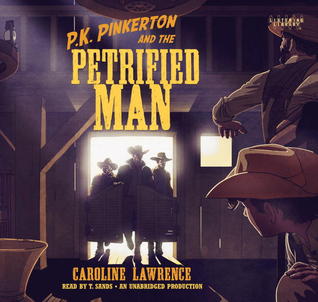
My intention was to make today's post a review of the middle grade historical/western/mystery, P.K. Pinkerton and the Petrified Man, by Caroline Lawrence (the book also seems to have some listings as "The Case of the Good-Looking Corpse," for reasons I haven't yet figured out). This is the second book in the series, and the 3rd I've read. I did an extremely brief review of Book 3, though I am enjoying the series and they deserve more (see caveats at the end of this post)

So my plan today was to do more. But I got a little sidetracked.  Before I go off on that, let's do the review basics:
15926763

Title: P.K. Pinkerton and the Petrified Man
Author: Caroline Lawrence; Narrated by Tara Sands
Publisher: Audio Edition (what I read): Books on Tape, 2013. Original publication (as The Case of the Good-Looking Corpse) 2012, 313 pages.
Source: Digital library

Summary: 
Newly-orphaned 12-year-old P.K. Pinkerton has hung up a shingle and gone to work as a Private Eye in Virginia City, Nevada in 1860-something. Business is slow until Martha, a young servant girl, comes looking for someone to find out who killed her mistress, Short Sally. P.K. takes the case and finds it a challenge--and a risk. With the help of P.K.'s main ally, Poker Face Jace, and a bit of aid from a young journalist named Sam Clemens, justice prevails, but not without a lot of excitement!

Here's where I would be reviewing the book, only I got distracted by something. See, P.K. clearly has Asperger's Syndrome (a form of high-functioning autism). This manifests in a dislike of being touched, a fondness for collecting things (and organizing them), and an inability to read emotions--or recognize faces. It was that last that sent me off track.

Because I don't recognize faces very well either. P.K. refers to the problem as "my thorn," referencing St. Paul and his "thorn in the flesh" that was some mysterious ailment that kept him (St. Paul) from doing all he wished. In the same way, P.K. considers face-blindness (official name: prosopagnosia) a handicap. And I read a review that objected to presenting this as a handicap, because we don't want to stigmatize Asperger's as a handicap (I can't find that review, and may not even remember it correctly. It doesn't matter, because it made me think). The thing is, face-blindness *is* a handicap. Especially for someone who wants to be a detective. The interest here is in how P.K. works around it (though I'm not sure his work-around would work, because it seems to me more of a means of remembering names than faces. I'll try to experiment, but Lawrence may have slipped up here).

All this leads me to what I know about prosopagnosia, which is mostly that a) having had it, apparently, since birth, it took me a really long time to figure out why other people could follow movies so much better than I can, and b) that it has usually felt like an excuse when I explain why I wasn't slighting someone just because I didn't recognize them. Oh, and c) it's a little awkward for a writer, too (I tend not to give my characters physical descriptions). What I also know is that I recognize many people quite well--by distinctive features, hair, clothing, or gait.

So I did a little research. One thing I learned is that face-blindness (let's stick to the pronouncable version) is not necessarily an aspect of Autism, but there is a lot of overlap. In my case, I'd say it's related, as my oldest son has Asperger's, and I have recognized a lot of signs and symptoms in the literature as also applying to me. So it's not a common aspect, but makes sense for P.K. to have it along with the other issues. And it makes an intriguing problem for the young detective.

I also learned that some people (maybe most?) acquire face-blindness from some trauma. Those people are probably driven more nuts by it than I am, because they know how this stuff is supposed to work. I found some very good info at https://www.faceblind.org/research/, including a test to see if you have it (if you take the test, please leave a comment about it). Yeah, I'm not crazy. Apparently other people can recognize faces even without hair and stuff. They even recognize actors when they change costumes! Who knew?

Finally, to return to the book, I want to say that I have been enjoying this series a lot. On the other hand, though it is apparently written for middle-grade students (writing level seems to match), the content is often pretty adult, and the story is more like an adult western. There is little or no bad language, but there are gun fights, dead bodies, and (what would you expect in a mining town like Virginia City in it's heyday?) most of the women are prostitutes, delicately referred to as "soiled doves." And P.K., who is half Lacota Indian, is subjected to the racism that was rampant at the time. Make your own judgement about appropriateness for your child.

Oh, and just to finish: if I meet you somewhere, then don't recognize you the next time, please don't be offended, even if it happens more than once. Just remind me who you are and let it go. Thanks.


Since I did sort of review the book, here's the usual boiler-plate:
Full Disclosure: I checked P.K. Pinkerton and the Petrified Man out of my digital library, and received nothing from the writer or publisher in exchange for my honest review.  The opinions expressed are my own and those of no one else.  I am disclosing this in accordance with the Federal Trade Commission's 16 CFR, Part 255: "Guides Concerning the Use of Endorsements and Testimonials in Advertising."

Thursday, April 23, 2015

T: Telescope Peak


Also Treasure Mountain, by Louis L'Amour, because I can!

First, Telescope Peak. Telescope Peak is the peak that stands on the West side of Death Valley, and towers over Badwater (the lowest spot in North America). It is 11,048' high, which puts it 11,331' above the view of it from Badwater (282' below sea level). Straight line between the alkali flats and the summit is 20 miles, so that's a lot of relief!

In spring of a good year (i.e. one when CA has seen some precipitation), the summit of the peak is buried in snow even when the bottom of the Valley is scorching. The trail, 14 miles round trip from the road's end at Mahogany Flat campground doesn't usually become passable without crampons and winter gear until mid-May.

 It's hard to get the color right--the salt at Badwater is white like snow, which is always hard to shoot.
Badwater and Telescope peak. 1998 was a wet year, reflected in the heavy snow cover (and great wildflowers down below).

Now for the book review:

282092 

Title: Treasure Mountain
2068755Author: Louis L'Amour
Publisher: Bantam, 1972. 192 pages
Source:  library (digital)

Summary: Louis L'Amour invented the Sackett family and, eventually, tracked their history through 2 or 3 centuries though most of the books were of course set in the Frontier West period. In this book, Tell and Orrin Sackett are on a quest to find out what happened to their father, who disappeared into the west 20 years before. The quest starts in New Orleans, but ends in the San Juan Mountains of Colorado, with (of course) a great deal of struggle and not a few good fights along the way.

Review:
I can't review a book like this as though it were Anna Karinina. L'Amour's westerns were never meant to be great literature, and they aren't. Sometimes they aren't even very well written (though this one seemed more free than most of the kinds of flaws that annoy me), but most are reasonably well plotted and all are delightfully embarrassing to love. 

Recommendation: For anyone who loves Westerns, and hopeless romantics.


Full Disclosure: I checked Treasure Mountain out of my digital library, and received nothing from the writer or publisher in exchange for my honest review.  The opinions expressed are my own and those of no one else.  I am disclosing this in accordance with the Federal Trade Commission's 16 CFR, Part 255: "Guides Concerning the Use of Endorsements and Testimonials in Advertising."


Friday, February 27, 2015

Friday Fiction: Swords of the Desert, Part II

Four kids from another world have landed themselves in the Mojave desert, just in time to be caught up in Jake Stone's troubles. Read the beginning of the story here; this really is just a single story divided in two.

I got really carried away with this one, and will be working more with the characters and the story. But I pruned it to about 2200 words total, to keep it to two posts. The longer version will show up somewhere, sometime...probably in that anthology I keep saying I'll assemble!


#
Jake thought maybe he should lay off the whiskey. He had to be hallucinating. Nothing about the kids looked right, not for white kids, not for Indians. Especially not the one with the tail. Jake refused to think about that.

Hallucination or not, they couldn’t stay where they were. Jake knew he’d been followed into the desert, and the men behind him would kill a kid without a moment’s thought. Jake slid down off the horse, and stood still until the children stopped cringing.

“Well, I guess you can’t understand me, and I can’t understand you, but come on, let’s get you somewhere safe.” Jake held out his water flask to the girl who seemed to be in charge, mentally figuring how long it would last and how far it was to the spring at Cima. They’d make it, though they might be thirsty.

Then he looked back. The outlaws’ dust was closer. “We’d better skedaddle.” They didn’t understand his words, but the tallest girl looked where he looked, and seemed to understand the situation.

#
I couldn’t understand his speech, but the stranger’s meaning was clear enough. Someone was coming after him, and not in a nice way. We knew about that sort of thing, and since he seemed willing to help us find our way out of this bizarre desert, we got up and went along. He noticed right off that Lessa was hurt, and wanted her to sit up on the giant animal.

Lessa was scared of the beast, but she was weak. The wound wasn’t bad, but she’d lost some blood, and she couldn’t keep up. She let him lift her to its back.

Wherever the Sphinx had landed us this time, at least they drank water. There was that one time…

#
The kids were quick, Jake saw, and they were tough. Even the one with the bloody bandage was game. He could see old Buck scared her silly—and what kind of kids had never seen a horse, anyway?—but when the boss girl told her to, she rode him.

Trouble was, they might make it to the wells at Cima, but what then? If he’d been alone, he’d have run for it. But with five of them and only one horse, they couldn’t even think about it.

Jake looked back again at the line of youngsters trotting along behind the horse. They looked tough, and one of them had a bow and quiver. That puzzled him, too. Not that bows were unusual in the area, but the bow wasn’t like any he’d ever seen. These kids were different. Jake shrugged. They were his responsibility now, whatever they were.

#
We trotted along for an hour or so, following the man and the big creature. Lessa was pale and squirming with discomfort when the man suddenly ducked aside into a clump of trees, and there was a little pool of water in the middle of them. He made a bunch more of his strange noises and lifted Lessa down from the beast.

He set to piling rocks and things to make some defenses, and we set to helping him. I had a thought.

“Joc, you climb up that tree thing and keep a lookout.”

A while later Joc slid down from the tree and said, “Someone’s coming.”

I tugged the man’s arm, and Joc pointed. The man couldn’t understand us, but he got the message. Now we could all see the dust cloud, and mounted men in it. I drew my sword, and Joc strung his bow. I wished we all had them. The man didn’t seem to be armed, though he had a long metal and wood stick that he laid carefully over the rocks. He handled it like a weapon, but it just looked like a club, which wouldn’t do much good, especially if whoever was after us had bows.

#
Jake glanced at the children. They looked calm. Did they understand what was about to happen? The one with the bow had strung it, and while it didn’t look like any bow Jake had seen before, it looked serviceable. The swords would be no use against guns.

Jake smiled grimly. He’d expected to die violently. He just never would have guessed he’d be defending the strangest bunch of kids he’d ever seen, against the meanest outlaws he’d ever met.

#
The attackers came on fast. I could hear the pounding of the great riding-beasts’ hooves, and then some kind of explosion. I guessed we hadn’t hidden too well, or they knew the spring, because they came right at us. Something hit a rock and showered us with stone chips.

We huddled lower. There were weapons here that we didn’t understand, and I felt really afraid for the first time. This was starting to look too much like the battle we’d escaped when the Sphinx brought us here: a lost cause.

I heard the man grunt, a kind of muffled sound as though it had been forced out of him. Something had torn a hole right through his shoulder, and blood soaked his shirt. He was still upright and his long stick was making explosions, but he was pale as water and I knew that shock and blood loss could kill him fast. Behind me I could hear the Sphinx whimpering.

I crawled over to the man and cut a strip from my shirt. When I touched the wound, the man flinched, but he went on firing his strange weapon.

I heard the Sphinx cry out again, and I knew what was coming. Well, just like last time, I thought. The Sphinx’s random transfers were better than staying where we were.

#
Jake knew he was hit hard. This was it, then. When he’d lost enough blood, he’d pass out, and Barlow would charge in.

When the girl began to bandage his wound, Jake was startled, but kept firing. That was the important thing. He doubted he’d make it, but he’d do his best for the kids. The older boy, the one with the bow, shot too. Jake saw an arrow go through one of the outlaws, who tumbled from the saddle and lay still. Jake whistled softly. That was some bow, and some shooting.

There were too many of them. There wasn’t time to reload the rifle, even if he could have with one arm useless. Jake dropped the long weapon and pulled out his six-gun. His vision was blurring. He would pass out, and then they’d all die. “Sorry, kids,” he whispered, and the world spun to black.

###
©Rebecca M. Douglass, 2015
The sort of country the children walk through.

And, just for fun--the post office/store at Cima, probably built not long after they were there :)  I'm not actually certain there's a spring there--but there pretty much had to be, anywhere people set down and tried to live. The cottonwood tree certainly suggests it.
 Looking at this...I think the next photo essay will have to be about the Eastern Mojave and the Cima Dome, where this story takes place!

Friday, February 20, 2015

Friday Flash: Genre Mash-up, Part I

NopeI'm still doing my own thing for my flash fiction prompts, and this week I pulled up a sub-genre mash-up that really caught my fancy. The lists gave me "sword & sorcery" and "wild west," and the story just started to come. And come. And come. I'm afraid you only get the first 1000 words today. The next 1000 words will be along next Friday, and I'm beginning to suspect it might take another thousand after that to finish the job. My apologies--this isn't even sort of an ending!


Swords of the Desert


We did pretty well against the first round of attackers. We met them with our swords bristling out in all directions, and they backed off after we cut down a couple of them. The Sarnassans weren’t very good fighters, but there were so many of them, I knew we stood no chance. The next round, they led with their spears, which was harder to defend against. Lessa screamed, and I had just enough time to guess she'd been hit when everything went black.

I didn't swoon. The world went black because the Sphinx panicked and transported us. He could do that, but the thing was, when he did, you never knew where you'd end up. Once, he landed us--but that's a different story.

When I could think again, I had no idea where we were. The air was hot and dry, and we stood in the bottom of a sandy wash. A few scrubby plants grew along the edges of the wash, and I could tell they were the type that would have thorns. I'd been born in country sort of like that, but this didn't look like Kamini, either. The plants were the right type, but they were no shrub I'd ever seen before. Warily, we looked around, but nothing attacked us. Only the sun shone down with a heat that felt like a blow, and I immediately began to sweat in my battle leathers.

"Ugh!" Joc grunted. "Where in the Shades did you land us this time, Sphinx?" We all lowered our swords and looked around. After a moment I sheathed my sword, and scrambled up the side of the wash. "No one around here. Come one. We'd better find some shade and some water, or we are cooked." I didn't bother asking Sphinx if he could take us home. He never can tell where he’s going. It wouldn’t have been safe to try, since we'd likely end up somewhere worse--under water, or back in the middle of that fight with a dozen Sarnassan lances through each of us. Usually someone with control over his magic figures out we're gone and pulls us back. That could take a while, though, and in the mean time we needed to take care of ourselves.

The others all sheathed their swords and scrambled up to join me. We looked across the empty land.

"There are trees over there," Lessa said. I remembered her scream and looked at her. Blood trickled down her arm, but she didn't seem to be badly hurt. "Sphinx, tie up that hole in Lessa's arm," I commanded. "Then we can walk over to those trees. If there are trees, there will be shade, and there should be water."

It was a good thought, but as we neared the trees I realized that we were walking up a shallow hill. That was weird. So were the trees. Their spikey branches weren’t casting the kind of shade I was thinking about, but it was something. We flopped down under the “tree” once I’d made sure there was nothing dangerous on the ground. I remembered that much from growing up in desert country. There’s always something sharp or poisonous or uncomfortable. Then, because it was hot and we had been fighting a battle and were tired, we went to sleep.
#
Jake Stone slumped in the saddle and let his horse pick a way through the Joshua tree forest. He’d been riding all day, and the prospector who’d told him there was a herd of wild cattle up here had surely been lying. There was nothing up here but those blasted Joshua trees, and the things gave Jake the willies. They didn’t look right.

Jake Stone’s plan was to find some wild cattle, round them up, throw a brand on them, and make a sale for enough money to get a stake and go back to prospecting. But things had gone wrong from the beginning, and now he had no cattle and maybe trouble riding his trail.

Jake pulled up, looking hard off to his left. There was something under that tree over there. If you could even call those things trees. Jake thought they were probably something from another world, or maybe God’s idea of a joke. But there was definitely something under the tree, and out here there weren’t many options. Probably cows, or calves. They were small for cows, but big for anything that lived out there of it’s own choice.

Jake rode closer, and stared. “I been riding too long,” he concluded. “I’m seeing things.” He rode closer. They were children, or at least small people. Jake couldn’t be sure, because he’d never seen children that looked like these, or wore such strange clothing. Whoever or whatever they were, they couldn’t stay where they were.

“Hey, you kids! What’re you doing out here?” Jake looked around, thinking they might be Indians, or might have escaped from Indians, but there was no one else in sight. Just four sleeping kids, one of them just waking up.

#
I heard a voice and opened my eyes, and wished I hadn’t. For one thing, it was hot, I was dreadfully thirsty, and my mouth and eyes were gummy. To make it worse, there was a really terrifying sort of man looking down at us from atop a very large hooved animal. And he was making noises at us, but it wasn’t any language I’d ever heard, and I may be only a youngster, but I’ve been around and I’ve heard a lot of languages.

I kicked the Sphinx. He’s the one who is really good with languages. He doesn’t have to have heard them before, he just sort of figures them out. He sat up and rubbed the sleep out of his eyes, and I saw the stranger’s eyes go wide when the Sphinx lashed his tail around. He does that when he’s scared.

“Stop it,” I said. The man opened his mouth and a stream of gibberish came out. I looked at the Sphinx. “Can you tell what he’s saying?”

"No." I looked from the crestfallen Sphinx to the nervous stranger, and tried on a smile. We'd have to go with what we had.
###


Just wanted you all to know that I actually love Joshua Trees!
©Rebecca M. Douglass, 2015

Wednesday, February 11, 2015

Middle Grade Review; P. K. Pinkerton and the Pistol-Packing Widows


18695116


Title: P.K. Pinkerton and the Pistol-Packing Widows  (The P. K. Pinkerton Mysteries #3)
Author: Caroline Lawrence; narrated by Tara Sands
Publisher: Listening Library, 2014.  Originally published by Orion Childrens, 2013. 192 pages.
Source: Library

Publisher's Summary:*
P.K. Pinkerton’s detective agency is thriving in Virginia City—until the evening P.K. is abruptly stuffed into a turnip sack and tossed into the back of a wagon! Surfacing in Chinatown, P.K. is forced into taking a job trailing the abductor’s fiancé in Carson City.

Danger lurks at every turn. P.K. must battle quicksand, escape the despicable former Deputy Marshall, Jack Williams, and save Poker Face Jace from certain death at the hands of the fatal “Black Widow,” who is courting P.K.’s friend and mentor.

Master-of-disguise P.K. Pinkerton has almost perfected the art of staying hidden in plain sight, but when the stakes become life or death, the only thing that can save the young detective is to give away the biggest secret of all.

Review:
I grabbed this book from the on-line audio catalog at the library on a whim. I liked the title, which had a certain absurdity, and I just needed something in a hurry. I didn't even notice that it was Book 3 in a series. Well, I might wish I'd started from the beginning, but I'm certainly not sorry I glommed onto the book! 


*Some readers may have noticed that sometimes I provide my own summaries, sometimes I use the ones the publisher uses in sales materials. There is a simple reason for this: while I prefer to do my own, sometimes I just don't feel like working that hard. So then I let someone else do the heavy lifting. I think there's something to be said for each approach, so I don't sweat it.


Full Disclosure: I checked PK Pinkerton out of my digital library, and received nothing from the writer or publisher in exchange for my honest review.  The opinions expressed are my own and those of no one else.  I am disclosing this in accordance with the Federal Trade Commission's 16 CFR, Part 255: "Guides Concerning the Use of Endorsements and Testimonials in Advertising."