Showing posts with label character. Show all posts

Wednesday, November 6, 2013

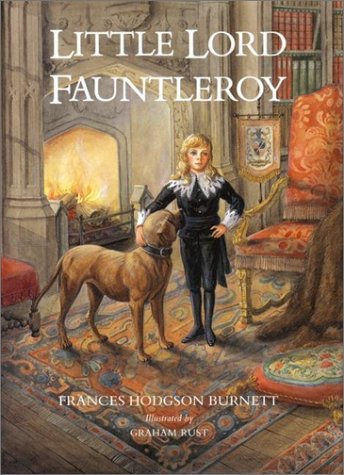
Kid Lit Blog Hop: Little Lord Fauntleroy


http://motherdaughterbookreviews.com/kid-lit-blog-hop-27/


1098307 

Review:
Little Lord Fauntleroy, by Frances Hodgson Burnett, 149 pages
Orig. Publication: 1877.
Source: Library e-book.

Summary:
This less-read work by the author of The Secret Garden follows the fortunes of young Cedric Errol, an American boy whose English father died when he was very young, leaving him and his mother to get on as best they can.  But when Ceddie is seven, an astonishing thing happens: it is revealed (to him; his mother knew all along) that his father was the youngest son of the Earl of Dorincourt.  Further, it seems that his father's two older brothers have both died without having sons, and Ceddie is now Lord Fauntleroy, heir to the earldom.  Transplanted to England and the home of his crusty, selfish, self-indulgent grandfather, Cedric is too pure and innocent to see anything but good in others (even his dreadful grandfather), and so brings about a miraculous transformation, with a little more help from fate.

Review:
As you can tell from my summary, the book is in some ways deserving of the reputation it has, though it by no means deserves it all.  I grew up knowing that a "little lord fauntleroy" was an over-dressed kid and probably a stuck-up prig into the bargain.  Actually, neither is true taken in context of the book.  Cedric's mother dresses him as nicely as she can, in the fashion of the time for a boy of good family, and this is continued when he comes to England.  But little of the book's focus is on his clothing.

It is Cedric's pure nature that is the focus of the book, and here the criticism is somewhat more deserved.  No child ever was or could be so pure, innocent, and good.  He's not awful; I've seen worse in the literature from the period, but he lacks that imperfect humanity that makes Mary in Secret Garden someone we can like and relate too.  The only reason Cedric isn't too perfect to live is that he is so naive.  I mean, really.  He lived seven years on the tough streets of New York and never noticed that not everyone is good?

And yet.  I can't despise him.  I can't like him as well as I like Mary, because he's just not enough of a human being (being only 7 is probably part of that.  He's just too young to be that interesting, especially as Burnett wrote his naivete more like he was five).  But I can't despise him.  I still rooted for him, and was glad when he got to keep his title and his inheritance.  Besides, unless he's totally spoiled, which is definitely a possibility (and no wonder the Earl's own sons mostly turned out badly if his idea of parenting is to give a boy whatever he wants, and no school as far as I can tell!) he'll be an improvement over his grandfather as manager of the estate.

Of Burnett's three books, this one does the least for me, largely because not only does Cedric not have a personality developed as fully as Mary or Sarah Crewe (A Little Princess), but he doesn't really have any adversity to overcome.  And that, more than his too-good nature, I think is the root of the problem of this book.  It might almost stand as a cautionary tale for those of us who hate to make our characters suffer.  Because, as our mothers all told us, suffering builds character(s).  Without some kind of challenge that the protagonist himself must overcome, you just have a bunch of things happening to a bit of fluff in the wind.

Full disclosure: I borrowed this book from the  library and received nothing from the author or the publisher for this review.  The opinions expressed herein are my own and those of no one else.

Wednesday, February 27, 2013

Voice: keeping it straight

Voice is, for me, one of the toughest things to get right.  For one thing, it's everywhere and it's plural.  The narrative voice is the biggie, since it runs through everything and had darn well better be consistent.  But every character has a voice, and each needs to be unique and right for that character.  I don't know about you, but I have a tendency to make everyone, up to and including my narrator, sound like me at my most ironic.  Needless to say, this is not always appropriate (though I gave the first-person narrator of Murder Stalks the PTA  permission to be the snarky cynic I sometimes feel like, and she's just fine, thank you).

Narrative voice is a character, just like any other.  What kind of character is determined in part by whether you choose to write in first person or in one of the various forms of 3rd person (or, I suppose, second person, but there are good reasons why that is uncommon).  But there are still so many variations, and like any other character, it develops as I write.  That means--yup--have to go back later and make it consistent.

You all know about the different kinds of narrators.  When it comes to voice, a first person narrator is an extension of a particular character, and the narrative voice should be consistent with (but not identical to--this part is a bit fuzzy) the conversational voice (and vocabulary) of that character.  It is also limited to what that person can see and know.  Thus, in The Ninja Librarian, the narrator (Big Al) can tell only what the Ninja Librarian does--never what he is thinking or why he does something, unless he explains (something he almost never does).  This allows me to keep the Librarian a bit of a mysterious presence--something I'd lose with an omniscient narrator.  Al must also use vocabulary  appropriate to the setting of the story.  Even with a first person narrator, however, the speech of other characters should be reported in their voices, not the narrator's.  Characters must still be distinct in their speech as they are in their actions.

The author will have to decide if the narrator will report the speech of more educated characters exactly as they say it--or as the narrator understands it.  So a child narrator might report the speech of an adult with mistaken words, to indicate the child's lack of understanding--but this, I suspect, should be used sparingly and deliberately, when the misunderstanding matters to the story.  Otherwise it's just cutesy (ick).

Third person narrators are divided into several types, which are described in just about any book on writing and I refuse to go into it all here.  I already told you that know all about it anyway. I'm interested in what that 3rd person sounds like.

Any form of third person narrator is typically written in a more neutral voice (for me, that means I have to go delete the wisecracks).  I think that the omniscient narrator who speaks aside to the reader about the characters and the action is not much used anymore, though it is not uncommon in older works, especially for children (Louisa May Alcott, for example, frequently breaks the 4th wall and addresses the reader directly with commentary on the behavior of the characters.  This reads today as a charming and anachronistic stylistic quirk, or annoying preachiness, depending on what she says and how you are feeling).  Whatever it sounds like, though, your narrative tone must be consistent.

Consistency is in fact the nub of what I'm talking about.  Big Al must always sound like Big Al.  The third person narrator of Halitor the Hero needs to be the same throughout, without changing level of diction or degree of insight into people's thoughts and motives.  This is harder than it sounds.  The temptation to use some clever turn of phrase can be overwhelming.  Go ahead if you must--but be sure to edit it back out later, when you've gotten over your cleverness.  Right now I am finding that Halitor's narrator is evolving a bit, and I'll have to make some decisions about levels of omniscience and involvement, then go back and edit until it all matches.  I'm pretty sure a 3rd-person narrator shouldn't evolve through a story (unlike a 1st-person narrator, who is expected to grow and change).

If you create a narrator who only observes, who is not allowed inside anyone's head, then proof very, very carefully for any place you wrote the words "he thought" or "she felt," because that violates the narrative voice you selected.  I am finding that it is pretty easy when writing in the first person to stay out of everyone else's head.  But I am writing Halitor the Hero with a third person narrator limited to peeking inside Halitor's head, and it feels slightly frustrating.  I want so often to comment on what another character is thinking or feeling.  I suspect it is very good discipline (and definitely good narration) to beat down the temptation.

As mentioned above, there is another aspect to voice: the voices of each individual character.  This one is really hard.  You have a whole zoo of characters, and while some are minor enough not to have any real personality (but I think that's probably another red flag requiring further editing--unless a character matters enough to have some individuality, what is her or she doing in the story?), in general each is going to need to be distinct from the others.  Manner of speech, tone, the things he or she will talk about.  Listen to the people around you.  No two sound alike, and I'm not talking about soprano vs. bass.  Different vocabulary.  Different tempi.  When you read your dialog aloud, can you tell who is speaking?  No?  Time for more revisions.

It's always time for more revisions.

I was going to write a bunch more about voice and how to get it right, but I think I'll just fall back on my #1 bit of revision advice: whether you are writing fiction, non-fiction, or even poetry, read it aloud.  When you say it and hear it, you will truly hear it.  I will also fall back on my assertion that I do not know what the heck I'm doing, except learning a whole boatload of stuff that they never taught me in those useless creative writing classes I took in school back in the Dark Ages.