Wednesday, January 5, 2022

#IWSG + Cozy Review & Author Interview: Murder in Second Position

This is a big post! Lots going on... hang in there.

 
What is the IWSG?
 
We are a group of writers who gather on the Internet to offer support and encouragement to each other! And we owe it all to the founder, Ninja Captain Alex Cavanaugh. Thanks, Alex!
Purpose: To share and encourage. Writers can express doubts and concerns without fear of appearing foolish or weak. Those who have been through the fire can offer assistance and guidance. It’s a safe haven for insecure writers of all kinds!

Posting: The first Wednesday of every month is officially Insecure Writer’s Support Group day. Post your thoughts on your own blog. Talk about your doubts and the fears you have conquered. Discuss your struggles and triumphs. Offer a word of encouragement for others who are struggling. Visit others in the group and connect with your fellow writer - aim for a dozen new people each time - and return comments. This group is all about connecting!

Every month, we announce a question that members can answer in their IWSG post. These questions may prompt you to share advice, insight, a personal experience or story. Include your answer to the question in your IWSG post or let it inspire your post if you are struggling with something to say. 

Remember, the question is optional!

January 5 question - What's the one thing about your writing career you regret the most? Were you able to overcome it?

Be sure to visit the awesome co-hosts for the January 5 posting of the IWSG:  Erika Beebe, Olga Godim, Sandra Cox, Sarah Foster, and Chemist Ken!

A quick answer to the question, and on to the rest of this post! I don't feel like I have any huge regrets... mostly, I wish I had known when I published my first book what I know now about the craft. I'm often tempted to pull it and re-edit, but probably never will. Mostly, I have no big regrets.

Now, my Writer's Update:
The holidays naturally derailed writing progress some, but also put pressure on me to finish editing my Nepal photos--I made it in time for a family slide show! I'm sharing those photos a few at a time on this blog over the next month or so. I also did finally (after far too much mucking about) get started on edits on the new novel (note to self: MUST decide on a title and start using it!). I'm still working on that first read-through where I create a new outline so I can figure out how to rearrange things. 

I've not been submitting things, and need to get back to that. And the blog is moving to it's new home starting tomorrow, if all goes well. You can check it out at www.Rebecca-Douglass.com, and sign up to follow me there,though we may still be working on the details. Note: If you are following me, and want to keep getting notices about new posts, you will need to re-follow on the new blog!


And now... from Great Escapes Blog Tours...

Murder in Second Position: An On Pointe Mystery by Lori Robbins

About Murder in Second Position


Murder in Second Position: An On Pointe Mystery  

Cozy Mystery 2nd in Series 
Level Best Books (November 23, 2021)
 
Paperback ‏ : ‎ 258 pages
 
ISBN-10 ‏ : ‎ 1685120210
ISBN-13 ‏ : ‎ 978-1685120214 Kindle ASIN ‏ : ‎ B09FM1JTFL

 Blurb:

Ballerina Leah Siderova belongs onstage. Not in an interrogation room at Manhattan’s Twentieth Precinct. And yet, for the second time in less than a year, that’s where she has a starring role. It wasn’t her fault someone killed the autocratic new director of the American Ballet Company. And it wasn’t her job to find the killer.

Leah is determined to stay as far away as possible from the murder investigation. After all, if she were going to kill someone, it would have been the woman who’s been relentlessly trolling her on social media. And that’s where things get complicated. Because when dancers say “ballet can be murder” they don’t mean it literally.

Most of the time.

My Review:
This was a fun, well-written read! I really enjoyed the glimpse into the world of ballet, despite not being a dancer (but one of my best friends was...), and it felt real and accurate from what little I know. Leah is a likable main character and an engaging narrator, if not always as sensible as she should be. I did worry about the whole eating disorder thing--dancers really do abuse their bodies in all directions.

They mystery was well constructed, with enough clues to point the way and enough misdirection to keep it interesting. If Leah doesn't always use good sense, she at least always *thinks* she's being safe and careful, and her reasons for not just leaving it all to the police are convincing. The police might not always agree, but she doesn't mess up the evidence so she passes!

There are a lot of characters, and in my usual scatter-brained fashion I had a little trouble at times remembering who is who. I'm honestly not sure if that's the book or my brain, and in the end it was all clear enough. Some of my issues might be because this is book 2 of the series, and there is some history that, while adequately reported, is left tantalizingly vague.

Recommendation:
This is a nice addition to the cozy-mystery shelf, and the series seems worth following up on. Especially if you are interested in the world of dance, check it out!


And now, we are delighted to have author Lori Robbins stop by for a chat!

RD: When did you start writing? Did you always know you wanted to be a writer, or did you stumble into it later in life?

LR: My first career was as a dancer, and the second was as a high school English teacher. Like many voracious readers, I always knew I wanted to be a writer, but it definitely took a while before that dream came true. My hero is Frank McCourt, who, after a long career as a high school English teacher, published Angela’s Ashes at the age of sixty-six. I figured if Frank could do it, so could I.

Over the years I wrote character sketches, parts of stories, and two terrible novels. All of that writing was good practice for when I began my first mystery, about five years ago. I’ve since written three books and am under contract for three more.

RD: What are your books about and who is the audience?


LR: Leah Siderova, the protagonist of my On Pointe Mystery series, is a thirty-something ballerina, who dances with a fictional ballet company based in New York City.

I’m a former professional dancer, and the books are filled with inside information about that very competitive world, although you don’t have to know a single thing about ballet to enjoy them! My readers, like me, enjoy traditional mysteries with more than a little humor.

Lesson Plan for Murder is the first book in my Master Class Mystery series. The protagonist is a crime fighting English teacher. Each chapter begins with the title of a famous book, which doubles as a clue to the mystery. That work is being rereleased by Level Best Books in June 2022, as part of a three book series.

All of my books feature amateur sleuths. I think part of what makes this genre so satisfying is that an ordinary person is given the opportunity to do extraordinary things. But the books aren’t one dimensional. In Murder in Second Position, for example, Leah’s quest takes place externally, in the context of a murder investigation, but it takes place internally as well. She learns there’s more to life, and to her, than being onstage.


RD: What is the best thing about being a writer?

LR: Because I write in the first person, I get to live, quite vicariously, through my characters. They’re a lot funnier and wittier than I am, and they’re far braver than I am.  I love how they take on a life of their own, which includes the ability to surprise me, even though I’m the one who brought them to life.

RD: If you could live anywhere in the world, where would it be?


LR: Paris is at the top of the list. I visit that beautiful city every year, and I’m looking forward to returning. I love the language as well, although it doesn’t love me back. My accent owes a lot more to Brooklyn than to France.
This love of all things French has made its way into most of my writing and has been the inspiration for several characters.


RD: If there’s a spider in the corner of the room, do you a) panic, b) have to drop everything until it is removed, or c) hope it’s planning to eat the more annoying bugs that get in?

LR: Thanks to Charlotte and her web, I’ve got a soft spot for spiders, as long as there aren’t too many of them. And I do encourage them to eat mosquitoes. This forbearance does not extend to creatures of the six-legged variety.

I will admit, though, if the spider crawled on me, as opposed to the floor or the wall, I would shriek madly and stomp mercilessly.


RD: Do you use a detailed outline before you start writing, or... ?


LR: I think detailed outlines are the best way to plot and plan a mystery. And someday I’ll write one. In the meantime, I’ll continue with my hybrid model. I begin with a character list and the characters’ relationships with each other. I then write a skeleton outline, which is constantly getting revised. For Murder in Second Position, a completely new character waltzed into the novel, and I love her so much she’s returning in book three.

In this book, as in the first installment, I tagged the wrong person as the murderer and had to rewrite quite a bit of text. I might have to rethink my earlier answer about the best thing about being a writer, because there are few things more exciting than being surprised by the story you yourself are writing.


RD: I love that answer, and am glad to know I'm not the only one with that problem. Before you go, is there anything else you would like your readers to know about you?

LR: My husband and I have six kids, which I realize sounds excessive. People often ask what we were thinking. And the answer is that at the time, rational thought was the last thing on our minds.

Now that the kids are mostly grown up, I can’t imagine what my life would be like if we’d been more like the very prudent people we admire.

As I was framing my response to this question, I realized my writing is a lot like my family life. I didn’t plot out every detail. And there were more than a few surprises along the way.

But it all worked out just fine in the end.

Thanks for stopping by, and have a great time with the next book!


About the Author:

Brooklyn-born Lori Robbins began dancing at age 16 and launched her professional career three years later. She studied modern dance at the Martha Graham School and ballet at the New York Conservatory of Dance. Robbins performed with a number of dance companies, including Ballet Hispanico, the Des Moines Ballet, and the St. Louis Concert Ballet. After ten very lean years as a dancer she attended Hunter College, graduating summa cum laude with a major in British Literature and a minor in Classics.

The opening book in her On Pointe Mystery Series, Murder in First Position, won the Indie Book Award for Best Mystery, was a finalist for a Silver Falchion, and is currently on the short list for a Mystery & Mayhem Book Award. Murder in Second Position will be released November 23, 2021. Her debut mystery, Lesson Plan for Murder, won the Silver Falchion for Best Cozy Mystery and was a finalist in the Readers’ Choice and Indie Book Awards. It will be re-released in June 2022. She authored two short stories in 2021: “Accidents Happen” in Mystery Most Diabolical, and “Leading Ladies” in Justice for All. She is an expert in the homicidal impulses everyday life inspires.

 
There is a giveaway with this blog tour!

a Rafflecopter giveaway


TOUR PARTICIPANTS
January 5 – Brooke Blogs – SPOTLIGHT
January 5 – The Ninja Librarian - REVIEW, AUTHOR INTERVIEW

January 6 – Christy's Cozy Corners – CHARACTER GUEST POST

January 6 – Sapphyria's Book Reviews – SPOTLIGHT

January 7 - Celticlady's Reviews – SPOTLIGHT

January 7 - Baroness' Book Trove - SPOTLIGHT

January 8 – Nellie's Book Nook – REVIEW, GUEST POST

January 9 – FUONLYKNEW – SPOTLIGHT

January 9 – Author Elena Taylor's Blog – CHARACTER GUEST POST

January 10 – Literary Gold – SPOTLIGHT

January 10 – Maureen's Musings – SPOTLIGHT

January 11 – Mysteries with Character – AUTHOR INTERVIEW

January 12 – BookishKelly2020 – SPOTLIGHT

January 12 – Escape With Dollycas Into A Good Book – GUEST POST


Have you signed up to be a Tour Host?
Click Here to Find Details and Sign Up Today!

Monday, January 3, 2022

Flash Fiction: One-Eyed Yak

This is a story written for the amusement of my trekking group in Nepal, using some very random prompts they gave me. I'll put the prompts at the end of the story! It was a great way to spend a couple of afternoons, and was meant only to be a bit of goofy entertainment. I'm sharing it here as a supplement to the photo posts on Nepal!


One-Eyed Yak


High above a wildly scenic lake way up in the Himalayas, a hermit lived in a cave with hand-painted walls.

Elbert Pumpernickel was not a happy hermit who had chosen the life of isolation and deprivation from religious or spiritual motives. He was in fact embittered, broke, and on the run. Or he had been on the run, until he came to the end of the trail at the cave above the lake. Now he was stalled, trapped, and more bitter than ever against the cause of his ruin.

None of the problems he had were his fault, of course. It was certainly not his fault he was stuck on this mountain, with nothing to do all day but stare down the valley at the lake, which he hadn’t yet realized was beautiful, because he was too busy being bitter. His bitterness, like everything else that had gone wrong in his life, was his parents’ fault.

It wasn’t that they failed to love him, though he had no real reason to believe they did, either. No, it was all their fault because they had named him Elbert Pumpernickel (though the surname, he admitted in his more reasonable moments, wasn’t actually their fault, they hadn’t done very well with it).

The torment had begun early. After months of staring at the lake he decided his course toward this cave on the mountain was set in motion by the teasing he received from the moment he started school and first began to interact with other children. Exactly why “Elbert” should be a risible name is unclear, but there it was. Six years of “Elmo-Bert” and “Elbow” had softened him up for four years of high school. There, aside from jokes about pastrami sandwiches, the torment consisted mainly of a universal cold shoulder. That, and a periodic dunking in the nearest garbage can, something that was all too possible because his parents had also failed to provide the genes that would have made him large and muscular.

There were also the stinky feet. Even the kindest and most pitying of the girls left him at the sock hops when they became aware of the rotten-cheese smell wafting from Elbert’s socks. When word of that got around, being dumped in the garbage can would be accompanied by an explanation that that was what you did with spoiled cheese and stale bread.

Later, as an initiation rite for a college fraternity that turned out not to exist, Elbert had stolen the makings for enough s’mores for his floor of the dorm. Out of that venture, he had gotten one marshmallow, and a knock on his door from the police before he had time to roast it. He did manage to stuff the evidence in his mouth before they cuffed him.

The CCTV had caught his face, a so-called friend fingered him, and there he was with a court date and an insulting fifty-dollar bail, which he’d still had to borrow from the coke machine in the student union.

Unable to face the shame and humiliation, not of being sent up, but of being sent up for stealing marshmallows, Elbert fled.

Where a young man of normal upbringing and sense might have fled to another state, Elbert concluded his life was over. Once he started running, he just kept going.

When he finally stopped running, Elbert was in Nepal, in a cave overlooking a lake at an absurd elevation. He had traded his jeans for a set of monk’s robes and his fringed buckskin jacket for a set of down pants and parka, and he managed to convince the locals, if not himself, that he was on a holy quest. The locals shrugged, having seen this before, and expected to find him shivering on their doorsteps any day.

After three years in his cave, Elbert had begun to paint the walls in psychedelic designs with pigments made from ground rocks. He had also learned to sit motionless and gaze down the valley at the lake for three hours at a time, and was working on making it four. In short, he was adapting, though he didn’t realize it and still bitterly resented his parents and his fate.

When the one-eyed yak began hanging around the cave in the fourth year, Elbert found the final link to the peace he hadn’t known he sought.

It took another three years, but in the end, Elbert and the yak became friends. The yak was the first friend Elbert had ever had, and he loved it more than he had ever loved his parents. He named the yak “Pumpernickel” in an ironic nod to his parents, and lovingly combed its hair daily.

Elbert didn’t return to the US until the yak died of old age, and every bit of the cave walls was re-painted in portraits of the love of his life, the yak who never minded about his smelly feet.  

Not a one-eyed yak.

Here are the prompts I was given:

—smelly feet

—marshmallows

—A man named Elbert who thinks all his misfortunes are due to being named Elbert

—A one-eyed yak

—looking down the valley for 3 hours

—a mountain lake


 ©Rebecca M. Douglass, 2021
 As always, please ask permission to use any photos or text. Link-backs appreciated.

Enjoyed this post? Avoid missing out on future posts by following us.


Friday, December 31, 2021

Photo Friday: Nepal Trek Part III: Up the Imje Khola River to Pangboche

If you are just joining the blog, here are the earlier posts that will set the scene:
Kathmandu
Trek Part I: Lukla to Namche
Trek Part II: Namche to Khunde

Also, I'm aware that it's New Year's Eve. Have a great time, and a better 2022.

Trekking Day 5:
We left Khunde and walked down through the neighboring town of Khumjung, stopping at the monastery where a multi-day ceremony was taking place to honor a dead elder of the community.

Walking towards Khumjang
The monastery where the ceremony was taking place.
The Khumjang gompa

Kim Bannister of Kamzang Journeys giving the large prayer wheel a spin.

There seemed to be no issues with us taking photos, nor with some coming and going. When I saw that our Bhuddist guide, Lhakpa, was taking pictures, I tried to capture some of the feel of the place. Part of the significance of this gompa is that they have what they claim is the only yeti scalp in existence. I'll skip the close-up.

Yeti scalp in the display case.

Continuing on, we stayed on the high trail above the Dudh Koshi river to climb to Mong La and on to Phortse.

A glimpse of the very well-built trail. Zooming in showed us that we had a lot of steps to climb. Ama Dablam (22,349'/6812 meters) is prominent in the distance.

Climbing toward Mong La ("la" means pass, but in this case it was more the high point passing over a shoulder of the mountain), with our day's destination visible in the distance.

At this point in the trip, the weather was still warm, as we were at "only" about 12,500'. That didn't feel low until much later in the trip!

After a tasty lunch at the Mong La Mountain View Lodge and Restaurant ("If you stay here you can see good view from here"), we continued on past the stupa, clockwise of course.

We had great views of Phortse, which wasn't far off. Only... yeah, we had to drop several hundred feet to cross the Dudh Koshi river, coming in from the left from Gokyo. We will follow the Imje Khola up the valley to the right, towards Ama Dablam.

Cool trivia bit: volleyball is big in the Khumbu, and while we were in Phortse, the Khumbu tournament  was going on a short way below our lodge. We heard later that Phortse took the championship.

Arriving in Phortse. The villages have suddenly gotten much smaller.

Day 6: Phortse to Pangboche

Hiking out of Phortse in the morning. The view is up the Dudh Koshi (towards Gokyo).

The route had its ups and downs, but was never short of scenery.

 Thanks to recent efforts to contain and remove trash, the trails were remarkably clean. But those blasted plastic bags get everywhere. My son had enough extra energy (thanks to being the only member of the party under 50, I think) to do a little rescue work. Skip the plastic, folks!

Ama Dablam, Lhotse, and our destination (Pangboche) in the valley below

Descending through Upper Pangboche, past the monastery, with Ama Dablam looming over everything.


Shining copper prayer wheels at the Pangboche monastery.

Always happy to arrive at our lodge! Some members of the party went back out to tour the town; I enjoyed a hottish shower in an almost-warm room.
The view from the dining room

We were to spend 2 nights here, with a visit to Ama Dablam base camp on the layover day, so it was laundry time! Washing clothes in icy water by hand was made slightly easier by the rubber kitchen gloves I had thought to take. It still took ages to thaw my fingers afterwards.
Our laundry line. Most of that was frozen before it was dry.

Happy New Year!

Notice: I expect the blog to migrate to my new web site January 6, with double posts on January 5th. Watch this space next week for more information, and/or sign up for my newsletter for a reminder!

 ©Rebecca M. Douglass, 2021
 As always, please ask permission to use any photos or text. Link-backs appreciated.

Enjoyed this post? Avoid missing out on future posts by following us.


Thursday, December 23, 2021

Merry Xmas, and another photo report!

Nepal Trek, Part II: Namche to Khunde

In our last, we had arrived in Namche (often called Namche Bazaar, but the locals have moved away from that name) and found our sunset blocked by the fog. Fortunately, when my son and I dragged ourselves out of bed at 5:30 to check the sunrise, we were better rewarded.

Kongde Ri from the Everest viewpoint

The viewpoint above Namche is also the Tenzing Norgay memorial. His statue shows him holding up his ice axe with the flag attached. The summit of Everest is just visible over the ridge of Nuptse and Lhotse.

Returning to the hotel, with Kongde out in full glory.

The Moonlight Lodge, Namche. Being only a long day's walk from the airport (11 miles, which we did in 2 days), it was nicer and better supplied than most of the lodges we stayed at.

With schools centralized in the larger towns, many of the children have to board during the school term. The Namche boarding house was right below our hotel, and as we prepared to leave the children were getting ready for school.

They wore smart uniforms, and housemothers are helping braid the hair of the younger girls.

All students are taught English from a young age, it being the lingua franca  of Nepal, as it were. We met several fairly young children who spoke English very well. The Namche school, and several others in the Khumbu (the Everest region), was founded by Sir Edmond Hillary.
Students clearly had numbers (as did we, come to think of it. I was #4, my son #5, and our bags and meals were handled by number). I counted about 70 toothbrushes on the rack, making it clear why numbers were important.

Leaving town, we headed pretty much straight on up the ridge, passing a chorten (a sort of a shrine) on the ridge.

Nearly to the top, we stopped to learn more about Sagharmatha Next, which is working to create more sustainable tourism in the Khumbu. The buildings being  constructed on the hill above Namche will house art studios and artists, local and international, who will work to create art from the waste stream. In addition, the organization is working with the Park on a waste management plan, and will be rolling out "Carry Me Back," a new initiative to enlist trekkers and guides to help carry the waste back to Lukla for removal.

Project director Tom Gustafsson shows our leader, Kim Bannister, one of the paving stones supporters can soon sponsor to help with the construction. Waste bags (for the carry-out program) will also be for "sale", though at this point that aspect of the web site isn't up and running.

A short way farther up, and we were atop the ridge with view of Everest (the left-most peak), and Yaks to be dodged. They are adorable, but can be cranky, and those horns are nasty!

Approaching Khunde

However fierce yaks may be, a joyous sight for us was seeing our yaks arrive with our luggage.
Yaks arrive at the Khunde Guest House
Our room. We provided the 0-degree sleeping bags that made these rooms habitable.

The view from the room was pretty okay, and I could check on the sunrise without getting out of my sleeping bag--always nice when the overnight temps in the room drop below freezing.
Once we'd had a late lunch, we climbed the hill behind town to the Hillary Memorial and a stunning viewpoint.
Approaching the viewpoint, just past the chortens and prayer flags.

The author

At the viewpoint, with the fog moving in, we experienced the amazing Brocken Spectre, which can be seen only when you are above a cloud with the sun behind you (typically from a mountaintop). It's hard to see here, but inside the rainbow halo is my shadow. It looks large because the shadow is actually on the clouds/mist just below me, not on the ground far below.

The fog moved the rest of the way in as we climbed a bit more to the Hillary Memorial, three chortens dedicated to Sir Edmond Hillary, his wife Louisa, and daughter Belinda. The latter two died in a plane crash during the construction of a hospital in the area, sponsored by the family.

Hillary memorial with Thamserku in the background.

From the lodge. It's nice when all the light and color you could want are visible through the windows.

Next: farther into the Khumbu as we head for Ama Dablam base camp.

 For now, happy holidays of all sorts to you, and I'll see you next week, when I've recovered from my own holiday celebrations.

###

Watch this space--the blog will be moving to our new home after the new year! That one's not quite ready, so I'm not sharing the URL yet, but just putting you on notice!

 ©Rebecca M. Douglass, 2021
 As always, please ask permission to use any photos or text. Link-backs appreciated.

Enjoyed this post? Avoid missing out on future posts by following us.


Monday, December 20, 2021

Middle Grade Monday: A Place to Hang the Moon

58957432. sx318

Title: A Place to Hang the Moon
Author: Kate Albus. Read by Polly Lee
Publication Info: Tantor Media, 2021. Original Margaret Ferguson, 2021, 309 pages
Source: Library
Publisher’s Blurb:
It is 1940 and Anna, 9, Edmund, 11, and William, 12, have just lost their grandmother. Unfortunately, she left no provision for their guardianship in her will. Her solicitor comes up with a preposterous plan: he will arrange for the children to join a group of schoolchildren who are being evacuated to a village in the country, where they will live with families for the duration of the war. He also hopes that whoever takes the children on might end up willing to adopt them and become their new family--providing, of course, that the children can agree on the choice.

Moving from one family to another, the children suffer the cruel trickery of foster brothers, the cold realities of outdoor toilets, and the hollowness of empty tummies. They seek comfort in the village lending library, whose kind librarian, Nora Muller, seems an excellent candidate--except that she has a German husband whose whereabouts are currently unknown. Nevertheless, Nora's cottage is a place of bedtime stories and fireplaces, of vegetable gardens and hot, milky tea. Most important, it's a place where someone thinks they all three hung the moon. Which is really all you need in a mom, if you think about it.

 
My Review:
This is a totally easy feel-good read. There is nothing extraordinary about it: the plot progression is obvious, and the standard tropes are called forth as expected. That doesn't stop it from being a highly enjoyable orphan story, in the great tradition of books about abused orphans who find their forever home with someone who will care for them. 

The biggest issue I had with the book was actually not the predictability of the plot (which these days is kind of a bonus for me), but a slight tendency to anachronism. Some of the language and diction of the characters didn't quite ring true to 1940s England, though I think most of the big-picture story did (leaving aside the utter absurdity of the premise, which is... utterly unrealistic). I do tend to get hung up on that sort of thing! 

The audio book was well produced and the reader did a good job--the characters were voiced distinctively and different accents rendered  convincingly.

My Recommendation:
This is utter brain-candy, a fun read if you are feeling the need for something a bit simple and sentimental. It's probably not the best introduction to the period for children, though the depictions of the mixed conditions for evacuees and the general mess the war caused are pretty good, really.

FTC Disclosure: I borrowed an electronic copy of A Place to Hang the Moon from my library, and received nothing from the author or the publisher in exchange for my honest review. The opinions expressed are my own and those of no one else. I am disclosing this in accordance with the Federal Trade Commission's 16 CFR, Part 255: "Guides Concerning the Use of Endorsements and Testimonials in Advertising.”   

 ©Rebecca M. Douglass, 2021
 As always, please ask permission to use any photos or text. Link-backs appreciated.

Enjoyed this post? Avoid missing out on future posts by following us.

Friday, December 17, 2021

Photo Friday: Trekking in Nepal, Part I: Lukla to Namche

Going over my photos, it's hard to see how I can do this trip report with anything like a reasonable number of photos, unless I do one day at a time (and even then it could be hard). For that matter, I could do a whole post on flying into Lukla! Here it is, though.

Background: My second son (age 22) and I signed onto a group tour with Kamzang Journeys, a 21-day trek in the Everest region, with several days in Kathmandu on either end. Let me say right up front: Kim Bannister, Lhapa Dorji Sherpa, and the whole Kamzang crew were amazing, and it was a fantastic trip. It probably didn't hurt that they were all so excited to be trekking again, after a two-year hiatus due to COVID. Nepal has focused vaccination efforts on the main tourist areas, making the trek feel as safe as anywhere in that regard (honestly, the vaccination rate in the Khumbu--the Everest region--is far better than in the county where I live). We also found that many if not most of the people spoke English, some very well. It appears to be taught now in all the schools. With so many different languages spoken in Nepal, it makes sense to use English as the common tongue, since it works on most tourists, too.

The real trip began with our 4:45 a.m. departure to the airport. All flights in and out of Lukla are in the mornings, pretty much, because the weather tends to deteriorate through the day. This did mean that we were in the mountains in time for breakfast. Lukla is at about 9300' and our first day would drop to the Dudh Koshi river then climb back to Monjo at a similar altitude, so we weren't too worried about the elevation--yet.

Preparing to board.

Great excitement at views of the Himalayas out the window.
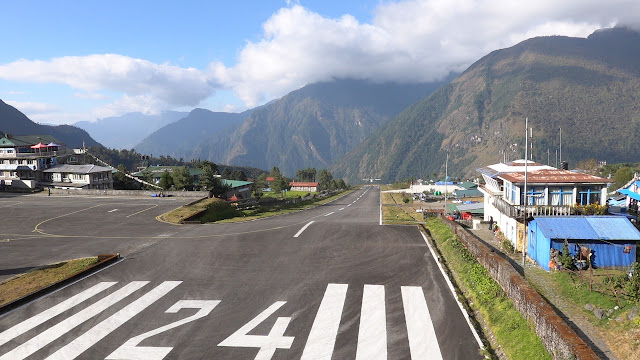
A short,  sloping runway. I'm standing on the wall at the top, watching planes take off. There's no adjusting for wind direction here--you always land uphill, take off downhill.

While we had breakfast, our guides bagged our duffels and loaded them onto the dzokios--yak/cow hybrids that handle lower-elevation packing in the region, where it is too warm for true yaks.

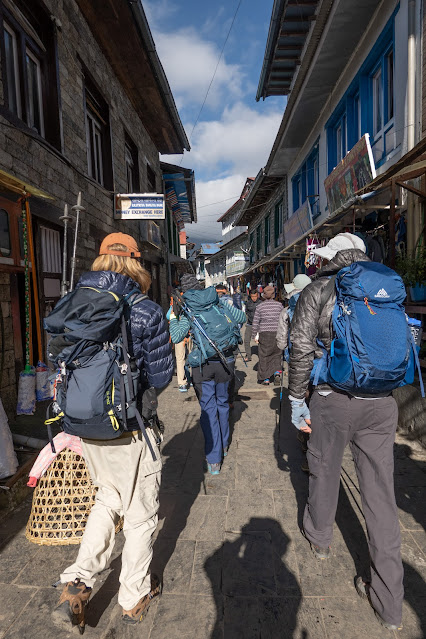
Starting off down Lukla's main street. One thing you notice right away: everything up here happens afoot. There are no vehicles on the "roads" and "streets" of the Khumbu. I hope it stays that way.
Nepal has made a huge, and largely successful, effort at reforestation of these regions, which had been stripped of everything burnable. Now, power comes from a small hydro plant and solar panels, with heat from small stoves that mostly burn dried yak dung.

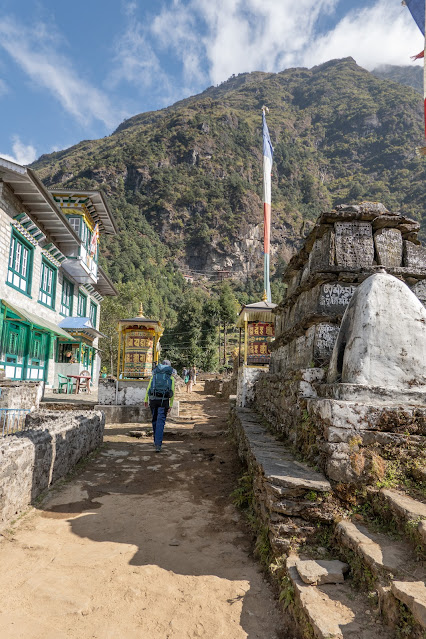
Great excitement at the first several mani walls--always circle them clockwise--and the giant prayer wheels that flanked the route in many places.

Not all prayer wheels were equally well maintained.

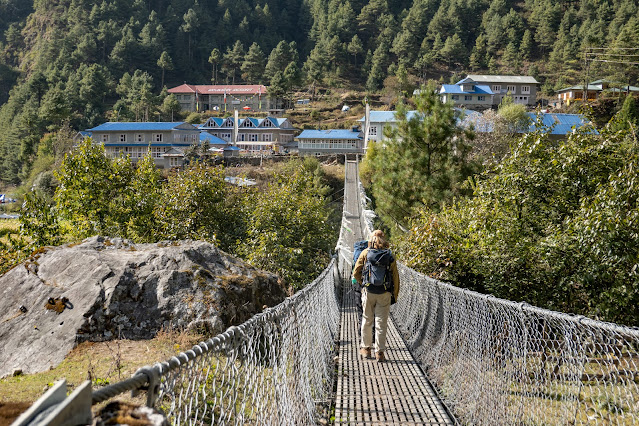
We enjoyed further excitement as we dropped to river level and began to cross bridges, some fixed, more of them swing bridges--and yes, the dzokios, yaks, and donkeys use those same bridges. They always have the right-of-way.


We got even more excited about our first glimpses of snow-and-ice-covered peaks.

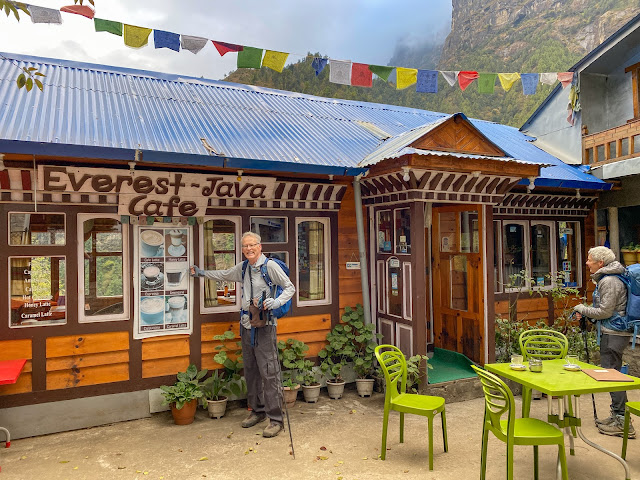
Happy to find our first-night lodge. I was surprised how many of the lodges sold (or at least advertised) espresso drinks. I was off coffee for the trip, so never found out if they were any good.

The second day, leaving Monjo for Namche (11,363') meant a big climb. We also entered Sagarmatha National Park almost at once, which caused some thinning of the number of villages and lodges, but not as much as you would expect from a US park model--this park acknowledges and accepts the people who live there, and were there before the park.

Entering the park.


Things did start to feel wilder. The Dudh Koshi is a glacial river (the name means "Milk River"), thus the beautiful color. 

The lower bridge is no longer used, so we climbed to the high bridge. It was... really high.

Really high.

Arriving in Namche.

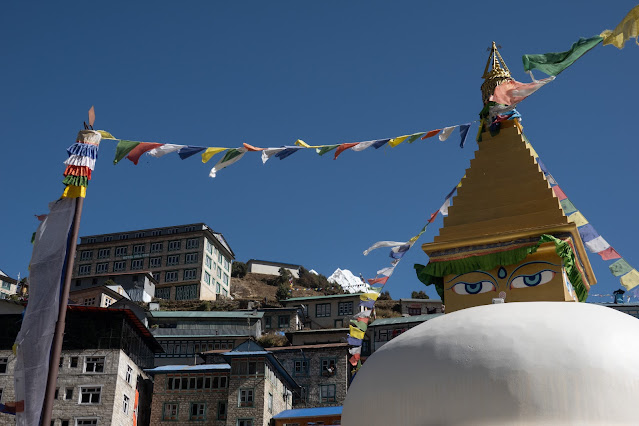
Namche Stupa

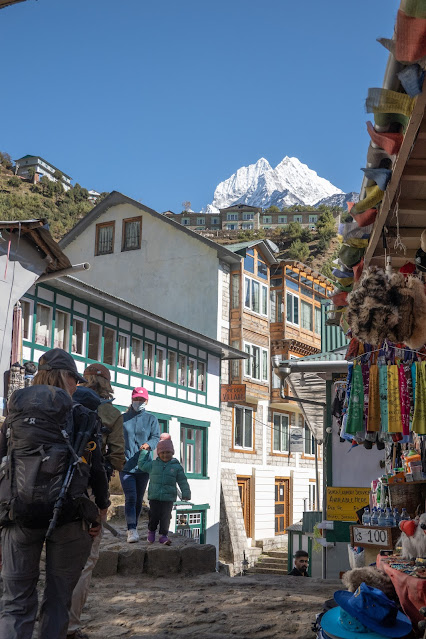
Climbing up the narrow streets and steps to our lodge nearly killed me. I'd been coping with stomach bugs all day, which really impacted my ability to cope with the altitude. I was so happy to see our lodge!
I recovered enough to climb to the Everest viewpoint for sunset, but the clouds moved in, so that all we saw was this lovely photo Lhakpa showed us from that very spot, in 2019.

Two days of hiking, to be followed by a day of rest and altitude adjustment. I'll pick up the story next week!

 ©Rebecca M. Douglass, 2021
 As always, please ask permission to use any photos or text. Link-backs appreciated.

Enjoyed this post? Avoid missing out on future posts by following us.