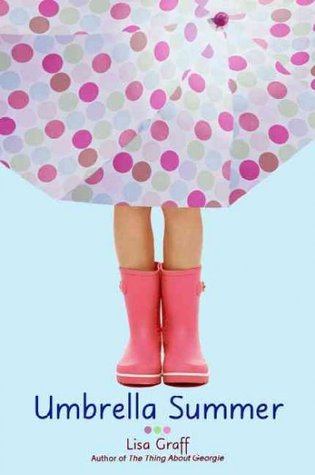
Title: Umbrella Summer
Author: Lisa Graff
Publisher: HarperCollins, 240 pages.
Source: Library digital resources
Publisher's Summary:
Annie Richards knows there are a million things to look out for -- bicycle accidents, food poisoning, chicken pox, smallpox, typhoid fever, runaway zoo animals, and poison oak. That's why being careful is so important, even if it does mean giving up some of her favorite things, like bike races with her best friend, Rebecca, and hot dogs on the Fourth of July. Everyone keeps telling Annie not to worry so much, that she's just fine. But they thought her brother, Jared, was just fine too, and Jared died.
My Review:
This is a decent book about grief and grieving. Even while Annie narrates, so the story is from her perspective, we are given enough views of her parents and other people that an attentive reader of any age will understand (maybe before Annie does) that she's not the only one grieving. As a parent, I was interested in how Annie's parents cope--or don't cope--with the loss of their son and the continuing needs of their daughter, because I can't really imagine having to do that.* Under the circumstances, it's not so surprising that it takes an outsider to help Annie recover.
The umbrella of the title refers to the things that people do to insulate themselves from their grief and loss, which need at some point to be put away, as the umbrella does after the rain stops. For Annie, it's obsessing about everything that can kill you, from traffic to gangrene. Her father retreats into himself, and her mother cleans house. To make matters worse for Annie, no one else in town seems to know how to act around her.
I thought that her observation that people look at her with "the dead-brother look" was sharp. Death makes us all uncomfortable, and the way she copes makes people even more uncomfortable, but no one knows quite what to say to her to help her out--until a new person moves into the neighborhood, with her own umbrella. The book never suggests that there's a right way to mourn and be done with it, but only that it may take some effort, but you can find a way out the other side and continue on.
As for the story and the writing, those are sound, but not outstanding. The management of grief is the story, and that works pretty well. That's the summer project for the Richards family. The writing didn't stand out as either fantastic or as having issues, and the book read quickly and easily.
My Recommendation:
This may be a better book for someone who knows a person with loss than for a kid who has lost someone. It certainly helps the reader understand grief. Because the death is handled gently, this is probably suitable for kids as young as 8 or 9.
*We came far too close once, so I have in fact imagined it. But I haven't imagined a *good* way to deal with that.
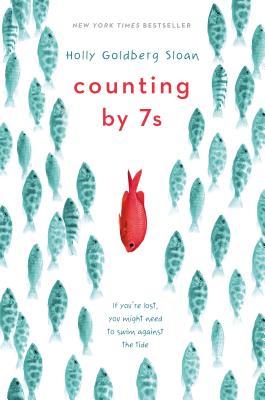
Title: Counting By 7s
Author: Holly Goldberg Sloan
Publisher: Dial Books, 2013. 246 pages (ebook)
Source: Library digital resources
Publisher's Summary:In the tradition of Out of My Mind, Wonder, and Mockingbird, this is an intensely moving middle grade novel about being an outsider, coping with loss, and discovering the true meaning of family.
Willow Chance is a twelve-year-old genius, obsessed with nature and diagnosing medical conditions, who finds it comforting to count by 7s. It has never been easy for her to connect with anyone other than her adoptive parents, but that hasn’t kept her from leading a quietly happy life...until now.
Suddenly Willow’s world is tragically changed when her parents both die in a car crash, leaving her alone in a baffling world. The triumph of this book is that it is not a tragedy. This extraordinarily odd, but extraordinarily endearing, girl manages to push through her grief. Her journey to find a fascinatingly diverse and fully believable surrogate family is a joy and a revelation to read.
The umbrella of the title refers to the things that people do to insulate themselves from their grief and loss, which need at some point to be put away, as the umbrella does after the rain stops. For Annie, it's obsessing about everything that can kill you, from traffic to gangrene. Her father retreats into himself, and her mother cleans house. To make matters worse for Annie, no one else in town seems to know how to act around her.
I thought that her observation that people look at her with "the dead-brother look" was sharp. Death makes us all uncomfortable, and the way she copes makes people even more uncomfortable, but no one knows quite what to say to her to help her out--until a new person moves into the neighborhood, with her own umbrella. The book never suggests that there's a right way to mourn and be done with it, but only that it may take some effort, but you can find a way out the other side and continue on.
As for the story and the writing, those are sound, but not outstanding. The management of grief is the story, and that works pretty well. That's the summer project for the Richards family. The writing didn't stand out as either fantastic or as having issues, and the book read quickly and easily.
My Recommendation:
This may be a better book for someone who knows a person with loss than for a kid who has lost someone. It certainly helps the reader understand grief. Because the death is handled gently, this is probably suitable for kids as young as 8 or 9.
*We came far too close once, so I have in fact imagined it. But I haven't imagined a *good* way to deal with that.
Title: Counting By 7s
Author: Holly Goldberg Sloan
Publisher: Dial Books, 2013. 246 pages (ebook)
Source: Library digital resources
Publisher's Summary:In the tradition of Out of My Mind, Wonder, and Mockingbird, this is an intensely moving middle grade novel about being an outsider, coping with loss, and discovering the true meaning of family.
Willow Chance is a twelve-year-old genius, obsessed with nature and diagnosing medical conditions, who finds it comforting to count by 7s. It has never been easy for her to connect with anyone other than her adoptive parents, but that hasn’t kept her from leading a quietly happy life...until now.
Suddenly Willow’s world is tragically changed when her parents both die in a car crash, leaving her alone in a baffling world. The triumph of this book is that it is not a tragedy. This extraordinarily odd, but extraordinarily endearing, girl manages to push through her grief. Her journey to find a fascinatingly diverse and fully believable surrogate family is a joy and a revelation to read.
My Review: This is a curious book. At times I was absolutely bowed down with the weight of Willow's grief, and at others, felt an odd lightness. Maybe that was the author's success in conveying the utterly world-shifting nature of what happens to Willow, because I really felt like I was living the experience with her.
There is a lot of food for thought in this relatively short book. There is the whole element of not-fitting-in, almost a cliche of books about middle school (well, it's a well-used trope for a reason. Does *any* kid feel like she fits in during those years?). This isn't hugely developed, but is rather allowed to contribute to the destruction of Willow's world--because she has no friends and no family other than her parents, she has to rapidly develop a very odd support structure.
The book also, of course, deals with grief. Not the way Umbrella Summer does, with a view to how you get over it, but more (in my mind), by showing what it feels like. Even making the reader feel it with Willow. But above all, I think the book is about family: what it is, what it's like to lose it, and how to make one out of what you have.
The odd thing (to me) about the book was the narrative voice. For most of the book, Willow narrates. But there are chapters which are told in the 3rd person, and focus on one of the other main characters, with varying degrees of detachment. I have to say that while this jarred me a bit reading, it proved to be powerful, in making the story not just about Willow, but about the lives she touches. That makes it a much fuller book, in my opinion. Willow's impact on other people also ends up making the book feel almost magical, a hint removed from reality at times. Willow herself, however, reject that nonsense.
My Recommendation:
My Recommendation:
This is an excellent story, and is full of things to think about. There is a discussion guide in the back with some questions that I thought were very good, but for me the best part was just appreciating the author's ability to make me feel what Willow feels. Because of how powerful those feelings are, I'd recommend this one for more like 10 or 11 and up.
FTC Disclosure: I checked Umbrella Summer
& Counting By 7s out of my digital library, and received nothing from the writers or
publishers for my honest review. The opinions expressed are my own and
those of no one else. I am disclosing this in accordance with the
Federal Trade Commission's 16 CFR, Part 255: "Guides Concerning the Use
of Endorsements and Testimonials in Advertising." 


