Showing posts with label children's books. Show all posts

Wednesday, January 24, 2018

Wednesday Wanderings: Historical Fiction


I have long had a love affair with children's historical fiction. It probably began with The Little House in the Big Woods, which I first read when I was what? maybe 6 or 7 years old? Looking back at it, nothing much happens in the book, but it didn't matter, because everything the Ingalls family did was strange and exciting to me. In the years since, I have read children's books set in periods from ancient Greece to the 1970s (anything since then hardly feels "historical" to me!). The vast majority of these books were interesting, apparently well-researched, and added something to my random pool of knowledge. Of course, you do need to bring some critical judgement to it--the Little House books, for example, are rife with the racial prejudices of the author's time  (something that more contemporary writers do a better job of addressing, since they are usually conscious, at the least, that such prejudices aren't acceptable. When Laura asks awkward questions about how the Indians might feel about the settlers in Indian Territory, she is told to be quiet, suggesting Wilder had her own concerns about justice, if not racism).

I have also read a somewhat smaller selection of adult fiction set in historical periods, and had a much more varied experience of the books. Of course, all those Louis L'Amour westerns I read in middle and high school are historical fiction, and probably could be used as a textbook example of the ways the genre (historical fiction, not "westerns," which is a sub-genre and plays by different rules) can go wrong. Hastily-written and often poorly edited, rife with stereotypes and misconceptions about the time and place (though L'Amour claimed that his books were, if nothing else, geographically correct--he wrote about real places and said that "if [he] wrote about a spring, that spring is there." I've never tested that claim), those westerns did little to increase either knowledge or understanding.

I've had better success with a few writers of mysteries with historical settings. Jacqueline Winspear (Maisie Dobbs) researched the dickens out of the between-the-wars period in England, and her books match up to the best of the children's books: they entertain and educate in one go. Gretel Ehrlich's Heart Mountain was both good history (and more nuanced than most) and a good read, and the works of Ivan Doig rank among the best books I've read.

But you may have read my review of Goodbye Picadilly last week. This was historical fiction erring on the side of trying too hard with the history, at the expense of story and character both. Other books (think romances) play fast and loose with history for the sake of a thrilling setting for a story. And many others, the more serious "literary" works, may do the history well, but I often find heavy going.

The result of all this is, though there are undoubtedly many high-quality works of (non-genre) historical fiction in the library's adult section, I approach a new author with caution and a lot of doubt, while I continue to read my way through any I find in the kids' room (some of which are definitely better than others). It makes me sad that apparently historical fiction is out of fashion with kids right now, with the result that little of it is being published. Too few kids (sadly, my own included) seem to understand that you can learn so much without having to sweat for it, just by reading a good story.

I've spent years researching to write a book based on my Grandmother's childhood, and in fact have drafted it a couple of times. It's still not what I want, but the research has been fascinating (involving, in part, reading all the women's and children's accounts of the Oregon Trail I can find), and I still want to publish that story. I hope that someday the market will swing back toward an appreciation of these glimpses of our history.


©Rebecca M. Douglass, 2018
As always, please ask permission to use any photos or text. Link-backs appreciated!

Monday, June 5, 2017

Middle grade fiction: Moo, by Sharon Creech

28217808 

Title: Moo: a Novel
Author: Sharon Creech
Publisher: Joanna Cotler Books (HarperCollins), 2016. 278 pages
Source: Library

Publisher's Summary:

This uplifting tale reminds us that if we’re open to new experiences, life is full of surprises. Following one family’s momentous move from the city to rural Maine, an unexpected bond develops between twelve-year-old Reena and one very ornery cow.

When Reena, her little brother, Luke, and their parents first move to Maine, Reena doesn’t know what to expect. She’s ready for beaches, blueberries, and all the lobster she can eat. Instead, her parents “volunteer” Reena and Luke to work for an eccentric neighbor named Mrs. Falala, who has a pig named Paulie, a cat named China, a snake named Edna—and that stubborn cow, Zora.

This heartwarming story, told in a blend of poetry and prose, reveals the bonds that emerge when we let others into our lives.
 

My Review:  I hadn't actually expected this to be in verse. I grabbed it from the new book shelf because the blurb looked interesting, and Sharon Creech is a pretty safe bet for an interesting read. I didn't even look at the interior, so I was taken a bit by surprise. The publisher's blurb says it's a mix of poetry and prose, but I think it's all poetry, of various sorts. Some poetic "lines" run toward paragraph length, but never really feel like ordinary prose. Other parts are what I learned to call "concrete poetry" way back when: where the shape of the words and lay-out on the page are part of the meaning. 

The poetry, and the story, works well. Despite the spare style, I had no trouble feeling in the middle of the story, and getting to know the characters quite well. At times, the book feels like a love-song to small-town Maine (a feeling I can understand, after only a couple of visits to the area), but the plot doesn't get lost. And the language is lovely. One thing about writing in verse: an author has to weigh each word, and be sure they are all the right ones. Creech, to no one's surprise, does this well.

My Recommendation:
For children or adults. The publisher markets it as a "tween novel," which pretty well hits my "middle grade" category of upper elementary, or ages 9-12. But the beauty of the language makes it a pleasure for a reader of any age. I'm thinking that a reluctant reader would enjoy the speed with which the pages turn, since the verse form keeps the words-per-page count low. And for the rest of us...definitely reminds me of One Morning in Maine (remember that one?), totally in a good way.


FTC Disclosure: I checked Moo out of my library, and received nothing from the writer or publisher for my honest review.  The opinions expressed are my own and those of no one else.  I am disclosing this in accordance with the Federal Trade Commission's 16 CFR, Part 255: "Guides Concerning the Use of Endorsements and Testimonials in Advertising."  

Thursday, April 6, 2017

#AtoZChallenge E is for Eva Hudson


Following the suggestion of fellow blogger and amazing author Jemima Pett, I'm doing a very simple A to Z with characters from my writing and the books of my author friends! I'm just posting a brief profile, sometimes a quote, and the book cover with links. Though you may also see some of my typical reviews (when I feature other peoples’ books) and the usual Friday Flash Fiction.


 E is for Eva Husdson

34726842    34726857


In a Nutshell: Eva Hudson is a new wave 1930s teen, who thinks school is a breeze and has a great head on her shoulders. From an early age, she has known she didn’t want to be 'normal'. She wants a life full of challenge and adventure that will break her from the stereotype of the times.

Biggest Secret: While her mind is full of great dreams, her biggest secret is that she's still figuring out the detail. Whatever she ends up doing, it will be something that makes a difference.


I haven't reviewed these books myself, but I will direct you to this review by Jemima Pett.

Wednesday, August 13, 2014

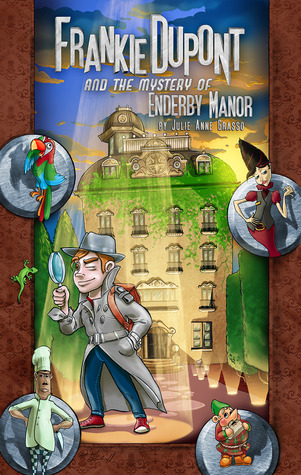
Middle Grade Review: Frankie Dupont and the Mystery of Enderby Manor

http://motherdaughterbookreviews.com/kid-lit-blog-hop-43/22066928  


Title: Frankie Dupont and the Mystery of Enderby Manor
Author: Julie Anne Grasso.  2014, 135 pages
Source: Free review e-book

Summary:
When his favorite cousin Kat disappears from Enderby Manor, 10-year-old Frankie Dupont, sleuth-in-training, is on the case. He has to deal with dubious and devious characters at the Manor, not to mention the bumbling Inspector Cluesome, before the final dramatic race to save Kat in time.

Review:
This was a fast, fun read! Frankie is an engaging character, and the story is well plotted to keep the interest of even reluctant readers. There is just a touch of the absurd, with just-over-the-top characters, and a dash of fantasy.  I went into this expecting another realistic kids-and-school type book, and was pleasantly surprised to find that it was something a little different. The book does require a certain amount of suspension of disbelief, but as the story develops and moves farther from the every-day, that becomes very easy.

The book is well edited, and illustrated with fun line drawings that depict key moments in the story. My main reservation is that Frankie has an awful lot of chutzpah, and I kept waiting for him to stumble. Things went just a little too smoothly for him, I think, but that is in part due to the short-and-simple nature of a book intended for younger middle-grade readers.

Recommendation:
Kids who enjoy mysteries (I was going to say Encyclopedia Brown and the Hardy Boys, but I might just be showing my age a bit) should enjoy this. Some might be a bit put off by the fantasy elements, but as many will probably be drawn in by them, given the popularity of fantasy just now.  I would class this as early-middle grade, for kids maybe 8-10 or 11, and probably very good for reluctant readers as it is written fairly simply and moves fast.

Full Disclosure: I was given a review copy of Frankie Dupont and the Mystery of Enderby Manor by the author, in exchange for my honest, not my favorable, review.  The opinions expressed are my own and those of no one else.  I am disclosing this in accordance with the Federal Trade Commission's 16 CFR, Part 255: "Guides Concerning the Use of Endorsements and Testimonials in Advertising."

Monday, July 28, 2014

Middle Grade Non-Fiction Review

After being away so long, I have a lot of catching up to do, and it will be a while before my posts are completely back on schedule.  But I have finished a number of books in the last two months, so I'll be trying to get review up for those!  Here's the first, from a book I finished just before we left for Peru.

2155053Title: Amazing Girls of Arizona: True Stories of Young Pioneers
Author: Jan Cleere
Publisher: The Globe Pequot Press, 2008, 183 pages.
Source: Purchased from the  Visitors Center at Saguero National Monument

Summary:
The book is a collection of a dozen brief biographies of girls and women who lived (or live) in Arizona. Arranged chronologically, they range from Olive Ann Oatman, who survived  an Indian attack in 1851 and was a captive for many years, to Ruth Okimoto, who was born in San Diego but was sent to an internment camp in Arizona during WWII at the age of 5.

Review:
Books like this are a particular passion of mine, and that means that I can afford to be critical.  Granted that this one appears aimed at younger readers (something I decided while reading it; as far as I could tell in the shop it was in the adult section), it still was disappointingly shallow. One thing I look for in such books is text drawn from letters and diaries, and there was very little of that. There was also a great deal that felt reconstructed (thoughts and feelings), which is okay in one sense but not what I want. Finally, in the case of some of the girls, I felt that the 'amazing' part was a bit of a stretch. 

There were a couple of girls whose memoirs would be worth reading. Eva Antonia Wilbur-Cruce sounds like she was a real character all her life, and she did pen a book (A Beautiful, Cruel Country) which I may want to read. And I'd love to read more from Edith Jane Bass, who grew up guiding early tourists around the Grand Canyon (though she died suddenly at age 28 and I don't think wrote anything more than an occasional letter).

Overall, this book serves as a decent introduction to the many lives of girls and women in the 19th and early 20th Centuries in Arizona, a state that didn't move too quickly into the modern era. But to get a real feel for the lives of pioneers, there are more and better books, both for adults and younger readers.

Recommendation:
For kids who need something specific to Arizona, or for die-hards like me who read everything available on or by pioneer women and children.

Full Disclosure: I purchased Amazing Girls of Arizona with my own money and of my own volition, and received nothing from the writer or publisher in exchange for my honest review.  The opinions expressed are my own and those of no one else.  I am disclosing this in accordance with the Federal Trade Commission's 16 CFR, Part 255: "Guides Concerning the Use of Endorsements and Testimonials in Advertising."

Wednesday, August 28, 2013

Middle Grade Fiction: Giving Kids Autonomy

As I have mentioned (since it sparked several reviews), there's been some discussion lately about missing and dead parents in Middle Grade fiction. I also recently did a post on books about boarding schools, and all this together has made me think about the importance of giving kids autonomy, both in books and in reality.

So this week I'm going to start a discussion about ways that authors give kids autonomy.  Next week I'll continue it with a discussion of what we parents do or should do to help our kids achieve some fraction of the level of self-sufficiency that the heroes of their books have.

 An obvious literary approach to getting parents out of the way is the orphan story.  That's easy.  No parents, lots of need to fend for yourself, especially in a historical or fantasy setting where there's no state structure to step in and offer substitutes (though given what I know of the foster system in my state, anyway, any kid who comes out of that with their head on straight and going in the right direction has plenty of gumption and self-sufficiency).

So if you don't want to kill off the parents, how else do you get the kids on their own?  There's boarding school (see last week's discussion, to which I now suddenly realize I should add Tamora Pierce's Tortall novels of Alanna and Keladry going through page training--if that isn't boarding school, I don't know what is.  Complete with strict adults who must be circumvented).  In many of the books I loved as a kid, parents simply gave kids carte blanche to roam, and they then could fall into adventures (think of Enid Blighton's "Famous Five).  This wasn't so far off reality back then; my brothers and I ran around in the woods and on the beach for hours at a time without checking in with parents.  In essence, the author (and the kids) can then just ignore the parents.

Historical fiction often makes more room for kids to be proactive and self-sufficient, as well.  That seems to have been reality.  Even little kids had chores and had to learn fast to do them themselves.

In one of my works in progress, I just made the main characters 16 or so, and put them on their own. Old enough to make it plausible, young enough that they don't have to do the adult love stuff (which I don't seem to want to write, and certainly not in a book aimed at kids).

And, of course, ultimately every kid is to some degree on her own in working out life's issues.  The bigger the issues, the more likely kids seem to be to keep them inside and try to go it alone.  So the parents can be right there and still the kids have to deal on their own.

Can you come up with any more approaches that writers use to make it plausible to have kids doing major (often adult-like) things?