Showing posts with label biography. Show all posts

Monday, June 7, 2021

Non-fiction Audiobook Review: Raven's Witness

55378412. sx318 


Title: Raven's Witness: The Alaska Life of Richard K. Nelson
Author: Hank Lentfer. Read by Basil Sands
Publication Info: 2020 Tantor Audio. 8:29. Original 2020 by Mountaineers Books. 256 pages.
Source: Library digital resources
Publisher’s Blurb:
Before his death in 2019, cultural anthropologist, author, and radio producer Richard K. Nelson's work focused primarily on the indigenous cultures of Alaska and, more generally, on the relationships between people and nature. Nelson lived for extended periods in Athabaskan and Alaskan Eskimo villages, experiences which inspired his earliest written works, including Hunters of the Northern Ice.  
 
In Raven's Witness, Lentfer tells Nelson's story--from his midwestern childhood to his first experiences with Native culture in Alaska through his own lifelong passion for the land where he so belonged. Nelson was the author of the bestselling The Island Within and Heart and Blood. The recipient of multiple honorary degrees and numerous literary awards, he regularly packed auditoriums when he spoke. His depth of experience allowed him to become an intermediary between worlds. This is his story. 

My Review:
I picked this book up from the library because it won kudos at the Banff Film festival, and it was at least an interesting read. First, the bad news: I hated the narrator. His delivery uses over-meaningful pauses and emphases that seem to imply significance and drama in every sentence, and it drove me nuts. I would have dumped the audiobook and gotten a text version, but the library only had the audio.
 
Once I got past the narration, however, the story is engaging and well-written. The narrator made me feel at first that it leaned toward purple prose, but in the end I decided that most of that was on Sands, and if read in a normal way it would be pretty decent. 

I came away with a feeling that though Nelson wasn't one of those people whose life you feel everyone ought to know about, he was worth learning about anyway. His work in his later years to help slow the logging in the Tongas National Forest is laudable, but I particularly liked his insights into the lives of the native people among whom he lived for several years, and appreciated his evolution away from anthropology--which always implies a certain superiority--to an openness to simply learn from them.

Lentfer became friends with Nelson in his final years, and the friendship and respect of a younger man for an elder informs the book all through. That's not necessarily a bad thing, but consider it a warning that there isn't a very strong critical thread in this presentation of Nelson's life.

My Recommendation:
Worth reading for insights into Alaskan history and culture, and as a reminder of what has been lost to the "march of progress." But get the print book and spare yourself the audio.


FTC Disclosure: I borrowed an electronic copy of Raven's Witness from my library, and received nothing from the author or the publisher in exchange for my honest review. The opinions expressed are my own and those of no one else. I am disclosing this in accordance with the Federal Trade Commission's 16 CFR, Part 255: "Guides Concerning the Use of Endorsements and Testimonials in Advertising.”   


******************************************

Meanwhile... Please consider pre-ordering your copy of my new short-story collection, Clues, Cops, & Corpses!

Amazon

Smashwords


 ©Rebecca M. Douglass, 2021
 As always, please ask permission to use any photos or text. Link-backs appreciated.

Enjoyed this post? Avoid missing out on future posts by following us.


Monday, February 8, 2021

Non-Fiction Review: Destiny of the Republic

12676103


Title: Destiny of the Republic: A Tale of Madness, Medicine, and the Murder of a President
Author: Candice Millard. Read by Paul Michael
Publication Info: Random House Audio, 2011; 9 hours 47 minutes. Original by Doubleday, 2011, 339 pages
Source: Library digital resources

Goodreads Blurb:
James A. Garfield was one of the most extraordinary men ever elected president. Born into abject poverty, he rose to become a wunderkind scholar, a Civil War hero, and a renowned and admired reformist congressman. Nominated for president against his will, he engaged in a fierce battle with the corrupt political establishment. But four months after his inauguration, a deranged office seeker tracked Garfield down and shot him in the back.

But the shot didn’t kill Garfield. The drama of what hap­pened subsequently is a powerful story of a nation in tur­moil. The unhinged assassin’s half-delivered strike shattered the fragile national mood of a country so recently fractured by civil war, and left the wounded president as the object of a bitter behind-the-scenes struggle for power—over his administration, over the nation’s future, and, hauntingly, over his medical care. A team of physicians administered shockingly archaic treatments, to disastrous effect. As his con­dition worsened, Garfield received help: Alexander Graham Bell, the inventor of the telephone, worked around the clock to invent a new device capable of finding the bullet.

Meticulously researched, epic in scope, and pulsating with an intimate human focus and high-velocity narrative drive, The Destiny of the Republic will stand alongside The Devil in the White City and The Professor and the Madman as a classic of narrative history.
 

My Review:
The biggest problem with this story is that it's fact, not fiction, so the narrative arc just doesn't work as well as we'd like. The set-up is perfect: Bell's genius, Lister's new understanding of germs and infection, all coming together just in time to save the president's life, right? Only, as we know, it didn't end that way. That simple fact forced the author to work extra hard to give the story a point, in my opinion. She doesn't do too bad a job.

With or without a greater significance, and even though Garfield was assassinated before he could do much as a president (though Millard argues that Chester Arthur, after Garfield's death, worked hard to carry out Garfield's agenda), his life is impressive. The early part of the book, recounting his early years, is inspiring. The account of the world's fair where Bell introduced his telephone is likewise interesting. It came so close to being ignored. Had no one noticed it, how much longer would it have taken for the technology to take hold? I'm sure it was inevitable that it would be picked up sooner or later, but it's fun to speculate.

In our times, maybe the most important message of this book is the clear depiction of the consequences of a refusal to recognize science. Lister had already proven his theory and found acceptance in Europe. Had Garfield been shot in England, he might well not have died (it was sepsis, not the bullet, that killed him). But for whatever reason, the American medical community clung to their old beliefs and continued to spread death and disease. I don't think I need to elaborate. It was also enlightening to see how devious the politicians were, and how willing to subvert democracy for personal gain. Plus ça change...

Finally, one caveat: the descriptions of the wound and Garfield's infections are pretty graphic. I had to take it in small doses, and definitely no listening at dinner time.

My Recommendation:
The book is well-written and well read. Perfect for those, like me, who like to pick up stray bits of history for no good reason. 

FTC Disclosure: I borrowed an electronic copy of Destiny of the Republic from my library, and received nothing from the author or the publisher in exchange for my honest review. The opinions expressed are my own and those of no one else. I am disclosing this in accordance with the Federal Trade Commission's 16 CFR, Part 255: "Guides Concerning the Use of Endorsements and Testimonials in Advertising."   

Monday, December 7, 2020

Nonfiction Review: Mobituaries, by Mo Rocca (audiobook)

52924988. sx318 sy475


Title: Mobituaries: Great Lives Worth Reliving

Author: Mo Rocca (read by the author)

Publication Info: Simon and Schuster Audio, 2019. Hardback, Simon and Schuster, 2019, 384 pages. 

Source: Library digital resources 

Publisher's Blurb: 

Mo Rocca has always loved obituaries—reading about the remarkable lives of global leaders, Hollywood heavyweights, and innovators who changed the world. But not every notable life has gotten the send-off it deserves. His quest to right that wrong inspired Mobituaries, his #1 hit podcast. Now with Mobituaries, the book, he has gone much further, with all new essays on artists, entertainers, sports stars, political pioneers, founding fathers, and more. Even if you know the names, you’ve never understood why they matter...until now.

Take Herbert Hoover: before he was president, he was the “Great Humanitarian,” the man who saved tens of millions from starvation. But after less than a year in the White House, the stock market crashed, and all the good he had done seemed to be forgotten. Then there’s Marlene Dietrich, well remembered as a screen goddess, less remembered as a great patriot. Alongside American servicemen on the front lines during World War II, she risked her life to help defeat the Nazis of her native Germany. And what about Billy Carter and history’s unruly presidential brothers? Were they ne’er-do-well liabilities…or secret weapons? Plus, Mobits for dead sports teams, dead countries, the dearly departed station wagon, and dragons. Yes, dragons.

Rocca is an expert researcher and storyteller. He draws on these skills here. With his dogged reporting and trademark wit, Rocca brings these men and women back to life like no one else can. Mobituaries is an insightful and unconventional account of the people who made life worth living for the rest of us, one that asks us to think about who gets remembered, and why.
 

My Review:

By the time you get through that blurb, I'm not sure how much there is left for me to say, except that the last paragraph of the blurb is pretty much spot on. I found the stories interesting and his delivery excellent (as you'd expect from a performer). I learned a bunch of things (I didn't know that about Herbert Hoover, who went on to be the president who got the blame for the Great Depression--remember "Hoovervilles"?), and enjoyed doing it.

Pretty much the only thing I found to complain about were some sections where he follows a well-developed story about one person or entity with a series of basically one-line similar cases. I wanted to know more about most of those!

My Recommendation:

This was great listening while driving, and the relatively short segments would also work well for times when you don't want to commit to a whole book at once. Check it out for some enjoyable, not too ponderous, bits of biography and history!

FTC Disclosure: I checked Mobituaries out of my library, and received nothing from the writer or publisher for my honest review.  The opinions expressed are my own and those of no one else.  I am disclosing this in accordance with the Federal Trade Commission's 16 CFR, Part 255: "Guides Concerning the Use of Endorsements and Testimonials in Advertising." 


Monday, November 30, 2020

Non-Fiction Review: Rebel Cinderella

 52398007. sx318 sy475

Title: Rebel Cinderella: From Rags to Riches to Radical, the Epic Journey of Rose Pastor Stokes

Author: Adam Hochschild. Read by Lisa Flanagan

Publishing Info: HMH Audio, 2020. Original, Houghton Mifflin Harcourt, 2020. 320 pages.

Publisher's Blurb: 

Rose Pastor arrived in New York City in 1903, a Jewish refugee from Russia who had worked in cigar factories since the age of eleven. Two years later, she captured headlines across the globe when she married James Graham Phelps Stokes, scion of one of the legendary 400 families of New York high society. Together, this unusual couple joined the burgeoning Socialist Party and, over the next dozen years, moved among the liveliest group of activists and dreamers this country has ever seen. Their friends and houseguests included Emma Goldman, Big Bill Haywood, Eugene V. Debs, John Reed, Margaret Sanger, Jack London, and W.E.B. Du Bois. Rose stirred audiences to tears and led strikes of restaurant waiters and garment workers. She campaigned alongside the country’s earliest feminists to publicly defy laws against distributing information about birth control, earning her notoriety as “one of the dangerous influences of the country” from President Woodrow Wilson. But in a way no one foresaw, her too-short life would end in the same abject poverty with which it began.

By a master of narrative nonfiction, Rebel Cinderella unearths the rich, overlooked life of a social justice campaigner who was truly ahead of her time.
 

My Review:

I found this a fascinating look into a bit of American history that doesn't get talked about much in your school classes. The story of Rose Pastor Stokes' life is pretty amazing, but for me the real value of the book lies in the context, which is pretty well presented. In essence, the story becomes the history of socialism in America, with the pluses and negatives of both sides--socialism and the fierce anti-socialist--clearly expressed.

Actually, I would say that the author is fairly sympathetic to the cause of socialism, while reporting the ways in which the movement went off track. The Russian Revolution clearly presented a special challenge to the movement, though it was WWI that truly derailed the socialist cause.

The character of Rose Pastor Stokes is interesting, and it is clear that her work with the union movement, rights for workers, and the need for safe working conditions was significant (and, as usual, overlooked in the history we studied in school). The narration by Lisa Flanagan was professional and transparent--it doesn't make the book, but nor does it mar it. 

My Recommendation:

This is well worth a read to understand more fully the history of socialism, and the goals of same. It's worth knowing the extremes our nation went to to suppress socialist views, which were considered inimical to the war effort, during and after WWI.

FTC Disclosure: I checked Rebel Cinderella out of my library, and received nothing from the writer or publisher for my honest review.  The opinions expressed are my own and those of no one else.  I am disclosing this in accordance with the Federal Trade Commission's 16 CFR, Part 255: "Guides Concerning the Use of Endorsements and Testimonials in Advertising."  

Monday, October 7, 2019

Non-fiction review: A Woman of No Importance

https://i.gr-assets.com/images/S/compressed.photo.goodreads.com/books/1539165474l/40595446.jpg


Title:  A Woman of No Importance: The Untold Story of the American Spy Who Helped Win World War II
Author: Sonia Purnell
Publication Info: Viking Press, 2019. 368 pages.
Source: Library digital resources

Publisher's Blurb:
In 1942, the Gestapo sent out an urgent transmission: "She is the most dangerous of all Allied spies. We must find and destroy her."

The target in their sights was Virginia Hall, a Baltimore socialite who talked her way into Special Operations Executive, the spy organization dubbed Winston Churchill's "Ministry of Ungentlemanly Warfare." She became the first Allied woman deployed behind enemy lines and--despite her prosthetic leg--helped to light the flame of the French Resistance, revolutionizing secret warfare as we know it.

Virginia established vast spy networks throughout France, called weapons and explosives down from the skies, and became a linchpin for the Resistance. Even as her face covered wanted posters and a bounty was placed on her head, Virginia refused order after order to evacuate. She finally escaped through a death-defying hike over the Pyrenees into Spain, her cover blown. But she plunged back in, adamant that she had more lives to save, and led a victorious guerilla campaign, liberating swathes of France from the Nazis after D-Day.

Based on new and extensive research, Sonia Purnell has for the first time uncovered the full secret life of Virginia Hall--an astounding and inspiring story of heroism, spycraft, resistance, and personal triumph over shocking adversity.


My Review:
I’m not sure where I got the tip-off for reading this book—I think it might have been the collection of brief sketches on women heroes of WWII I reviewed here. Whatever the reason, I’m glad I picked it up. The biography is well-written and historically diligent, with no effort to create thoughts and motives where they aren’t known—which is almost everywhere.

Virginia Hall was an exceptionally private person, perhaps because of her work as a spy, perhaps just by nature (which caused which?). In any case, we have to learn to know her primarily through the eyes of the men she worked with, and official documents. The reward for that research effort is a book that combines all the elements of a spy thriller with a strict adherence to fact. You might even call it a slightly dry spy thriller, except I was never bored. 

The other aspect of the book that makes it both a valuable and at times painful read is the history of sexism it exposes. Virginia Hall was acknowledged by the vast majority of those who knew her work as one of, if not the best spy in France during the war. Yet because of her gender, she was consistently passed over for promotion, and for much of the war the SEO (British Intelligence) and later the OSS (US Office of Special Services) routinely tried to put men with less—or no—experience and qualifications in command of her. After the war, it was even worse.

Happily for all of us—because in the end Ms. Hall performed feats of espionage and guerrilla warfare that may have tipped the balance for the Allies after the D-Day landings—she wasn’t particularly inclined to give in and accept her “place” as a woman. I might say she was a woman ahead of her time, but in fact I would argue that she was one of the women who made our time possible.

My Recommendation:
This is a book that helps to explode the myths not only about what women can do, but also about what they *did* do. And I didn’t even mention the fact that she had a disability, having lost one leg below the knee due to a hunting accident and a case of gangrene. Any time I’m feeling sorry for myself because things hurt when I’m hiking, I’ll be remembering Virginia, crossing the Pyrenees on foot, in winter, with a 1930s-technology false leg (named Cuthbert).

FTC Disclosure: I checked A Woman of No Importance out of my library, and received nothing from the writer or publisher for my honest review.  The opinions expressed are my own and those of no one else.  I am disclosing this in accordance with the Federal Trade Commission's 16 CFR, Part 255: "Guides Concerning the Use of Endorsements and Testimonials in Advertising."  

Monday, July 2, 2018

Non-fiction Audio: East to the Dawn

7173703 

Title: East to the Dawn: The Life of Amelia Earhart
Author: Susan Butler; read by Anna Fields
Publisher: Blackstone Audio, 2009. Originally 1997 by Da Capo Press, 512 pages.
Source: Library digital resources

Publisher's Blurb:

Amelia Earhart captured the hearts of the nation after becoming the first woman to fly solo across the Atlantic in 1928--and her disappearance on an around-the-world flight in 1937 is an enduring mystery. The image we have of Amelia Earhart today--a tousle-haired, androgynous flier clad in shirt, silk scarf, leather jacket, and goggles--is only one of her many personas, most of which have been lost to us over time. Through years of research and interviews with many of the surviving people who knew Amelia, Susan Butler has recreated a remarkably vivid and multifaceted portrait of this enigmatic figure. Listeners will experience Amelia in all her permutations: not just as a pilot but also as an educator, a social worker, a lecturer, a businesswoman, and a tireless promoter of women's rights. We experience a remarkably energetic and enterprising woman who battled incredible odds to achieve her fame, succeeded beyond her wildest dreams, and yet never lost sight of her beginnings, ensuring that her success would secure a path for women after her. This richly textured biography is the perfect complement to the 2009 film Amelia, starring Hilary Swank, Richard Gere, and Ewan McGregor. 

My Review:  

This was a fascinating story, once we got past the requisite exposition of Amelia's family antecedents. I in fact had no idea of much of anything about this remarkable woman aside from her role as a pioneering female pilot, and her eventual loss at sea while flying around the world (and even for that, my mental image had her lost in the wrong ocean).

In many ways, Amelia seems a bit unfocused. As she enters adulthood, she can't quite grasp what she wants to do--though much of her seeming instability of purpose is a combination of shortage of funds and a tendency to run up against the obstacles placed in the paths of ambitious women in the early 20th Century. In fact, I gather from the book that she herself was pulled two ways by her need for a serious and useful career--and her love of fast cars and fast airplanes. So maybe she was an adrenaline junkie, not ADHD.

What was cool to figure out was that in spite of flying being where her fame was located, Amelia's real importance is as a social worker and above all as an advocate for women's rights. She spent much of her life fighting against the injustices of "women can't do that," and even her flying was as often as not in the service of proving the nay-sayers wrong.

The book is well-written, though I would have spent less time on the generation before Amelia and maybe moved faster through her early childhood as well. But it is clear, and aside from some issues with keeping a lot of characters straight (always a problem with audio books, especially non-fiction), was easy to follow. The narrator was excellent, which is to say, I hardly noticed it (except, I think, for one Seattle-area mispronunciation, which I can no longer recall).

My Recommendation:
Well worth reading/listening to. I'll bet the printed book has lots of photos that I didn't get to see, so it might be worth getting and reading that.

FTC Disclosure: I checked East to the Dawn out of my library, and received nothing from the writer or publisher for my honest review. The opinions expressed are my own and those of no one else. I am disclosing this in accordance with the Federal Trade Commission's 16 CFR, Part 255: "Guides Concerning the Use of Endorsements and Testimonials in Advertising." 

Wednesday, May 10, 2017

The Last Season, by Eric Blehm: Non-fiction review

214091


Title: The Last Season
Author: Eric Blehm
Publisher: Harper Perennial, 2006. 335 pages.
Source: Borrowed from a friend.

Publisher's Summary:
 

My Review:  

A third of the way through the book, I was wondering why I was reading it. This was partly the inevitable result of picking away at it in tiny bits when I wasn't very engaged, but it was also a result of the way the book is written. Let me hasten to add that, not long after that, I settled down to read for real and soon found myself caught up in the story.

The main issue with the book is really the question of whether, aside from the mystery of his disappearance, Randy Morgenson was really a person in need of a biography. And the point of the book is really the disappearance and the search operation, with the rest of Randy's life feeling a bit as though it's there to make this into something more than an in-depth magazine article. But at some point, too, we realize that the construction of Randy's nature, through his past and up to the time of his disappearance, was essential to the searchers.

I was also intrigued by the description of a life that might have been one of those Robert Service wrote of when he penned "The Men That Don't Fit In" (except I think Service is too hard on them, and Randy would tell Service that his life had its own rewards). Randy really couldn't live in the front country for long, and that was both what made him an amazing ranger, and what (I'm guessing) also made it a difficult job in the end. He seemed to subsume his need to roam the world into a need to park himself in the depths of the Sierra for months at a time, an urge I can understand.

Randy was also, in some ways, a mystic, and I have less sympathy for that. Still, he turned that impulse toward conservation, and toward writing about the mountains in the manner of John Muir or Mary Hunter Austin--with prose that ranges toward the purple, but carries a lot of understanding and love. The pieces of his writing--journals as well as published essays--included in the book make for interesting reading.

My Recommendation:

If you like John Muir, or wonder about what kind of person it takes to spend the whole summer in a cabin three days' hike from the nearest road, take a look. Not every back-country ranger (thank goodness) needs to be quite as wedded to the mountains as Randy Morgenson. But I'm guessing that the job requires a certain amount of that impulse Robert Service wasn't sure about.

FTC Disclosure: I borrowed The Last Season from a friend, and received nothing from the writer or publisher for my honest review.  The opinions expressed are my own and those of no one else.  I am disclosing this in accordance with the Federal Trade Commission's 16 CFR, Part 255: "Guides Concerning the Use of Endorsements and Testimonials in Advertising." 

Monday, July 13, 2015

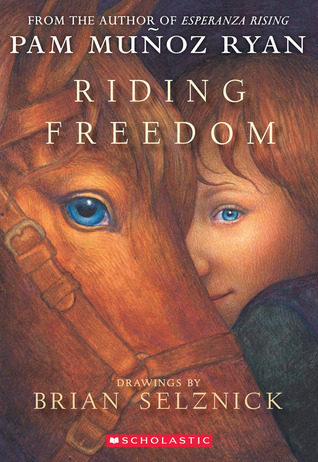
Middle Grade Review: Riding Freedom

1061557


Title: Riding Freedom
Author: Pam Munoz Ryan; illustrated by Brian Selznick
Publisher: first published 1998 by Scholastic, 144 pages. Ebook published 2013; on my Nook it had 75 pages.
Source: library (digital)

Summary:
Based on a real person, Charlotte Parkhurst, this book tells of a girl who disguises herself as a boy to escape a workhouse (masquerading as an orphanage). Unlike most who did that sort of thing (at least in books), she did not resume her female persona. Now known as Charley, Charlotte went on to become an expert stage driver, emigrated to California, and became--50+ years before it was legal--the first woman in the country to vote (so far as we know!). Note: the summaries on Amazon and Goodread talk about her being married and losing husband and baby, then resuming her male role. Nothing in the book suggests any such thing, including the historical note at the end, though there is mention of a time spent in Atlanta which isn't covered in the book.

Charlotte's story is both expanded and compressed. Expanded, because very little is known of her life (for obvious reasons), so the author had to invent small incidents, dialog, and feelings. But it is also compressed, in that the author chose to put all the key events into far fewer years than they actually encompassed for the sake of a more coherent narrative.

Review:
I am a huge fan of historical fiction, and finding a book like this, based on a remarkable real person, is a delight. Though I enjoyed it a great deal, the writing style is not to everyone's taste--it is definitely written in the style of a children's biography, with more "showing" and made-up dialog than an adult book would have, but still with a certain distance and a great deal more "telling" than we consider optimal in a novel. Frankly, I didn't care. The story is compelling, and well-told. Selznick's illustrations only add to the delight.

Like many readers (based on a scan of the reviews), I would have liked to know more about what happened after the book ends. Charlotte had a great friend at the orphanage, Hayward, and she invites him (according to their childhood plan) to join him on the ranch she eventually buys. What becomes of that relationship? I believe that the author does not pursue this because he is not an historical character, but the possibilities are tantalizing.

Recommendation:
This is a book that offers a good look at issues faced by women in the 1800s, as well as being an inspiring story of perseverance in the face of great odds. I recommend it for those who like history and historical fiction, biography, and stories of strong women.

Full Disclosure: I checked Riding Freedom out of my library, and received nothing from the writer or publisher in exchange for my honest review.  The opinions expressed are my own and those of no one else.  I am disclosing this in accordance with the Federal Trade Commission's 16 CFR, Part 255: "Guides Concerning the Use of Endorsements and Testimonials in Advertising."

Monday, July 28, 2014

Middle Grade Non-Fiction Review

After being away so long, I have a lot of catching up to do, and it will be a while before my posts are completely back on schedule.  But I have finished a number of books in the last two months, so I'll be trying to get review up for those!  Here's the first, from a book I finished just before we left for Peru.

2155053Title: Amazing Girls of Arizona: True Stories of Young Pioneers
Author: Jan Cleere
Publisher: The Globe Pequot Press, 2008, 183 pages.
Source: Purchased from the  Visitors Center at Saguero National Monument

Summary:
The book is a collection of a dozen brief biographies of girls and women who lived (or live) in Arizona. Arranged chronologically, they range from Olive Ann Oatman, who survived  an Indian attack in 1851 and was a captive for many years, to Ruth Okimoto, who was born in San Diego but was sent to an internment camp in Arizona during WWII at the age of 5.

Review:
Books like this are a particular passion of mine, and that means that I can afford to be critical.  Granted that this one appears aimed at younger readers (something I decided while reading it; as far as I could tell in the shop it was in the adult section), it still was disappointingly shallow. One thing I look for in such books is text drawn from letters and diaries, and there was very little of that. There was also a great deal that felt reconstructed (thoughts and feelings), which is okay in one sense but not what I want. Finally, in the case of some of the girls, I felt that the 'amazing' part was a bit of a stretch. 

There were a couple of girls whose memoirs would be worth reading. Eva Antonia Wilbur-Cruce sounds like she was a real character all her life, and she did pen a book (A Beautiful, Cruel Country) which I may want to read. And I'd love to read more from Edith Jane Bass, who grew up guiding early tourists around the Grand Canyon (though she died suddenly at age 28 and I don't think wrote anything more than an occasional letter).

Overall, this book serves as a decent introduction to the many lives of girls and women in the 19th and early 20th Centuries in Arizona, a state that didn't move too quickly into the modern era. But to get a real feel for the lives of pioneers, there are more and better books, both for adults and younger readers.

Recommendation:
For kids who need something specific to Arizona, or for die-hards like me who read everything available on or by pioneer women and children.

Full Disclosure: I purchased Amazing Girls of Arizona with my own money and of my own volition, and received nothing from the writer or publisher in exchange for my honest review.  The opinions expressed are my own and those of no one else.  I am disclosing this in accordance with the Federal Trade Commission's 16 CFR, Part 255: "Guides Concerning the Use of Endorsements and Testimonials in Advertising."

Monday, April 21, 2014

R: Last of his Kind, by David Roberts


It's a shame I didn't need W instead, but there it is.  Instead of pegging it to the amazing mountaineer whose story this is, I've tied it to the biographer's name.

The Last of His Kind: The Life and Adventures of Bradford Washburn, America's Boldest Mountaineer


Title: The Last of His Kind: The Life and Adventures of Bradford Washburn, America's Boldest Mountaineer 
Author: David Roberts
Publisher:William Morrow, 2009

Review:
This one needs no summary, because it's all there in the subtitle.  It is the life of Brad Washburn, June 7, 1910 to January 10, 2007.  Washburn was an adventurer, an early climber and explorer of Alaska's mountains who began a love affair with climbing in the Alps as a teenager.  He was also a photographer and a pilot, and he was David Roberts' mentor.  The accounts of climbs are concise and vivid, and the personal relations are treated with gentle care, so that we do see Washburn as a whole person, but I never lost sight of the fact that Roberts loved and admired his mentor. 

Roberts insists that Washburn's greatest accomplishments are in his first ascents of a number of remote Alaskan peaks, with a secondary nod to his truly extraordinary photography (several examples of which are in the book).  But I agree with Washburn, who considered his greatest accomplishment to be his work with the Boston Museum of Science, where as Director for many decades he took the museum from the dusty do-not-touch model common at the time to be one of the leaders in the hands-on interactive museum style.  Helping to pioneer that movement is, in my opinion, a truly great act.

My only other complaint about the book is that Roberts spends a long chapter near the end recounting a couple of his own expeditions.  They are interesting to read about, and Washburn was instrumental in setting him off on them, but they are not really part of Washburn's story.  Roberts can be forgiven this bit of self-indulgence, however. 

Recommendation: For those who like mountains, mountaineering, and stories of the great adventurers of a nearly a century ago.  Also those who don't mind just a touch of hagiography.

Full Disclosure: I was given The Last of His Kind  by a friend with no connection to the author, and received nothing from the writer or publisher in exchange for my honest review.  The opinions expressed are my own and those of no one else.  I am disclosing this in accordance with the Federal Trade Commission's 16 CFR, Part 255: "Guides Concerning the Use of Endorsements and Testimonials in Advertising."