Today's Wanderings are a bit more literal than usual... the Ninja Librarian is on vacation, collecting new photos to share, but probably not writing.
As I write this a few days before my departure for Hawai'i, I just want to throw out a few thoughts about the end-game on bringing out a book (for self-publishers). Death By Adverb is on track for release next Wednesday, and here are some of the details I needed to get in order before leaving for my trip:
--Final versions of Kindle, Smashwords, and Createspace (paper) books. This includes the last-minute proofing corrections and all the formatting and separate extra bits for each version.
--Making sure the cover is the right size for the final page count.
--Uploading all those files and sending for a proof copy of the paperback.
--Lining up some release-day bloggers and getting them all the info (I'll post a schedule and links next week!). If you want to get in on this, let me know and I'll send you the info on Monday.
--Actually, I think that about covered it, aside from marketing.
Marketing. I'm not so hot at that. I'll need to do FB posts, Tweets, and... oh, hey, I'm more than overdue for a newsletter! Maybe with a discount code...
What with all that, it's not surprising that I'm not really up on a couple of other things--like any new writing, or deciding about the April A to Z Challenge. It's addictive--I was sure I wasn't going to do it, but with a master sign-up list once again in the offing, it promises to be better this year. Maybe I'll do something simple. I want to talk about writing and my books and find a way to make my usual reviews fit (I have at least 2 scheduled for next month already).
That's about it for my musings, wanderings, and general house-keeping. Any thoughts about A to Z? About releasing books? About whether I should have my head examined for doing either?
Showing posts with label musing. Show all posts
Showing posts with label musing. Show all posts
Wednesday, March 21, 2018

Wednesday, January 24, 2018
Wednesday Wanderings: Historical Fiction

I have long had a love affair with children's historical fiction. It probably began with The Little House in the Big Woods, which I first read when I was what? maybe 6 or 7 years old? Looking back at it, nothing much happens in the book, but it didn't matter, because everything the Ingalls family did was strange and exciting to me. In the years since, I have read children's books set in periods from ancient Greece to the 1970s (anything since then hardly feels "historical" to me!). The vast majority of these books were interesting, apparently well-researched, and added something to my random pool of knowledge. Of course, you do need to bring some critical judgement to it--the Little House books, for example, are rife with the racial prejudices of the author's time (something that more contemporary writers do a better job of addressing, since they are usually conscious, at the least, that such prejudices aren't acceptable. When Laura asks awkward questions about how the Indians might feel about the settlers in Indian Territory, she is told to be quiet, suggesting Wilder had her own concerns about justice, if not racism).
I have also read a somewhat smaller selection of adult fiction set in historical periods, and had a much more varied experience of the books. Of course, all those Louis L'Amour westerns I read in middle and high school are historical fiction, and probably could be used as a textbook example of the ways the genre (historical fiction, not "westerns," which is a sub-genre and plays by different rules) can go wrong. Hastily-written and often poorly edited, rife with stereotypes and misconceptions about the time and place (though L'Amour claimed that his books were, if nothing else, geographically correct--he wrote about real places and said that "if [he] wrote about a spring, that spring is there." I've never tested that claim), those westerns did little to increase either knowledge or understanding.
I've had better success with a few writers of mysteries with historical settings. Jacqueline Winspear (Maisie Dobbs) researched the dickens out of the between-the-wars period in England, and her books match up to the best of the children's books: they entertain and educate in one go. Gretel Ehrlich's Heart Mountain was both good history (and more nuanced than most) and a good read, and the works of Ivan Doig rank among the best books I've read.
But you may have read my review of Goodbye Picadilly last week. This was historical fiction erring on the side of trying too hard with the history, at the expense of story and character both. Other books (think romances) play fast and loose with history for the sake of a thrilling setting for a story. And many others, the more serious "literary" works, may do the history well, but I often find heavy going.
The result of all this is, though there are undoubtedly many high-quality works of (non-genre) historical fiction in the library's adult section, I approach a new author with caution and a lot of doubt, while I continue to read my way through any I find in the kids' room (some of which are definitely better than others). It makes me sad that apparently historical fiction is out of fashion with kids right now, with the result that little of it is being published. Too few kids (sadly, my own included) seem to understand that you can learn so much without having to sweat for it, just by reading a good story.
I've spent years researching to write a book based on my Grandmother's childhood, and in fact have drafted it a couple of times. It's still not what I want, but the research has been fascinating (involving, in part, reading all the women's and children's accounts of the Oregon Trail I can find), and I still want to publish that story. I hope that someday the market will swing back toward an appreciation of these glimpses of our history.
©Rebecca M. Douglass, 2018
As always, please ask permission to use any photos or text. Link-backs appreciated!
As always, please ask permission to use any photos or text. Link-backs appreciated!
Wednesday, June 22, 2016
Musings on reading Terry Pratchett's Wintersmith
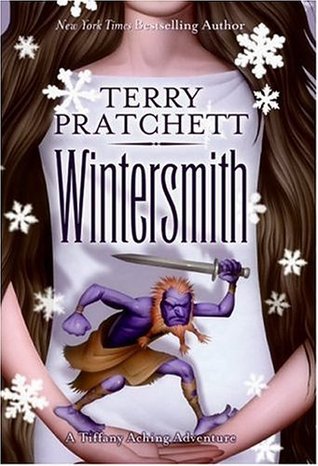
Title: Wintersmith
Author: Terry Pratchett
Publisher: HarperTempest, 2006. 323 pages.
Source: Library
I don't have the gall to review Terry Pratchett. But I'm happy to share the musings I've had while reading Wintersmith, the 3rd of the Tiffany Aching books. I'm happy to find there is one more. I shall savor the pleasure.
I am a huge fan of Pratchett and his Discworld, and like to think about how he does it, whatever "it" may be. Here, in no particular order, are some thoughts engendered by Wintersmith.
1. Third Thoughts. Pratchett proved his genius when he came up with this one. We all know what Second Thoughts are. I'm going to eat a quart of ice cream. No, on second thoughts, that might not be a good idea. Third Thoughts stand outside the head and study it all, and probably argue with the first and second thoughts. Not everyone gets to have them, but I'm thinking that for a writer, Third Thoughts are the editor that can actually decide that the lovely passage I just wrote has got to go. Third Thoughts will tell me so, probably profanely.
2. Pratchett doesn't write kids books for kids. Some claim Tiffany Aching is for kids. After all, the protagonist is 9 in Wee Free Men, 11 in A Hat Full of Sky, and turned 13 halfway through Wintersmith. And she's even having some teenaged problems. Boy trouble. But no, this book isn't aimed at children, though teens could learn a lot from it. I can relate to this, too. The Ninja Librarian is about 1/2 a kids book, and I'm not kidding when I say it's for "10-year-olds of all ages."
3. Okay, I didn't see that ending coming. I should have, but I didn't. Is that me being dense, or is that the perfection of a great ending, that once you've read it, it seems inevitable, even though you couldn't have thought it up yourself in a month of Sundays?
4. I've looked and thought a lot lately about writing dialects and accents. Pratchett seems to pull it off marvelously, and he does it with vocabulary (though the Mac Nac Feegle need a little glossary for some of their vocabulary), not spelling. I will take lessons.
5. I want to grow up to be one of the Discworld witches. Somewhere between Granny Weatherwax and Nanny Ogg. Which leads me to....
6. I never knew anyone (well, maybe I do) who can jam as many improper ideas and implications into language that will pass any censor. You don't have to write a single 4-letter word to get the ideas across.
That's enough rambling for now. If you've never read any of Terry Pratchett's books, run right out and start. I'm not sure where you should start; most people agree that the first book (The Color of Magic) isn't his best, though it was good enough to capture me. My favorites might be the ones about the witches, like Equal Rites, but I'm awfully fond of the Watch, too. And the sorcerers are good for a laugh...
#########
Still running my summer sale!

Subscribe to:
Posts (Atom)