Showing posts with label orphans. Show all posts

Sunday, May 5, 2019

Middle Grade Monday: A Stitch in Time

35795944

Title: A Stitch in Time
Author: Daphne Kalmar
Publication Info: Feiwel and Friends, 2018. 256 pages (hardback)
Source: Library digital resources

Publisher’s Blurb:
Donut is an eleven-year old geography buff who keeps her taxidermied mice hidden in her late mother’s hope chest. Her pops passed away, leaving her an orphan. Aunt Agnes has moved in, bringing along her lumpy oatmeal, knitting, and a plan to drag Donut off to Boston forever.

Donut stands to lose everything: her friends, her village, her home, the woods, and walks where the memories of her pops are stored up.

While Donut dodges the ache of missing her pops, she and her best friend Tiny plan how to keep her where she belongs. Holed up in a cabin on Dog Pond, Donut clings to the hope that Aunt Agnes will throw in the towel and leave Vermont without her.

A Stitch in Time is shot through with gorgeous, evocative language, and gets right to Donut’s heart.
 

My Review:
Maybe I never grew up, because I think my reaction to this book is that of a kid: without giving anything away, I was rooting for Donut's own solution to work. The ending was the realistic one, and maybe even better for her, but it wasn't the kid's ending. That kvetch aside, this really was a great, quick read. Donut is a very relatable character, and I liked the way her views of the adults, especially her aunt, shifted into a more three-dimensional understanding. Even the minor kid characters proved more fully human than is often the case.

The writing is tight, and so's the action. Donut has a clear objective and her own ways of getting there. The handling of her grief over the loss of her father is delicate, at times maybe too removed as she goes about being herself, but I think that's also realistic for how a kid might handle such a huge loss--as much as she can, she just doesn't think about it, then is periodically overwhelmed.

I wouldn't mind seeing a sequel to this one, to see how the next phase of her life goes.

My Recommendation:
It was a good read, and well suited to kids from 8 or so up. I do wonder if they will share my disappointment in the ending. The more I think about it, the more I feel like it went the wrong way. Are the adults always right? I felt like the author was telling us they are, but I was never quite convinced. 


Full Disclosure: I borrowed an electronic copy of A Stitch in Time from my library, and received nothing from the author or the publisher in exchange for my honest review. The opinions expressed are my own and those of no one else. I am disclosing this in accordance with the Federal Trade Commission's 16 CFR, Part 255: "Guides Concerning the Use of Endorsements and Testimonials in Advertising."  

Monday, September 26, 2016

Middle Grade Monday: Cynthia Voigt and the Tillermans

Sort of a dual review of Homecoming and Dicey's Song,  the first two books of the Tillerman cycle by Cynthia Voigt. A review of #3, A Solitary Blue, will come separately as these two are the books of the cycle that are really about Dicey.

233333   https://d2arxad8u2l0g7.cloudfront.net/books/1386923650l/11831.jpg 
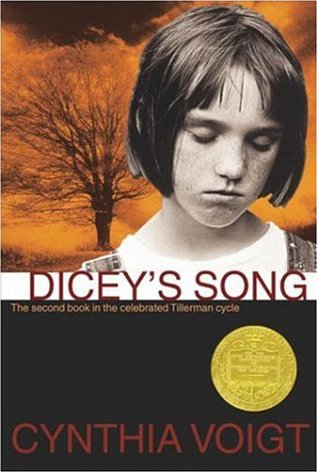
1442628I couldn't find an image of the cover of Homecoming from the hardback I read. I did find it for Dicey's Song, so I'm including it. I think I like it better.

Publisher: Homecoming: Atheneum Books for Young Readers, 1981. 320 pages.
Dicey's Song: Atheneum Books for Young Readers, 1982. 204 pages.

Source: Library


Summary:
Homecoming follows the four Tillerman children--Dicey, age 13, James (10), Maybeth (9), and Sammy (6) after their mother walks away from them in a shopping mall parking lot. They find their way, mostly walking, to their great-aunt's house in Bridgeport, but nothing there is what they expected. So the Tillermans set out again, in search of the home they need.

In Dicey's Song, the siblings are settled with their grandmother, but that turns out not to be the end of Dicey's work. There are a number of problems to solve, and Dicey and her grandmother both have a lot to learn about being a family, and about reaching out to a hand that's reaching to them.

My Review:
Because these books date back to my high school college years, they do have a feeling of being of another time (as an aside, it is only when reading books from that era that I believe things were really that different then). I would hope that those differences wouldn't stop a modern child from reading, because I think anyone would admire Dicey and the inner strength that keeps her going when she has no idea what she's doing.

The "Great Middle Grades Reads" Goodreads group has discussing in the past the trope of the dead/absent parent in middle grade books, and the way in which that can be used to set the children free to be independent. In this case, the absent parents force Dicey to grow up--but what she is already mature enough to know is that they most need a parent. She's not looking for adventure, but Dicey is willing to take a lot of chances and tell all the lies she needs to in order to keep the family together and find a home. The lost parents don't feel at all like a trope; they feel like a tragedy.

Dicey is an interesting protagonist. She is often prickly and difficult, and I at times wanted to shake her and insist she let people into her life and pay attention to them. But that was, after all, what she had to learn to do. After being in charge from far too young an age, as the children's mother became more and more mentally ill and incapable, she'd become too self-reliant and untrusting, and very nearly lost her way a few times. In the end, I liked Dicey, prickles and all, and was wholly absorbed in her story. And that, after all, is what books should do.

I was very glad there was a sequel and I could get it quickly, because I did feel that the first book left almost as many things hanging as it tied up. By the end of the second book, I felt better about leaving her. In a lot of ways, the two really should be one fat book, though the first does have enough of an ending to satisfy most kids, anyway.

Both books won multiple awards, and I think they are justified. I even think these are books that might appeal to both adults and the children for whom they were written.

Recommendation: 
I recommend the series for kids maybe 11 or 12 and up. I can't point to anything that's inappropriate for younger kids, but it just felt a little old for most grade school children. Some of that is due to the situations in which Dicey finds herself, but I think it's mostly just the level of the writing, which is not particularly simplified for young readers. I'll also recommend it for anyone (of any age) who just likes a good story.

FTC Disclosure: I checked these books out of my library, and received nothing from the writer or publisher in exchange for my honest review.  The opinions expressed are my own and those of no one else.  I am disclosing this in accordance with the Federal Trade Commission's 16 CFR, Part 255: "Guides Concerning the Use of Endorsements and Testimonials in Advertising."  

###

Meanwhile, don't miss this month's promotion, in advance of Monday's cover reveal for The Problem of Peggy! (The Ninja Librarian, Book 3)

The price for The Ninja Librarian has dropped to 99 cents for the ebook, at Amazon or Smashwords. So get a copy and discover the world of Skunk Corners for yourself!

https://www.smashwords.com/books/view/141510
  

Wednesday, October 22, 2014

Middle Grade Classics: A Little Princess

This is the cover from the first edition in 1905


Title: A Little Princess
Author: Frances Hodgson Burnett
Publisher: Warne Published in 1905, expanded from the serialized novel, Sarah Crewe, published in St. Nicholas Magazine in 1888.
I read the

Summary:
When the wealthy Captain Crewe brings his little daughter Sarah back from India to go to school in London, she is the prize boarder at Miss Minchin's boarding school. But when he dies and leaves her penniless, Miss Minchin turns Sarah into an unpaid drudge for the school. Sarah's resolve to always be a "princess" in spirit is sorely tested before everything resolves itself into a happy ending.

Review:
I won't pretend this is the first time I've read this book. For all it's dated and follows a stereotypical pattern (unbelievably good child keeps shining through tribulation and is given a great reward as a result), I  love the story, and I've read it many times. (Oddly, I don't think I ever read it when I was a child). Maybe I want to believe in happy endings. I love that Sarah uses her imagination to escape her intolerable reality, and that she can spin stories well enough to carry others away with her. The descriptions of the child's suffering of mind and body are moving to the point of pathos, but I have always been able to immerse myself in the story and enjoy it on it's own terms. And that is what is needed to enjoy this, as it is for many children's classics.

The lessons about generosity and selflessness ring a little old-fashioned (or at least heavy-handed, since after all, we might hope that generosity isn't an outdated virtue!), but the lesson about the power of imagination is one that every writer has long since learned.

Recommendation:
For fans of orphan stories and hard-luck school stories, as well as those who want to explore the classics of children's literature. The language will feel a bit odd and dated to modern children, but I think that most good readers would have no problem with it. The story will almost certainly appeal primarily to girls, though the lessons aren't bad for boys, either.


Full Disclosure: I long ago purchased A Little Princess, and received nothing from the writer or publisher in exchange for my honest review.  The opinions expressed are my own and those of no one else.  I am disclosing this in accordance with the Federal Trade Commission's 16 CFR, Part 255: "Guides Concerning the Use of Endorsements and Testimonials in Advertising." 
 ###
Further musings: 
I have been watching old DVDs of a 2002 PBS show called Manor House, in which ordinary people are recruited to fill an English manor house as it would have been in 1905. They have everybody, from the lord of the Manor to the scullery maid. And therein lies the problem, because for the most part, 21st Century folks have trouble working as servants, especially in that extremely hierarchical society. The butler has to continually remind them that even the servant's hall isn't a democracy, and they have no "right" to time off, or even to complain.

This made me think about two things. One was Sarah Crewe and how she copes with her sudden shift from, effectively, lady of the manor to scullery maid (and those descriptions of her working 14 and 16 hours a day at a very tender age appear to be simply statement of fact as life was lived then). Now, being a child, she may in one sense adapt more easily than an adult (kids do tend to adapt to a new reality pretty quickly), but of course, her gracious acceptance is also exaggerated to show her noble personality.

The other thing I thought about was my own brief excursion into the servant's life. When I finished my undergraduate studies, I spent a winter working as an au paire in Monaco (!). Now, in some families, the au paire is part of the family. I drew a more wealthy family, where I definitely felt that I was seen as a servant. Shall we simply say that the experience suggests that I would have been one of the less successful "servants" in the Manor House? It's no small thing for a person who has grown up with a firm belief in equality to suddenly find themselves decidedly not equal. And that may be a good thing, outside of historical re-enactments.  As we used to say when I was an undergrad, "Question Authority!"

Thursday, February 20, 2014

Flash Fiction Friday: Twisted Love

NOTE: THIS WEEK'S STORY IS NOT FOR CHILDREN

Chuck Wendig gave us a skimpy prompt this week, just the title, or plot (however you chose to look on it), "Twisted Love."  I chose to use it for both and then decided to write this as an homage to L.M. Montgomery.  For any who know Montgomery only as the author of Anne of Green Gables, Montgomery wrote a great many short stories, and many of them were gothic in nature.  A startling number dealt in greater and lesser depth (as did her novels) with the ways in which love can be twisted and poisoned.  So here, in a story I think Montgomery would recognize, is

Twisted Love


When she was very small, Lena had wondered why she alone among the children at the little school in Seaside lived in darkness.  Not just physical darkness, though she envied the other children the candles and lamps that allowed them to read after nightfall.  But Lena felt from an early age that she lived in a sort of spiritual darkness, not as the preacher would see it, but one which left her feeling as though all light had been shut out of her life.

Even as a child, Lena knew no one loved her, knew it in her soul and thought about it in that odd way of children who are much alone.  When she was small, she dreamed of telling her mother that she knew she wasn’t loved, and of running away.  She would go deep into the woods, and find a beautiful little cottage of stone and a mother who did love her, and no stepfather.  For while Lena saw that her mother did not love her, she saw even more clearly that her stepfather hated her.

It was only slowly, as she grew, that Lena learned, piece by piece from things overheard and things said in anger, why she was unloved.

Once, a girl named Hannah Stewart had been the belle of her small town, happy, pretty and young, and given to flirting with all the boys.  She took nothing seriously, and didn’t need to, for her older sister Madeleine, who stood in the place of her own dead mother, did the thinking and worrying for her.  They had no mother, and their father was too caught up in his work to bother about them, so they were everything to each other, and loved one another dearly, despite Hannah’s feeling that Madeleine was too serious, and Madeleine’s sure knowledge that Hannah’s lightness would lead to trouble.

And it did.  Pretty, flighty Hannah found when she was but eighteen that she had gone too far, and when pressed could not even say which of several boys might be the baby’s father.  Madeleine despaired over Hannah’s depravity; Lena, learning of it as she entered her teens, knew in her heart that Hannah had refused confession, rather than been unsure of the father.  She had chosen to protect someone, and Lena hoped that it was she, but greatly feared it was the unknown father of whom her mother had been thinking.

Madeleine took her little sister away so that none should know her disgrace.  She found a remote cottage, and there nursed and scolded and loved the girl, and stayed by her through a pregnancy that took more from her than it should have.  And when the baby was born, Madeleine knew at once who the father must be.

Saying nothing to her sister, she wrote to Justin Carter and told him he was a father, and must come and marry the baby’s mother.  Hannah knew nothing of this.  She named the baby after her sister, held her for a day, and died.

When Justin arrived, eager to marry the girl he loved, Hannah was dead, and Madeleine had a plan.  In his grief at Hannah’s death—for if he had not been her first choice, she had been his—he agreed to everything.  The child would be his, and would have the best of everything.

Justin and Madeleine were married that very week, and moved to the distant town of Seaside, where no one knew them and all assumed the baby was theirs.  Justin had trained as a lawyer, and took up his work there and, as his new wife had expected, made a good living for the family.

Lena never knew them in the year or two when they had been almost happy, in a mild, dispassionate sort of way.  By the time Lena was two, Justin could no longer deny what he had suspected from the first: that he was not the girl’s father, and that, in fact, her father was the one man he hated.  He had hated Albert Hawkins as a ne’er-do-well and a scoundrel, as well as a rival.  Now that he knew what he had done to his beautiful Hannah, Justin hated him with a deeper passion that poisoned his soul. 

And love betrayed became hatred all around.  Justin could no longer abide the sight of the child, and Madeleine, who blamed Lena for her mother’s death, had never liked her.  Now Justin turned his hate as well on the woman who had tricked him into a loveless marriage, and he could no longer bear either.  All the love that he had borne for Hannah turned to hatred of these two creatures who between them had robbed him of her, and trapped him until death.

He ceased to pretend the child was his, though he said he had married Madeleine in pity when her husband was killed while she was with child.  He never said so, but made it clear to all that he neither loved nor respected her.

So Lena had grown up in an atmosphere of hatred and resentment, and her own impulses to love, spurned at every turn, turned inward.  Gradually she, too, learned to love and trust none but herself.

By the time Lena was fourteen she was in possession of most of the facts of her own life, for Justin was wont to fling them at her as weapons when she displeased him.

She returned from school one spring day to find both Madeleine and Justin stuck down with some kind of fierce fever and cough, too weak to rise.  When they called out to her to help them, she stood in the doorway and looked on them with a hard face.

“Why?”

“For the love of God and your parents,” cried Madeleine, forgetting that Lena had never known love.

“What parents?” Lena asked.  She felt strange, and knowledge of what she was about to do washed over her.

“Why, we are your parents, child,” said Justin.  “Under the law.” 

Lena gave a short, harsh laugh, for it was like him to be both honest and brutal.  “Oh, under the law.”  Her face grew still harder.  “I have no parents.”  She looked at Madeleine.  “I tried to love you, and you cast my love back into my face.  You never forgave me for my mother’s death.  Yes,” she said, seeing by Madeleine’s face that she had not known how much Lena knew, “I know who my mother was.  You may have loved her, but you never loved me, even for her sake.  And you,” she turned to Justin, “you were never any kin at all, as you have made clear all these years.  I have neither mother nor father,” for though she had heard the name of Albert Hawkins, she could not feel him to be a parent, though Justin blamed him for her every fault.

Lena looked from one to another of the fever victims.  “I tried to love you, to be what a daughter should, and you flung it back in my face.  I was a little child who only wanted to be loved, and you gave me only your hatred.”

Her face wore a mask now of hatred and fury far beyond her years.  “Now you dare to call on my love to help you?  Well, I know nothing of love, nor family.”  She moved to the bureau and found the stash of money Justin kept there, pocketing it with a final malediction.  “I will take my inheritance and leave you to your bitterness.”

Justin tried to get up, to follow the money as she left the room, but he sank back, unable to rise, overcome by a fit of coughing.

Lena did not weep as she left the house, the only home she had known, and left behind her the two bitter souls to live or die as they would.  She had long since wept out all her tears for the mother-love she had never known.  They had left only a bitter residue, and a pocket full of bank-notes.


##

©Rebecca M. Douglass 2014

Wednesday, September 11, 2013

MG Book Review: Pictures of Hollis Woods

9815297


Pictures of Hollis Woods, by Patricia Reilly Giff.  Read by Hope Davis.
Print book published by Wendy Lamb Books, 2002
Audiobook published by Listening Library, 2002
Source: Library (Overdrive)

Summary:
Hollis Woods has spent her 12 years in a long string of foster homes, and can't every seem to get it right.  She runs away from all of them after a while, even from the one home where she really wants to stay.  Now she's been put with Josie, a retired art teacher who's beginning to forget things.  For the first time, Hollis starts to think about what someone else needs, and tries to figure out how to make it happen.

Review:
I really enjoyed this quick read (even on audio books, it took only 3 1/4 hours, and I listened to the whole thing in one day, while doing my Saturday chores).  Hollis narrates her own story, and her voice is a mixture of defiant, self-absorbed, disheartened, and loving which I found authentic.  Her one carefully guarded wish is for a family, but her own sense of undeserving keeps her from grasping it when it's in reach.  It takes the time with Josie and her cousin Beatrice to teach Hollis a few important things: that she is talented (Hollis is an artist; thus the "pictures" of the title), that she is worth loving, and that she can love others.

To me the book had a feel of historical fiction, as though set perhaps 20 or 30 years back, but I'm not sure that's the case.  Maybe that just springs from a wish that the foster system might be less broken now than it was for Hollis. 

To an adult, the ending feels a little too tidy and happy to be realistic, but I think it's perfect for middle grade (and, frankly, I am a sucker for a happy ending, so I'm not really complaining).  The writing is polished and language well-chosen.  There was one glitch in the recording, which seems to be actually in the Overdrive file, as I downloaded it from two different library sites (which I realize come from the same central Overdrive source) and had the same problem at the same spot.  So I did miss a bit from the start of Chapter 17, but was largely able to fill it in, and in any case that is no fault of the book or the author.

One other note, in light of my recent discussions of middle grade books about kids without adults: this book is an "orphan book," of the variety where the orphan finds a family.  But the book is about the journey to that family, and during that time Hollis is more often in contention with the adults around her than relying on them.  Her distrust is completely natural and realistically developed and portrayed, including the ways in which her efforts to figure it all out for herself lead her astray.  I think that Giff has managed both to use the orphan motif to give her lead child character autonomy and to show her and the reader why it might have been better to talk to the adults, though clearly not to all the adults.

Recommendation:
Wholly suitable for kids from about 3rd grade up.  There is no violence to speak of, and no sexual situations.  The language seems accessible to younger readers.  The message of the book seems positive.


Full Disclosure: I checked Pictures of Hollis Woods out of the digital library and received nothing whatsoever from the author, publisher, or narrator in exchange for my honest review.  The opinions expressed in this review are my own and no one else's.

Wednesday, August 28, 2013

Middle Grade Fiction: Giving Kids Autonomy

As I have mentioned (since it sparked several reviews), there's been some discussion lately about missing and dead parents in Middle Grade fiction. I also recently did a post on books about boarding schools, and all this together has made me think about the importance of giving kids autonomy, both in books and in reality.

So this week I'm going to start a discussion about ways that authors give kids autonomy.  Next week I'll continue it with a discussion of what we parents do or should do to help our kids achieve some fraction of the level of self-sufficiency that the heroes of their books have.

 An obvious literary approach to getting parents out of the way is the orphan story.  That's easy.  No parents, lots of need to fend for yourself, especially in a historical or fantasy setting where there's no state structure to step in and offer substitutes (though given what I know of the foster system in my state, anyway, any kid who comes out of that with their head on straight and going in the right direction has plenty of gumption and self-sufficiency).

So if you don't want to kill off the parents, how else do you get the kids on their own?  There's boarding school (see last week's discussion, to which I now suddenly realize I should add Tamora Pierce's Tortall novels of Alanna and Keladry going through page training--if that isn't boarding school, I don't know what is.  Complete with strict adults who must be circumvented).  In many of the books I loved as a kid, parents simply gave kids carte blanche to roam, and they then could fall into adventures (think of Enid Blighton's "Famous Five).  This wasn't so far off reality back then; my brothers and I ran around in the woods and on the beach for hours at a time without checking in with parents.  In essence, the author (and the kids) can then just ignore the parents.

Historical fiction often makes more room for kids to be proactive and self-sufficient, as well.  That seems to have been reality.  Even little kids had chores and had to learn fast to do them themselves.

In one of my works in progress, I just made the main characters 16 or so, and put them on their own. Old enough to make it plausible, young enough that they don't have to do the adult love stuff (which I don't seem to want to write, and certainly not in a book aimed at kids).

And, of course, ultimately every kid is to some degree on her own in working out life's issues.  The bigger the issues, the more likely kids seem to be to keep them inside and try to go it alone.  So the parents can be right there and still the kids have to deal on their own.

Can you come up with any more approaches that writers use to make it plausible to have kids doing major (often adult-like) things?

Wednesday, July 10, 2013

Middle Grade Review: Bo at Ballard Creek

Bo at Ballard Creek, by Kirkpatrick Hill, illustrations by LeUyen Pham
Bo at Ballard CreekPublisher: Henry Holt & Co., 2013
Middle Grade historical fiction

Source: Library.  I just plucked this one off the new book shelf, first because it looked like historical fiction (my favorite), and then on reading the blurb I thought it might fit in with the orphan theme I've been looking at.

Brief Summary:  This turned out not to actually be an orphan story.  Yes, Bo is an orphan (abandoned as a baby by her mother).  But she is promptly taken up by a pair of miners, Jack and Arvid, who become her Papas (she names them both Papa, which should be confusing but isn't), who are en route to the mine at Ballard Creek, Alaska, in about 1930.  So she's not an orphan--she has a pair of loving parents, not to mention the whole community at Ballard Creek who help raise her.  The book is the account of their last year at Ballard Creek, when Bo is about 5.

Review:  This book made me think of Little House in the Big Woods, both because it does something everyone will say you can't do nowadays: it's a middle-grade (say, ages 8-10) book with a much younger protagonist.  It's also more a series of sketches of life at Ballard Creek than it is a novel.  Through most of the book, not much really happens, though a single story (of a little boy who is found near the town and taken in by them all) develops through the final chapters.

So, by all the rules, this book shouldn't work at all.  And I admit I kept waiting for something to happen, holding my breath for the disaster that was surely going to strike and destroy their happy life.  But that's not the sort of book this is.  It's a soothing, pleasant account of life in a time and place that's mostly gone now.  I think there are two main points to the story: first, that a family looks like whatever works for you.  This isn't a veiled depiction of a gay couple; the miners all partner up to keep safe and sane, and there's not a whiff of sexuality anywhere in the book.  It's just saying that they're a family because they act like a family.  The second point, brought home at the end of the book and made explicit, is that nothing escapes change.

Using a very young protagonist allowed the author to look at everything in town with fresh, interested eyes.  Bo doesn't go to school, so she's not reading about the outside world, and all she knows is Ballard Creek.  That allows for a feeling as you read of being totally in that place, at that moment--as small children usually are.

As you can tell, I enjoyed this story a lot.  I'm not sure how to rate it, as some readers will feel there needs to be more action, more plot.  For them, it's probably about a 3.  But for those who like to just immerse themselves in a time and place, and let life roll by. . . it's a 5.

Full Disclosure: I checked out this copy of Bo at Ballard Creek from my library and received nothing whatsoever from the author or publisher in exchange for my honest review.  The opinions expressed in this review are my own and no one else's.

Notice: This blog is posting itself in my absence.  If you comment, I WILL respond. . . but not for a few weeks.  This does not mean I no longer love you.  It just means I've gone hiking.

Wednesday, July 3, 2013

Middle-grade review: The Flight of the Doves

Kid Lit Blog Hop day! 
Kid Lit Blog Hop

After the fun I had last week with two old favorites, I decided to go ahead with one more of my old "orphan books."  So here is my review:
The Flight of the Doves The Flight of the Doves, by Walter Macken.
Published by Scholastic Books, 1968.  224 pages.
I bought this book from the Scholastic book advertising flyer thingie (you remember those, right?  Kids still get them, too) with my own pocket money when I was in grade school, shortly after it was published.  Did I just admit that?

Brief Summary: Finn and Derval Dove are living in England with "Uncle Toby," who married their mother after their father died.  Their mother is now dead as well, and Toby isn't nice to them at all.  In fact, he's abusive.  One night things come to a head, and the two children run away that very night.  Their destination: their Granny O'Flaherty somewhere in the west of Ireland.  Finn is 12, Derval 7, and neither knows exactly where they are going--until news coverage of their case gives it away.  They cross Ireland on foot and with help from various people, and come in the end to find the family they need.

Review: I think this might be the perfect balance of adventure for the middle grade child.  There is excitement, narrow escapes, and lots of creativity and initiative required from Finn (Derval is not a very developed character; she is the small child who provides both a reason for Finn to do what he does and the greatest source of anxiety during the process).  But the danger is never life-threatening, unless you count being sent back to an abusive and loveless existence.  And what they do feels totally believable.  There are no exceptional skills on their part, no super powers or even knowledge beyond what any kid Finn's age would have known in the 1960s.  He does it all with stubbornness and determination, and just enough adult help to be believable.

The writing style feels a little odd.  I'm not sure if it's dated or just that the author is making a conscious effort to keep it within the parameters for children of a certain age, but sentences feel short and declarative.  Nonetheless, it reads well and the writing feels more like a stylistic choice than a grade-level requirement.  The plot, as noted, is believable, and the story develops quickly and moves fast enough that I have trouble putting the book down, even though I've probably read it a dozen times or more.

Four and a half stars.
 

Full Disclosure: I bought this copy of The Flight of the Doves when I was in grade school, and received nothing whatsoever from the author or publisher in exchange for my honest review.  The opinions expressed in this review are my own and no one else's.


Notice: This blog is posting itself in my absence.  If you comment, I WILL respond. . . but not for a few weeks.  This does not mean I no longer love you.  It just means I've gone hiking.

Monday, June 24, 2013

Middle-Grade Monday: Two Old Favorites

I accidentally scheduled two posts for the same day.  I've pulled one, just to keep things a little more manageable.  So if you got a notice and now you can't find it, Men at Arms  will be up on Wednesday.

Apropos of a Goodreads.com discussion of orphans in children's books, I decided to take a look back at a couple of my favorite books from childhood.  These are books that I read and re-read dozens of times, so they clearly had something that worked for me.  On re-reading as an adult, I still have that feeling for them, but one of the stories stands up to a more thoughtful perusal, and one doesn't (even if I do still love it).  I was going to say it may be no coincidence that both these books are old, but, well, yeah, it's no coincidence, because they were old enough to be on the shelves of the library when I was a kid.  DUH they're old!


Nancy and PlumFirst, the one that doesn't hold up so well.
Nancy and Plum, by Betty MacDonald
Publisher: Joan Keil Enterprises (this is a reprint, brought out by MacDonald's daughter in the 80's when the original had fallen out of print, which I tracked down on line).  Original copyright: 1952.

I see from Goodreads that the book has been reprinted several times, and is available in several languages.  Nonetheless, it has never shared the popularity of MacDonald's other children's books, the Mrs. Piggle-Wiggle stories (which, to be perfectly frank, even as a child I found hopelessly preachy and annoying).  Betty MacDonald, for the record, is the author of the memoirs The Egg and I and Onions in the Stew, which was also made into a play and is, or at least once was, often done by high school drama clubs (including, inevitably, ours: the story is set in my home town, where MacDonald's daughters went to high school with my mother).

Brief Summary: Nancy and Pamela (Plum) Remson are orphans, dumped at Mrs. Monday's Boarding Home for Children by their only relative, a bachelor with no interest in children.  Mrs. Monday is greedy, cruel, and generally nasty, and her "home" is a place where children get lousy food and hard work, reminiscent of Oliver Twist.  Two-thirds of the book recounts the girls' travails through a miserable Christmas when they are left alone at the boarding house, their efforts to make a doll for a fellow-boarder, to go on a real picnic, and to maintain their sense of self-worth in the face of Mrs. Monday's cruelty and the nasty tattling of her niece, Marybelle.  The last part of the book tells how they run away when the last straw is reached, and how they come to find a good and loving home (I don't consider this a spoiler because it is an inevitable feature of the genre).  Bookended by two very different Christmases, this works very well as a holiday story.

Review: Well, I still love the book.  I can't help it.  But it really is not a very good book.  The situations are stereotypical, the characters are caricatures, and the story arc is very well-established (like Oliver Twist, they even end up being returned to captivity and treated worse than ever, before they achieve final freedom).  There is also a strong element of the preaching that makes Mrs. Piggle-Wiggle unreadable (to me), a sense that she's working too hard to make a point or instill a moral.  So why do I still like it?  For one thing, it's a comforting story.  The little girls never lose that spark that makes them more than victims, and the certainty that the evil oppressor will get her come-uppance is reassuring.  As a kid, I'm pretty sure I also liked the smart-alec comebacks that Plum pulls off.
Two Stars.


The Lion's PawThe second book has aged better.
The Lion's Paw by Robb White.
Published by Doubleday in 1950, so it's from a similar era.  I picked this one up at a library book sale, I think.  It is in any case an old library copy.

Brief Summary: Twelve-year-old Penny and her nine-year-old brother Nick live at an orphanage--an "Eganapro" as they call it, from reading the sign over the gate in reverse.  It's not an awful place, but it's an institution and they don't fit well.  They long to sail away on one of the boats they can see in the distant harbor, if they can't have a real home.  One day Nick just reaches the end of his rope, and declares he will go with a woman who wants to adopt him as a chore boy, then run away from her.  Penny convinces him to come back and get her, and their adventures begin.  They end up aboard a sailboat with 15-year-old Ben Sturges, all on the run from the orphanage and Ben's Uncle Pete.  Set in Florida during WWII, the adventure is mild, but still exciting, as they dodge all their pursuers, encounter an alligator, and try to make a final escape during a dramatic storm, all the while hoping that if they just find one particular seashell, the Lion's Paw of the title, Ben's father will return from the war and all will be well.


Review:  As I say, this story seems to hold up better.  None of the characters is overdrawn--the adults are human, and trying in general to do what's right by the kids (or in a few cases, to earn the reward for finding them), rather than wantonly cruel and evil. The sailing adventure is just exciting enough, and the happy ending isn't completely obvious, though we are pretty sure how it will work out.  And White leaves out any preaching.  He's spinning a story for kids, not bringing up kids, and tells it as it seems to the kids, largely through the eyes of Penny.  As usual in books of this sort, the children have skills and abilities beyond their years (way beyond my kids at similar ages, and more than I had--and I was  pretty independent).  That's a problem for the suspension of disbelief, but necessary for stories like this to work.   And there's only the tiniest bit of saccharine, mostly just at the end.

Four Stars.

It occurs to me, looking over my book shelves, that there's another book in this category that I loved to bits as a kid: The Flight of the Doves.  I'll have to do a review of that one soon!
 The Flight of the Doves

 Full Disclosure: I purchased these copies of Nancy and Plum  and The Lion's Paw myself and received nothing whatsoever from the authors or publishers in exchange for my honest review.  The opinions expressed in this review are my own and no one else's.

Wednesday, March 20, 2013

Book Review: Three Times Lucky

by Sheila Turnage.  Middle grade fiction, 312 pages.

Tupelo Landing, North Carolina, population about what you can fit in a dinky cafe, including one Mo LoBeau, age 11.  Mo washed into town as a newborn, carried on flood debris from a hurricane.  Now she lives with Miss Lana and the Colonel (he washed up in that same storm, and has no memory of what went before) in what by any standards would be a non-traditional family.  But even though Mo is pretty happy with the way her summer-before-sixth-grade is shaping up, she has never stopped looking for her "Upstream Mother," the one who lost her in that flood.  Then things get difficult.

Though the story is, as near as I can tell, in a contemporary setting, Tupelo Landing has the feel of a town from about 1950, possibly because it pretty much stopped changing 60 years ago.  Turnage captures the slow, dusty summer feel, not to mention the feeling of everyone knowing everyone's business, beautifully.  That the story ends up showing that they may not know each other as well as they thought is no coincidence, I'm sure.

A murder, an old crime, and a kidnapping, and Mo's summer isn't turning out quite the way she expected.  She and her best friend Dale set out to solve it all, with maybe just a little help from Joe Starr, a detective from the big city.  They need to take time, too, to help his big brother with a little financial setback.  The story moves fast, in its leisurely summer way, and captures beautifully the equally pressing importance (to Mo) of things that an adult might consider to be at very different levels of significance.  It all matters to eleven.

In the end, with the help of another  hurricane, all the loose ends are tied up, and Mo makes some surprising discoveries about the meaning of family.

Overall, I found it a good read, fast-moving and with enough suspense to make me stay up too late finishing it.  I did get a little confused at the end about how certain issues untangled themselves, but otherwise have no complaints.  4.5 stars.


I somehow got myself committed to two 3rd-Wednesday posts, and this is the first.  Later today (seconds before midnight?) (okay, or maybe tomorrow.  Sheesh.) I'll post the other, my contribution to the Progressive Book Club's discussion of Save the Cat, a how-to book on screenwriting, which I am reading and discussing as a writer of novels, not movies.

Monday, March 4, 2013

Book Review: Escape from Warsaw (The Silver Sword)

by Ian Serraillier, originally published 1956 in England as The Silver Sword.  Published in the U.S. as Escape from Warsaw.

Escape from Warsaw is a children's war story, and written less than a decade after the end of WWII.  This lends a certain immediacy to the story which is, I think, offset for modern readers by the somewhat distancing style.  We are accustomed nowadays to children's books depicting war, suffering, and despair with the same gritty realism that we (and the kids) see on the evening news.  Oddly, in this period so soon after so many children had lived through events most of us can't even imagine, few writers chose to show the bitter despair, death, and suffering in quite such a cinematic fashion.  I have to state right here that this is neither criticism or praise, merely observation.  Writing styles change, and my recent bout of reading classic children's books gleaned from the pages of 1001 Children's Books You Must Read Before You Grow Up has made that abundantly clear to me.  We don't dress like we did in 1956, either (for which I, addicted as I am to blue jeans, t-shirts, and sweats, and very grateful).  In part, I wonder if Serraillier felt no need to describe in detail what too many had so recently lived through.

The story spans the years of the war, being the account of how the war went for the Balicki family of Warsaw.  For most of the book we follow the adventures of the children, Ruth (13 in 1940), Edek (11) and Bronia (3).  But the story opens, not with them, but with several chapters in which their father is taken by the Nazis, locked in a camp, and escapes and makes his way back to Warsaw.  By this time it is 1942, as far as I can make out.

When Joseph Balicki arrives in Warsaw, he finds his home destroyed, his wife taken to labor in Germany, and is told that his children are surely dead, as the Germans blew up the house after taking Mrs. Balicki.  Despite weeks of desperate searching, he is unable to find any trace of them, but refuses to believe they are dead.  In the first of a series of coincidences that admittedly strain credulity, he encounters a young orphan, a boy of perhaps 10 or 11 named Jan, and gives him a token--the silver sword of the original title--and a message for the children, in case he should ever meet them.  The message is that he has gone on to Switzerland, to his wife's family.  One thing that I found jarring here was that he was able to inquire through official channels, despite being an escaped prisoner.  It's not clear who was running the Polish Council for Protection to which he turns (presumably Poles, not Germans), but it is hard to believe it would have been safe.

We then turn to the children, beginning on the night their mother is taken, and move rather quickly through about two years (? dates and the passage of time get a bit fuzzy, which I have to say bothers me--I like to know exactly when, where and how).  The children make a home in the ruins of their city.  Edek, now 12 or 13 or so, supports the girls with small jobs and smuggling, and Ruth starts something of a school among the many, many orphaned/abandoned children.  The hardship of this time is presented matter-of-factly, without harrowing the feelings (unless you stop and think too much about all those homeless children with no one to look after them).  Still more oddly, the fact that Edek is eventually captured and sent to a labor camp, leaving Ruth and Bronia to struggle on until the liberation of Warsaw by the Russians, is rather off-handedly presented.

Roughly the second half of the book is taken up by the reconstruction of the family.  First, Jan becomes part of the family by chance, and only later is the connection discovered.  He and the two girls then set out in search of Edek--and find him, again by chance (this is about the 3rd unbelievable coincidence).  A series of adventures and narrow escapes follows--even though the Germans are defeated, the occupying armies would prefer to put children somewhere safe, and keep refugees out of Switzerland.  In a final coincidence (yet presented in a fashion more believable than some of the others), the family is reunited on the Swiss border, and a happy ending is constructed for all.

I did find it interesting that the author didn't quite stop with the joyful reunion of the family, but includes a wrapping-up chapter that gives them a new home, and describes the challenges each of the four children faced in recovering from the war and re-entering a more normal life.  Each of the older children has significant issues to overcome (can you say PTSD?), but each eventually puts the war behind him or her and goes on to live a normal life--as did so many after the war.  One wonders what illnesses, stresses, and mental disorders it inflicted on them in later life, but that lies beyond the scope of the book.

I found the book an easy read, fairly gripping, and enjoyable.  Stylistically, as noted, it is dated, and may seem strange to today's children, but is not difficult at all.  My largest criticism is of the use of what seem to me unreasonable coincidences to lead to the happy ending.  The note at the beginning of the book states that the "characters are fictional, but the story is based upon fact."  It is not clear exactly what parts are fact--I have to assume it is factual in a rather general way, perhaps pulling the adventures of many refugees together to make for one glorious story.

I give the book 3.5 stars, down from 4 due to the outrageous-coincidence factor.  Still a good read, and a good introduction for young readers to the WWII era, though it would be better with maps.

Wednesday, January 9, 2013

Book Review: Knight's Fee

Knight's Fee, by Rosemary Sutcliff. First published 1960

Here I am again, reviewing a book written before I was born. This book was another of my finds via 1001 Children's Books You Must Read Before You Grow Up. [NB: I continue to assume that I am not yet grown up, let alone old, despite evidence suggesting otherwise].  I find that I have read many of the more recent books suggested there, at least ones of the sort that interest me, because I have been working at the library for over ten years, and tend to read books as  they come in to the library.  Many others I read in my childhood. But the local library was small when I was a kid, and options were limited. Knight's Fee is another of those that I never saw when I was young.

Knight's Fee is set a scant generation after the Norman Conquest of England (1066, for any of you who haven't reached that point in your history classes yet). Randal, the protagonist, is the orphaned child of a Breton soldier and Saxon (i.e local) woman. He has no family nor is he of anything like noble blood. But by a series of chances, at age 10 he is taken from his job as dog boy and becomes the companion of Bevis d'Aguillon, Norman heir of a small English manor.

Randal's rise from lowest of the low to varlet (I think I would have said "page") and then Squire would be unbelievable, except that Sutcliff somehow makes it both inevitable and yet clearly a matter of great chance, a bit of luck the boy never forgets. Nor does Sufcliff hold back on the foreshadowing. From his first arrival at the holding of Dean (the d'Aguillon home), his sense of coming home is coupled with a sense of inevitable loss.  We know this isn't going to end well for everyone.

Nor is Randal very old before a chance over-hearing leads him to make an enemy whose prediction--that he "one day will weep blood for this"--is kept close to the reader's mind as events unfold. Randal grows and becomes a squire; Bevis becomes a knight, as Randal, being poor and landless, cannot.

The conclusion is no surprise, but it is not disappointing. How Randal rises to meet each challenge, how he faces loss and gain, is really what makes the book. He could continue to always be a kennel-slave who happened to get away from it. But instead he truly becomes the knight and the lord when it is thrust upon him.

The style of the book is, as expected from something written more than 50 years ago, a bit dated. It won't read to a modern kid like they are used to (though I have trouble putting my finger on the difference--something of tone and style), and you don't end up as far inside Randal's head as we are accustomed to do with characters today. But for all that, the story is very satisfying, and presents a period of history, its people and politics, in a well-researched manner without ever seeming to be anything but a good story.  Writing and editing are top-notch, and vocabulary does not talk  down to the young reader.

Five Stars.