Showing posts with label family stories. Show all posts

Monday, January 4, 2016

Middle Grade Classic: Five Little Peppers and How they Grew

318996 

Title: Five Little Peppers and How They Grew
Author: Margaret Sidney. Read by Rebecca Burns
Publisher: Tantor Audio, 2005. Originally serialized in the children's magazine Wide Awake in 1880. Approx. 300 pages in print editions.
Source: Library digital resources

Summary:
Mrs. Pepper is a widow with five children: Ben, Polly, Joel, David and Phronsie. They are very poor, but managing as best they can in their Little Brown House in Badgertown. The greatest desire of the children is to have a nice birthday for their mother, and maybe celebrate Christmas, while the Mrs. Pepper most wants for her children to get an education--something she can't afford, either to pay school fees or to spare the pennies the older ones bring in working. Despite the challenges of their lives, they remain positive in outlook, and the reader is soon as convinced as they are that "their ship will come in" any day. Of course, it does, in a most unexpected way.
Review:
Although this book is more or less contemporaneous with Louisa May Alcott's books, one thing I noticed quickly was that it does not have the preachy tone that mars most children's books of that era (including Alcott's, much as I love them). The characters (the children and their mother) are all a bit too good to be believable, but escape sanctimony by making some very human mistakes (which always work out fine in the end).
I found the story charming, if sentimental. It isn't so sweet you need an insulin injection after reading it, but there is also nothing at all in it to disturb or challenge the reader. It made a nice bit of fluff to listen to during the holidays, especially as there is a marvelous Christmas scene.

Rebecca Burns does a creditable job reading, though I felt it could have been a bit smoother, and the children's voices could be rendered less annoyingly. That was a minor thing, however, and as the story went on I got used to it and ceased to be particularly aware of the narration.

Recommendation:
I'm not sure how I missed reading this long ago, but I can recommend for any reader from about age 7 up who enjoys classic tales. The language is, for the most part, simple enough for younger readers to manage (and doesn't feel particularly dated, though there will be references to things a modern child may need explained), and the story is free of excessive peril or tension. No one will have nightmares after enjoying this simple tale, though they are likewise unlikely to have any grand dreams.

Full Disclosure: I checked Five Little Peppers out of my digital library, and received nothing from the writer or publisher in exchange for my honest review.  The opinions expressed are my own and those of no one else.  I am disclosing this in accordance with the Federal Trade Commission's 16 CFR, Part 255: "Guides Concerning the Use of Endorsements and Testimonials in Advertising."


############################

Want something more adult and up-to-date? Enter the Giveaway for a copy of my newest mystery, Death By Ice Cream!

Goodreads Book Giveaway

Death By Trombone by Rebecca Douglass

Death By Trombone

by Rebecca Douglass

Giveaway ends January 31, 2016.
See the giveaway details at Goodreads.
Enter Giveaway


Or be the first on your block to own a copy:

Amazon pre-orders for the Kindle!
Smashwords pre-orders for all ebook formats.

And in case you haven't read the first book, get Death By Ice Cream at Amazon, Smashwords, or Barnes & Noble.
 

Wednesday, May 20, 2015

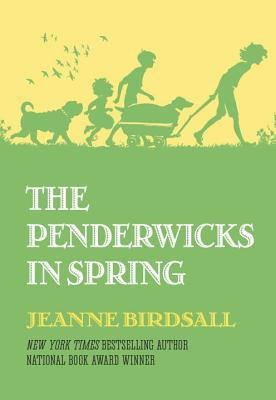
Middle Grade Review: Penderwicks in Spring

22693811 

Title: The Penderwicks in Spring
Author:  Jeanne Birdsall
Publisher: Alfred A. Knopf, 2015. 339 pages.
Source:   Library

Publisher's Summary:
Springtime is finally arriving on Gardam Street, and there are surprises in store for each member of the family. Some surprises are just wonderful, like neighbor Nick Geiger coming home from war. And some are ridiculous, like Batty's new dog-walking business. Batty is saving up her dog-walking money for an extra-special surprise for her family, which she plans to present on her upcoming birthday. But when some unwelcome surprises make themselves known, the best-laid plans fall apart.

My Review:
I have been following this series since I stumbled on the first book (published 2005) not long after the second was published (2007). We read the first book to our boys, and we all loved it. By the time I got the second book, the boys had moved on to other kinds of books, but I devoured it and waited with bated breath for the 3rd (2012). Now, at last, Ms. Birdsall has come out with a 4th book in the series, and we have to make some adjustments.

For three books, the focus was on the three oldest Penderwick sisters, who were just at the beginning of the teen years. Along the way, their long-widowed father remarries, but nothing much changes in the family from the reader's perspective. Now we have jumped ahead about 5 years, and our eyes and ears on the family are Batty's, with a bit of young Ben--the step-brother who joined the family when Mr. Penderwick married, and with whom the very young Batty of earlier books was much taken. (Note: it must be very strange for Ben, the lone male with 5 sisters).

The older girls still matter, and their stories are still important, but they are all filtered through Batty's perspective, and are secondary to her story. I had just finished listening to the audio of the first book, so I had a particularly hard time at first with the idea of Batty being nearly 11, and having the half-sophisticated reasoning skills of the child approaching her teens. She still feels younger than Jane feels in the first book, though they are the same age, though in many ways she is clearly mature and responsible (she is most like the Older Penderwick Sisters when caring for her 2-year-old sister).

I think each book has delved a little deeper into serious issues (the first one used the girls' motherless status more as a plot point than as something that matters; by the 3rd we are dealing with their best friend Jeffrey's abandonment by his father, a rift that is not handled tritely). Now we get to the full weight of the family history, and it is Batty who has to bear that weight, and the effect on her is profound, and depicted so well by the author that I could feel the weight of it myself while reading. The book still has much of the light and delightful feeling the first captured, but there are some real things going on here, and I'll not deny I shed some tears on Batty's behalf.

Ms. Birdsall tied up a lot of loose ends at the end, but I think not too much so to allow for a 5th book, which I dearly hope will not take her another 3 or 4 years to write.

Recommendation:
Read the series in order, but READ THE SERIES! Kids and adults. Just read it.
Full Disclosure: I checked The Penderwicks in Spring out of my library, and received nothing from the writer or publisher in exchange for my honest review.  The opinions expressed are my own and those of no one else.  I am disclosing this in accordance with the Federal Trade Commission's 16 CFR, Part 255: "Guides Concerning the Use of Endorsements and Testimonials in Advertising."

Wednesday, August 28, 2013

Middle Grade Fiction: Giving Kids Autonomy

As I have mentioned (since it sparked several reviews), there's been some discussion lately about missing and dead parents in Middle Grade fiction. I also recently did a post on books about boarding schools, and all this together has made me think about the importance of giving kids autonomy, both in books and in reality.

So this week I'm going to start a discussion about ways that authors give kids autonomy.  Next week I'll continue it with a discussion of what we parents do or should do to help our kids achieve some fraction of the level of self-sufficiency that the heroes of their books have.

 An obvious literary approach to getting parents out of the way is the orphan story.  That's easy.  No parents, lots of need to fend for yourself, especially in a historical or fantasy setting where there's no state structure to step in and offer substitutes (though given what I know of the foster system in my state, anyway, any kid who comes out of that with their head on straight and going in the right direction has plenty of gumption and self-sufficiency).

So if you don't want to kill off the parents, how else do you get the kids on their own?  There's boarding school (see last week's discussion, to which I now suddenly realize I should add Tamora Pierce's Tortall novels of Alanna and Keladry going through page training--if that isn't boarding school, I don't know what is.  Complete with strict adults who must be circumvented).  In many of the books I loved as a kid, parents simply gave kids carte blanche to roam, and they then could fall into adventures (think of Enid Blighton's "Famous Five).  This wasn't so far off reality back then; my brothers and I ran around in the woods and on the beach for hours at a time without checking in with parents.  In essence, the author (and the kids) can then just ignore the parents.

Historical fiction often makes more room for kids to be proactive and self-sufficient, as well.  That seems to have been reality.  Even little kids had chores and had to learn fast to do them themselves.

In one of my works in progress, I just made the main characters 16 or so, and put them on their own. Old enough to make it plausible, young enough that they don't have to do the adult love stuff (which I don't seem to want to write, and certainly not in a book aimed at kids).

And, of course, ultimately every kid is to some degree on her own in working out life's issues.  The bigger the issues, the more likely kids seem to be to keep them inside and try to go it alone.  So the parents can be right there and still the kids have to deal on their own.

Can you come up with any more approaches that writers use to make it plausible to have kids doing major (often adult-like) things?

Saturday, October 13, 2012

Book Review: Looking Back With a Smile

Looking Back With a Smile, by Edward Farber
Category: Memoir

Edward Farber's Looking Back with a Smile is a quick and fun read.  Mr. Farber has taken the idea of a memoir in a slightly different direction, not trying to create any particular significance out of his life, but looking back and picking out the bits that make him smile, and that he thinks would do the same for the reader.  The result is a rather episodic construction of a life lived through a good chunk of the 20th Century, both personal and nostalgic.

A quick and easy read at only 89 pages, LBWS offers both a fun glimpse into how our country was at different periods during the last 70 years, but also a reminder that we all have stories to tell.  That, in fact, is largely the point of the work: to share the little stories that otherwise get lost, and to encourage his readers to do the same, even if only to share with their families. 

In a way, what Mr. Farber has done reminds me of the NPR feature "Story Corps," where they get "ordinary" people to record conversations with a loved one, recalling some significant event or element of their history and relationship.  In the end, none of the people seem so ordinary after all.  The tone of the book is that of oral history, reminiscing around the fire on a winter night, and a reminder that all our lives are significant.

That the tone works is a tribute to Mr. Farber's skill in selecting and presenting the incidents he recounts.  Occasionally, I wish he'd tell a little more, follow up a bit on what happened next.  Most most of the time I could just smile and move on to the next little episode.  LBWS isn't great literature.  But it's a nice bit of entertainment you can read in an hour or so, or you can (as I did) dip into an episode or two at a time until suddenly you find yourself (alas) in the 21st Century.

I'll give Mr. Farber 4 stars, because he did what he set out to and did it well.