Showing posts with label knights. Show all posts

Wednesday, March 26, 2014

MG Classics: The Door in the Wall

Given my penchant for reading and re-reading books from my childhood and before, I have decided that I will label books in that category (and the reviews) as "Middle Grade Classics."  I'm rather arbitrarily putting in that category anything written before about 1970 (I could argue that the publication of The Outsiders in 1967 marked a significant change in children's lit, but that's a discussion for another time.  No doubt I'll have it).  The feature will run randomly (whenever I happen to have read a middle grade classic) and will just indicate in the post title that the book is old, dating back at least to my childhood (quiet about what that suggests, you in the back!).

###
72543

Title: The Door in the Wall, audio edition.
Author: Marguerite de Angeli
Publisher: Original:  Doubleday 1949 (128 pages).  I listened to the Listening Library edition from 2008
Newbery medal, 1949

Summary:
Set in Medieval England, this is the story of 10-year-old Robin, son of Sir John de Bureford, a knight in the service of the king.  Robin's parents have gone to serve the king and queen, and Robin is meant to go to learn to be a page, squire and knight (to be fostered--a common practice among the nobility in those times).  But plague strikes London, and when Robin becomes sick, even though it is not plague (my interpretation is polio), he finds himself left alone as servants flee or die.  Left unable to walk, he certainly can't go to learn to be a knight.  He is rescued by Brother Luke, who takes him to the monastery, nurses him, and begins to teach him.  Robin gradually regains strength, and eventually is able to go to the family friend who was to foster him.  There, he finds that he can do something heroic, even if he cannot walk well, and he learns the meaning of Luke's claim that "Thou has only to follow the wall far enough and there will be a door in it."

Review:
This book is definitely a product of its time.  By today's standards of writing, the story is "told" rather than shown, and the adventures feel calm and distant, even when Robin is undergoing real and present danger.  The writing style mimics something of the "high romance" tone (a 19th-century idea of what medieval writing would sound like; presumably this was developed by people who never read Chaucer), which I find kind of fun but would probably feel alien and static to modern children.

Oddly, despite the fact that so much happens in this book, and even listening to a dramatized version with music added (a nice touch, and the Listening Library audio is really well done), it feels very calm and uneventful.  Yet a number of things happen.  First, in the manner of children's books of the era, Robin goes from being focused on his misery to thinking about what he can do, rather than what he can't.  I am not sure he ever gets beyond thinking of himself, even when he saves the castle--he is thinking as much of how a knight's son ought to act and about making his father proud as he is about saving others--but he does learn to find his own place in the world.  And do any of us really stop thinking about ourselves first?

While the story is clearly dated, I think it still has something to offer, especially to those who don't want edge-of-your-seat suspense the whole way.  This is an adventure story you can read without fear, and a fairly good view into the medieval world, as well as a somewhat transparent lesson about making the best of what you have.

#

Full Disclosure: I borrowed  The Door in the Wall from my public library, and received nothing from the writer or publisher in exchange for my honest review.  The opinions expressed are my own and those of no one else.  I am disclosing this in accordance with the Federal Trade Commission's 16 CFR, Part 255: "Guides Concerning the Use of Endorsements and Testimonials in Advertising."

Wednesday, April 10, 2013

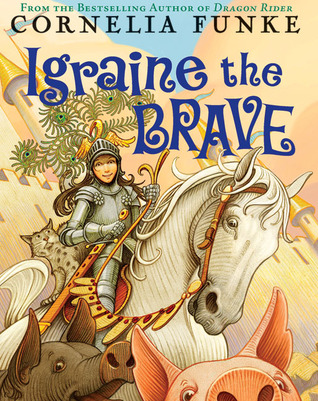
I: Igraine the Brave


Igraine the Brave
Back to the kids: Igraine the Brave, by Cornelia Funke


The only other book by Cornelia Funke that I have read is The Thief Lord, so I really wasn't expecting such a light-hearted romp as Igraine provides.  A somewhat tongue-in-cheek version of a knights-in-shining-armor tale, the book opens as Igraine is turning 12.  Though her parents and brothers are magicians, all Igraine wants is to be a knight, and for something exciting to happen.  By the end of the book, she certainly has gotten the second wish, and appears to be well on the way to getting the first.

The castle is threatened by a nefarious knight, the neighbor's nephew wants to steal their magic books, and her parents render themselves unable to protect the castle through a small magical accident.  Only Igraine can save the day, with a little help from her friends, old and new.

A quick, fun read, Igraine should appeal to readers from 8 or 9 up (occasional big words might give pause, but the writing is essentially simple and the story clean and not terribly tense).  Girls will appreciate the heroine who isn't willing to let her gender dictate her choices (nor her family--everyone else may be a magician, but she is going to be a knight, thank you very much).  And before she has finished, she has proven her courage, saved the castle, and become squire to the knight who has helped her.  And her parents have been disenchanted so that all can live happily ever after.

The intricate pen-and-ink drawings that illustrate the book add a final delightful touch. 
4.5 stars.

Wednesday, January 9, 2013

Book Review: Knight's Fee

Knight's Fee, by Rosemary Sutcliff. First published 1960

Here I am again, reviewing a book written before I was born. This book was another of my finds via 1001 Children's Books You Must Read Before You Grow Up. [NB: I continue to assume that I am not yet grown up, let alone old, despite evidence suggesting otherwise].  I find that I have read many of the more recent books suggested there, at least ones of the sort that interest me, because I have been working at the library for over ten years, and tend to read books as  they come in to the library.  Many others I read in my childhood. But the local library was small when I was a kid, and options were limited. Knight's Fee is another of those that I never saw when I was young.

Knight's Fee is set a scant generation after the Norman Conquest of England (1066, for any of you who haven't reached that point in your history classes yet). Randal, the protagonist, is the orphaned child of a Breton soldier and Saxon (i.e local) woman. He has no family nor is he of anything like noble blood. But by a series of chances, at age 10 he is taken from his job as dog boy and becomes the companion of Bevis d'Aguillon, Norman heir of a small English manor.

Randal's rise from lowest of the low to varlet (I think I would have said "page") and then Squire would be unbelievable, except that Sutcliff somehow makes it both inevitable and yet clearly a matter of great chance, a bit of luck the boy never forgets. Nor does Sufcliff hold back on the foreshadowing. From his first arrival at the holding of Dean (the d'Aguillon home), his sense of coming home is coupled with a sense of inevitable loss.  We know this isn't going to end well for everyone.

Nor is Randal very old before a chance over-hearing leads him to make an enemy whose prediction--that he "one day will weep blood for this"--is kept close to the reader's mind as events unfold. Randal grows and becomes a squire; Bevis becomes a knight, as Randal, being poor and landless, cannot.

The conclusion is no surprise, but it is not disappointing. How Randal rises to meet each challenge, how he faces loss and gain, is really what makes the book. He could continue to always be a kennel-slave who happened to get away from it. But instead he truly becomes the knight and the lord when it is thrust upon him.

The style of the book is, as expected from something written more than 50 years ago, a bit dated. It won't read to a modern kid like they are used to (though I have trouble putting my finger on the difference--something of tone and style), and you don't end up as far inside Randal's head as we are accustomed to do with characters today. But for all that, the story is very satisfying, and presents a period of history, its people and politics, in a well-researched manner without ever seeming to be anything but a good story.  Writing and editing are top-notch, and vocabulary does not talk  down to the young reader.

Five Stars.