Showing posts with label war. Show all posts

Wednesday, July 8, 2020

Non-fiction Review: The Winter Army

https://i.gr-assets.com/images/S/compressed.photo.goodreads.com/books/1574072728l/48853749._SX318_.jpg

Title: The Winter Army: The World War II Odyssey of the 10th Mountain Division, America's Elite Alpine Warriors
Author: Maurie Isserman. Narrated by Brian Troxell
Publication Info: Audible Audio, 2019. Hardcover 2019 by Houghton Mifflin Harcourt, 336 pages
Source: Library digital resoures
 
Publisher's Blurb/Goodreads:
The epic story of the U.S. Army’s 10th Mountain Division, whose elite soldiers broke the last line of German defenses in Italy’s mountains in 1945, spearheading the Allied advance to the Alps and final victory.

At the start of World War II, the US Army had two cavalry divisions—and no mountain troops. The German Wehrmacht, in contrast, had many well-trained and battle-hardened mountain divisions, some of whom by 1943 blocked the Allied advance in the Italian campaign. Starting from scratch, the US Army developed a unique military fighting force, the 10th Mountain Division, drawn from the ranks of civilian skiers, mountaineers, and others with outdoor experience. The resulting mix of Ivy League students, park rangers, Olympic skiers, and European refugees formed the first specialized alpine fighting force in US history. By the time it deployed to Italy at the beginning of 1945, this ragtag group had coalesced into a tight-knit unit. In the months that followed, at a terrible cost, they spearheaded the Allied drive in Italy to final victory.


Ranging from the ski slopes of Colorado to the towering cliffs of the Italian Alps, The Winter Army is a saga of an unlikely band of soldiers forged in the heat of combat into a brotherhood whose legacy lives on in US mountain fighters to this day.

My Review: 
I’m a sucker for interesting books about bits of WWII, as well as for books about mountaineering and outdoor adventures, so of course I had to check this one out. I got the audiobook from my library, and enjoyed it, but didn’t find it as compelling as I expected. The story is well-written, and many of the players are familiar: David Brower (Sierra Club), Fred Beckey (who wrote THE mountaineering guides to the Cascades), and a couple of other names I knew all showed up on the roster of the 10th Mountain Division.


What held it back was in part how much of the book was about the drive to create the force, and the initial struggles to get it going. The other disappointment was finding out just how little of their mountain training they ended up using. I knew about the elite mountain troops, and somehow I had thought they got to prove that their training and expertise were worth it. Instead, they had very little opportunity to do so, though they fought valiantly and well when they got to Italy, and played no small role in the Allied victory there. They just didn't get to do it on skis.


Reality interfered with a great story, and left us with a very good story, well told. This was an unusual bunch of men, many of whom chose to serve as enlisted men in the 10th rather than as officers elsewhere. They deserve their own chapter in the history books, and I am glad to have read it. Kudos to the narrator as well, for an excellent delivery that never called attention to itself.


My Recommendation:

Another worthwhile chapter for those interested in those who fought WWII, and how they did it, with a bonus for the skiing and mountaineering.


FTC Disclosure: I checked The Winter Army out of my library, and received nothing from the writer or publisher for my honest review. The opinions expressed are my own and those of no one else. I am disclosing this in accordance with the Federal Trade Commission's 16 CFR, Part 255: "Guides Concerning the Use of Endorsements and Testimonials in Advertising." 

Monday, January 6, 2020

Middle Grade Monday: Nowhere Boy (audio book)

36717949 


Title: Nowhere Boy
Author: Katherine Marsh
Publication Info: 2018, Listening Library. Hardback published 2018, Roaring Brook Press, 368 pages.
Source: Library digital resources

Publisher's Blurb:
Fourteen-year-old Ahmed is stuck in a city that wants nothing to do with him. Newly arrived in Brussels, Belgium, Ahmed fled a life of uncertainty and suffering in Aleppo, Syria, only to lose his father on the perilous journey to the shores of Europe. Now Ahmed’s struggling to get by on his own, but with no one left to trust and nowhere to go, he’s starting to lose hope.

Then he meets Max, a thirteen-year-old American boy from Washington, D.C. Lonely and homesick, Max is struggling at his new school and just can’t seem to do anything right. But with one startling discovery, Max and Ahmed’s lives collide and a friendship begins to grow. Together, Max and Ahmed will defy the odds, learning from each other what it means to be brave and how hope can change your destiny.

Set against the backdrop of the Syrian refugee crisis, award-winning author of Jepp, Who Defied the Stars Katherine Marsh delivers a gripping, heartwarming story of resilience, friendship and everyday heroes. Barbara O'Connor, author of Wish and Wonderland, says "Move Nowhere Boy to the top of your to-be-read pile immediately."
 

My Review:  
Another of my impulse-borrows, I stuck this on my phone and started listening without a lot of thought. I was intrigued by the premise: the unhappy American boy and the refugee, both lost and out of place, and wondered how the author was going to pull it off. Soon, I couldn't stop listening.

At the start, Max's story reads like so many middle-grade misfit stories. He's unhappy about the move to Brussels (for which I kinda wanted to dope-slap him, because--living abroad!), and no one understands him. Literally, since he's attending a regular public school despite knowing no French. It feels almost trivial.

The contrast with Ahmed's story is so stark as to make me wonder, at first, if this could work. The cover illustration captures that perfectly: one boy living in sunshine and color and whining about it, and the other living in a grey world and trying not to despair. What impressed me was the way the author gradually brings those worlds together, never losing sight of the fact that Ahmed's world is not, and cannot be, like Max's, but allowing them to at least share some overlap. Some aspects of the way the story works out felt a little unreal and forced, but I appreciated that there was a lot of hope offered in the end, and Marsh manages to make it believable.

The audio narration was not bad, but I was bothered by the use of a French accent to depict passages where people were meant to be speaking in French. It felt wrong, because of course they were NOT speaking with an accent; they were speaking their native language. For some reason that bugged me. On the other hand, the frequent insertion of bits of French into the dialog were kind of fun, and hearing those aloud brought back my own French studies.

My Recommendation:
This is a thought-provoking story about friendship as well as about the treatment of Syrian refugees--and maybe other migrants seeking safety and a better life in other parts of the world? The book is well worth reading, however you do it. Suitable for children 9 and up. There are some distressing bits relating to war and terrorism, as well as the deaths of family members.


FTC Disclosure: I checked Nowhere Boy out of my library, and received nothing from the writer or publisher for my honest review. The opinions expressed are my own and those of no one else. I am disclosing this in accordance with the Federal Trade Commission's 16 CFR, Part 255: "Guides Concerning the Use of Endorsements and Testimonials in Advertising."  

Wednesday, October 26, 2016

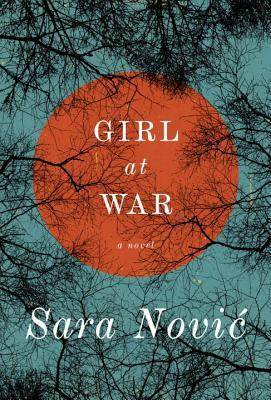
Fiction Review: Girl at War, by Sara Novic

23209971 


Title: Girl at War
Author: Sara Nović

Publisher: Random House, 2015. 316 pages
Source: Library

Publisher's Summary: 
Zagreb, summer of 1991. Ten-year-old Ana Jurić is a carefree tomboy who runs the streets of Croatia's capital with her best friend, Luka, takes care of her baby sister, Rahela, and idolizes her father. But as civil war breaks out across Yugoslavia, soccer games and school lessons are supplanted by sniper fire and air raid drills. When tragedy suddenly strikes, Ana is lost to a world of guerilla warfare and child soldiers; a daring escape plan to America becomes her only chance for survival.

Ten years later Ana is a college student in New York. She's been hiding her past from her boyfriend, her friends, and most especially herself. Haunted by the events that forever changed her family, she returns alone to Croatia, where she must rediscover the place that was once her home and search for the ghosts of those she's lost.


My Review:
This is an ambitious book, and for the most part, I think it does its job well. The author is writing historical fiction, but from a near-history that is still a part of the lives of most living people. She is also taking something that happened "over there" and bringing it home to the reader as you realize that the people in this war story aren't in any significant way different from us (they weren't "long ago" or in a 3rd-world country where we can convince ourselves that "things are different there"). That, combined with the fact that the main character is only a child during the war, brings it home to the reader in a powerful way. 

The structure is challenging for the author: roughly half the book is set during the war, when Ana is 10. The rest is a decade later, and Ana has a completely different life. The author resists the temptation to swap  back and forth constantly. Instead, the first 1/3rd to 1/2 of the book is set in the earlier period, with a few flashbacks in the second half as Ana slowly fills in the parts that are missing between her tragedy and her relocation to America. That works well, I think, and allows the reader to really engage with the young Ana (making the shock of the war all the greater), while also keeping us engaged as she slowly fills in the final links that help us understand Ana's trauma and inability to settle into her American life. The cognitive dissonance of her own life is reflected well in the contrast between New York and her return to Zagreb.

Recommendation:
I didn't think this was a perfect book, but it was a very good one, and I think well worth reading for a clearer understanding of a war that was pretty distant to most of us.

FTC Disclosure: I checked Girl at War out of my library, and received nothing from the writer or publisher in exchange for my honest review.  The opinions expressed are my own and those of no one else.  I am disclosing this in accordance with the Federal Trade Commission's 16 CFR, Part 255: "Guides Concerning the Use of Endorsements and Testimonials in Advertising." 

Thursday, April 21, 2016

Friday Flash: The Present Will Be Infernal

It was a random title draw at Terribleminds.com this week, but I confess I simply picked the title I liked best. For your reading pleasure, 997 words.

The Present Will be Infernal

That was what the prophecy said: “The present will be infernal.” My Da always added, “and the past and future don’t look so good either.”

Most of our suffering was on account of the war. Anytime we managed to get some small crop, seemed like either an army came along and requisitioned the whole thing, or two armies came along and held a battle atop our fields, trampling them to mudholes.

Corpses don’t make for good fertilizer, at least not right away.

Our village always managed to just scrape by, but it wasn’t pretty. That explained Da’s take on past and present. As for the future—our village won’t have one. The armies took our young men. They’d always taken some, the ones who itched to get out, or who thought they wanted an adventure. But this time, King Tellert declared a muster, and claimed every male of fighting age. He defined “fighting age” pretty broadly. I wept when my Da left, side by side with my brother.

The chances were slim that we would meet again, in this world or any other.

When we all got over our shock at losing sons and brothers and husbands, and any men we might have courted, we realized the future was gone too. With only a few young brides, none of them in the family way, our village was doomed.  No men, no babies. No babies, no future. With the war raging by, it’s hell now, but soon enough it’ll be…nothing.

“There’s only one thing to do.” Our headman, Balthazar, could barely stand, but we paid attention. If we didn’t, he could still swing that cane he leaned on. “We must leave. Find a new home with another village.”

“What?”
“Give up?”
“How could we survive?” 

“Silence!” Balthazar’s voice cut through the babble of frightened women and elders. “Leave, or stay here and die slowly. Each of you,” he looked from face to frightened face, “must make that decision for yourself.” Silence fell as women realized they must decide alone. In a handful of cases, they had to decide for children, though those were precious few. Not many youngsters were born to our war-trampled village, and fewer survived infancy. They turned to each other, bewildered.

I turned to no one.  Da and Paulo had been my only kin. If they lived, they would know of nowhere to find me but our village. I didn’t know what to think. We had already lost everything to the infernal past and present, and now the future passed out of reach.

Balthazar had one more thing to say. “I will not go. I cannot walk so far.” Voices interrupted to clamor that they would carry him, but we all knew that was a lie. Several ancient men and women hobbled to his side. “We will wait together,” Granny Teela said in her cracked voice. She didn’t say what they would wait for. She didn’t have to.

“Who will protect us on the road?” The woman who asked that wept as she clutched the hand of her young daughter.

Sheena stepped forward at the head of a half a dozen women of our age. Two men, too old for the army but still able to wield a spear, joined them. “We will guard.” Sheena looked at me, questioning.

I shook my head, and looked at the cluster of our eldest elders. My path was clear.

“I will stay. The elders will need someone who can bring water and cook.” And, I did not say aloud, fight. The present might be infernal, but I would not see these elders into hell without a fight.

“Alone?” Sheena didn’t bother saying I would be little use. I shrugged.

“You will need all the arms you can get to survive your trip. I have no family. I will stay.” I knew what I was saying, and Sheena met my eyes with a look of pity and respect mingled. She knew, too.

#

Seven of us stood in a silent cluster and watched the ragged column of our past and future shuffle away into the distance. Since the army had taken all our draft animals, and even the goats, the women were bowed under burdens far beyond their strength.

When they had passed out of sight, I limped to the well and drew a bucket of water. The elders went into the village hall, where people had placed many of the things they could not take: the best beds, food, enough to last out our short lives. I collected bows, spears, and even a couple of swords that the men had left behind when taken off by the army.

I would face hell with a full armory and with a full belly.

#

When the army came, they marveled that the village was silent and still, save for a single line of smoke from a single chimney.

I stood in the doorway and watched the long columns approach. This wasn’t the army that had taken Da and Paulo. Thus my last hope fled. I would die alone. I touched my sword, and clutched the spear in my left hand. Beside me, four bows thrust through the arrow slits, but the arms that wielded those bows were weak and wasted.

“There is nothing here for you,” I called out to the soldiers. “We are the remnant of a dead village. Ride on.”

Their general threw back his head and laughed. “Ride on? Why not take what we might, and kill those who remain?”

“Why not indeed? Though you will find little enough to take, and why kill those who are already on the brink of another world?”

My people came from the shadows to stand beside me, and the man stared.

“It is as you say,” he marveled. “Only the old and dying, and guarded by a girl-child with a crooked leg.” He turned his column and they marched away.

The present would remain infernal.

©Rebecca M. Douglass, 2016

Wednesday, November 11, 2015

Armistice Day

November 11 is honored in the US as Veteran's Day, but as I am fairly fascinated by WWI and have been researching the period for years, I'm taking it back several decades to talk about Armistice Day. I am fascinated by the histories of our wars, and horrified that these things happened, and continue to happen.

Today, at 11:11 a.m. on 11/11, we mark the end of WWI. The treaty negotiated to end the war stipulated that hour, and though many stopped fighting once the treaty was signed, there were shots exchanged, and men killed, up until the minute. I know that the hour was on European time, but I will mark it where I am.

Of course, this is now a day to mark the efforts and sacrifices of everyone who fought and labored in all our wars, good, bad and indifferent (make your own judgements as to which were which. It often depended on where you were standing). And let's not forget the non-combatants.

In WWI, my grandfather was rejected from the army because he had a faulty heart. He nonetheless dropped out of college and served as a chaplain through the YMCA. (This sacrifice of a few years allowed him to return to college just in time to meet my Grandmother, whom he would otherwise never have known...).

 In WWII, members of the US Merchant Marine (i.e. sailors on commercial cargo vessels) had casualty rates exceeded only by those of the US Marine Corps. With limited to non-existent ability to shoot back, they braved hostile seas to carry supplies where they were needed.

In every war, people left behind are also making sacrifices, of pieces of their lives, of the lives of their loved ones. On this day, we can honor them all. Then we can work to put an end to the wars. After all, Armistice Day was meant to celebrate the end of the War to End All Wars.

Thursday, October 16, 2014

Friday Flash Fiction: Crow Egg

First, and most important: Jemima Pett has unraveled all the dastardly deeds in our serial mystery, "Half a Clue." If you haven't been following along, the rest of the story is collected here.


Now, for my story. This week's Chuck Wendig Terribleminds.com challenge was pretty simple. We were supposed to pick three names of types of apples from a list, and use them in some way in our story, as apples or just as weird word combos. Naturally, I read it in a tearing hurry and didn't get it right. Instead, I selected just one and used it as the title of my story. Close enough, since no one is grading us. Are they? Hope I'm not going to get sent to the principal's office again!


Crow Egg


Claire sat under a tree in the middle of the orchard, throwing hard, tiny apples at the tree trunks. The apples were the extras, the ones the trees shed because they couldn’t grow so many on one branch. The small missiles thwapped against the tree-trunks like little bullets.

Claire could throw, as she could do so many things, because of her brother Jim. Jim had mostly taught her to throw by mocking her attempts until she mastered the art. It had taken a lot of watching him play baseball to figure out what she was doing wrong, and still longer to learn to do it the right way, but she’d done it so she could finally hear Jim say, “Good pitch, Sis. You’ve sure gotten over throwing like a girl.” Claire refused to say she was learning to throw “like a boy.” Throwing with power and accuracy was just throwing well, not like a boy.

Ping! She nailed another tree. Splat! That one had been half rotten, and spattered satisfyingly when it hit the gnarled trunk. Claire didn’t feel satisfied.

Claire was sitting in the orchard because Jim was gone. For all her 12 years, he had been there, teasing her, fighting with her, and teaching her how to live. Now he had gone off to fight in the War, and everyone said what a wonderful thing that was. Everyone but Claire.

Well, everyone but Claire and her Dad. He had refused to say a word against Jim’s going, but she knew when he was unhappy by the tight look on his face. That look had come onto his face when Jim announced he was enlisting, and it never left anymore.

To make matters worse, Claire and her father were both realizing that it had been Jim who had raised her, in his own boyish way. Their mother had died of the ’flu when Claire was a baby, but thanks to her brother she’d never missed having a mother. Until now. Now she not only had no one to teach her to be a girl, at an age when she was beginning to realize it might be a good thing to learn, but she had no one to teach her to be a tomboy, either. No one to admire her for hitting every tree she aimed at, and no one to scold her for getting grass stains on her Sunday dress from climbing trees after church. Dad never noticed.

Claire heard her father call from the house, and climbed to her feet. She took her time brushing the dirt and grass from the overalls she wore everywhere but school and church, knowing that the dinner he called her to would be poor, their time together strained. Without Jim, neither of them new how to talk about missing Jim.

She paused beneath the tallest tree in the orchard—the only one that wasn’t an apple tree—and peered up through the branches. Father had never been willing to cut down the huge old pine, and at the very top there was always a crow’s nest. Every year Claire vowed she would climb up and look into it, as Jim had done. She never had done it. Not yet.

#
When the telegram arrived, only weeks after Jim had gone into the trenches, Claire knew the world had ended. Everyone knew what it meant when you got a telegram, if you had a boy at the Front. She didn’t even stay to see Dad open it, and she didn’t stop to hear the delivery boy’s sympathy. He’d known Jim at school, so he meant it. But he’d said the same words to so many families.

Claire fled to the orchard, to the trees. She stopped beneath the old pine, and began to climb.

Claire didn’t stop until she reached the top, and could see into the crow’s nest. The bird was away, stealing apples or eating worms. She looked at the nest, a mix of old weaving and new, and far larger than seemed necessary for the single egg that lay there. The egg was smaller than she’d expected, to hold all that potential life. Life like the one Jim wouldn’t get to have now.

Suddenly she hated the crow, hated the egg, hated those lives that went on while Jim’s—and hers—ended. She reached out with one hand, clinging to her perch with the other, and snatched up the egg. It was warm, and smooth, and harder than she’d expected to crush. She shifted her fingers and squeezed again, and felt the sharp shards of shell cut her hand, the warm liquid pour through her grip. She dropped it, and saw the tiny, unformed crow she had killed, and began to cry, even as she heard her father’s voice calling her name.

He didn’t sound right. He didn’t sound heartbroken. He sounded elated. Her head spun. “Claire! He’s coming home! He’s wounded, but he’s alive and he’s coming home!”

Uncomprehending, she stared at the bird she had killed, at the agitated crow now circling her head.

“I’m sorry,” she whispered to both, and began the long climb down.

###

©Rebecca M. Douglass

Monday, July 21, 2014

Non-fiction Review: The World Until Yesterday

17707587


Title: The World Until Yesterday: What Can We Learn from Traditional Societies?
Author: Jared Diamond
Publisher: Penguin Books, 2012.  512 pages
Source: I bought it for my brother and then kept it, as he'd already gotten it.  Some people are impossible to buy for!

Review:
I like non-fiction, if it's well-written and engaging, and I particularly like history.  You've probably noticed I like books about adventures and adventurers.  And so far, I've mostly liked Jared Diamond's thought-provoking works that delve into history in search of better understanding of how societies work (and don't work).  But I have to admit that The World Until Yesterday, while containing much that was of interest, just didn't grip me (note that it sat on my "currently reading" shelf for months).

The book is a study of traditional societies and what we can learn from them in several key areas: War (and peaceful relations), treatment of young and old (think child-rearing issues), understanding and responding to danger, and a final section on Religion, Language and Health.  The idea is good, but for me, the execution was somehow lacking.  The book lacked the compelling narrative force that I found in, for example, Guns, Germs, and Steel or Collapse.

 As I considered why I felt that way, I realized that I had very different reactions to different parts of the book, so that was one clue: the book doesn't feel as unified as his other books.  It seems like it lacks a clear destination, as it were.  But maybe I also found some areas more relevant than others.

The opening section on War took a long time to get through, in large part because I felt like there was less to learn there.  That might not be fair--Diamond talks about the societies that have strong forces for mediation and negotiation, just because they understand that the consequences of carrying even minor disputes to their extremes can be year or generations of blood feuds.  We can definitely learn from that, though it has to be approached very differently in a modern society.

I was more interested in the section on child-rearing, because I'm pretty sure that our standard 21st-Century US approach isn't very good (this includes my own, by the way, though I have tried to replicate some of the feral childhood I enjoyed).  The discussion of treatment of the elderly, on the other hand, was more of an explanation of why some societies reject and even kill their old people while others treasure and revere them.  Of course we can't help noticing that we're created a society that doesn't have much room for the old, especially the old and poor or those too old to do much of anything.

Tied closely to both war/violence and treatment of the young and old is the section on responses to danger.  Again, there are good points here, and the anecdotes Diamond uses to support them make for interesting reading.  Many of us are very aware that our US society has a lot of trouble recognizing real danger, so that we take no end of precautions to prevent our children from being snatched from the street by strangers (highly unlikely), then feed them snacks loaded with sugar, fat, and salt (risk factors for diseases that are really horrible and very real dangers). 

The discussion of religion was interesting, because I never thought of religion in quite those terms before (the evolutionary advantage of religion?  How did irrational mystical beliefs ever come into being?).  I could recommend this section for anyone who sometimes thinks about things like that.

Finally, the section on heath and nutrition felt obvious and superficial.  We know that stuff about diet, and while I was interested in the added understanding for why traditional people are so subject obesity and related diseases when exposed to a Western lifestyle, the discussion of nutrition and healthy eating would probably better be left to an expert in that field.

Ultimately, I thought that Diamond made some good points, shared some interesting history and anthropological insights, but that the point of the book could well have been conveyed in a more concise fashion.  It almost felt at times as though the author had some really cool bits of history and stories that he wanted to share, and had to hunt for a framework to hang them on.  I still think it's a useful book, and Diamond writes well.  But it does not measure up to the others of his books that I've read.

Recommendation:
For those who really like Diamond's work, or who have a special interest in traditional societies.  For others, I'd recommend rooting around in it for the parts that interest you, and not sweating reading the whole thing. 

Full Disclosure: I purchased my copy of The World Until Yesterday, and received nothing from the writer or publisher in exchange for my honest review.  The opinions expressed are my own and those of no one else.  I am disclosing this in accordance with the Federal Trade Commission's 16 CFR, Part 255: "Guides Concerning the Use of Endorsements and Testimonials in Advertising." 

Saturday, November 30, 2013

Flash Fiction Friday: Dragonmistress

What's that?  You say it's Saturday?  Quiet, you!  I must've lost a day in there.  Probably was attacking that turkey for 24 hours straight.

We'll just pretend it's Friday, okay?  Okay.  So here's the story.  I borrowed another line from the Wendig first line challenge of a couple of weeks ago.  I took my first line from the contribution of Bookewyrme.

Here is. . .

Dragonmistress


Dragonmistress
(Wendig opening line challenge).

She rode in on a dragon; or more accurately, clutched in its front claw.  It wasn’t exactly the entrance she’d planned, but it had turned out to be impossible to ride astride the dragon as Korrina believed the riders of old had done.  Most of the desired effect: the populace gaped in awe and wonder anyway.

Of course, they could barely see beyond Skyborne, the dragon, and when they did spot the woman in the grip of the beast, many probably thought that Korrina was not Dragonmistress, but dragon dinner. 

Dragons were big.  Far bigger than any remembered or imagined.  So much dragon lore had been lost in the centuries since the last Dragonmistress rode a dragon through the skies over their village.  No one even knew what made a woman become a Dragonmistress—Korrina only knew that, from birth, she had been pulled to the land of the dragons, and at last she had gone.

Now she had returned, in the grip of an immense dragon.  It wasn’t just the size that had prevented mounting it, however.  The neck ridge was impossibly sharp, and spiked.  Skyborne had not known, any more than Korrina, how the Riders of old had done it.  They had tried no end of ideas, with no end of unhelpful suggestions from the younger dragons—there were none older—but ended up with Skyborne picking Korrina up in her huge claw and flying her back to the village.

It wasn’t ideal, but Korrina told herself that didn’t matter.  She was, at least, alive, and had succeeded in partnering a dragon, just the way the old songs told it.  Though the old songs made the creatures seem more war-like and less . . . prickly.  The songs had definitely said nothing about prickles.

For all that, here she came with a dragon to save the village.  It would have been easier had the villagers not screamed and fled as they approached.  Skyborne circled the village lazily a time or two before landing in the square.  People scattered in all directions as they came down, and did not approach even when Korrina hopped down from the claw and shook out her tunic, which had become a bit rumpled on the flight.

“You stay here,” she instructed the dragon unnecessarily.  There was no place for her to go.  “I’m going to gather the leaders and make a plan.”

She was also going to send old Tomin into the oldest archives in search of the answer to how a Dragonmistress properly rode a dragon, and what kind of saddle she used.

Skyborne lowered her huge head and licked Korrina’s face.  “Stop that!” the girl sputtered, half drowned.  A dragon had a big tongue.  A very big, very wet, tongue.

But I love you, Skyborne protested.  It is how a dragon shows love.

“We’ll have to work on that,” Korrina said.  “I could have drowned.”  But her mind had moved on, thinking about what they had seen from the air.  What was drawing ever nearer over the hills to the south.  The barbarian army.

If she and Skyborne did not find a way to defeat them, the village was doomed.  And a dragon might not be enough.  To Korrina’s surprise, she’d learned that dragons, beyond claws and teeth meant for hunting deer and sheep, were short on weaponry.  Especially, she had found the whole fire-breathing thing to be a myth.  The gods knew how that had begun, but it was a pity it wasn’t true.  They could have used some fire-breathing.

But one thing Skyborne had given to Korrina: the respect of the Elders.  They listened to her warning, and they listened to her plan.  She gave them no chance to do anything else.  Then she held her breath.

“We must do what?” protested the Headman, a supercilious man with too much nose.  “Will you not lead a flock of dragons to burn our enemies out of existence?”

“No.  I will not.”  Korrina didn’t explain that there were no other dragons old enough to come, or that none would come without riders.  Nor did she say that they didn’t breathe fire in any case.  She just said, “We’ll do it this way or not at all.  If you don’t want my help, and that of Skyborne, we can leave.”  That got their attention, and within an hour every able-bodied man or woman was at work, digging pits across the neck of open land that led to the village.

Korrina had Skyborne take her up again to view the situation, though old Tomin hadn’t yet found out how the Dragonmistresses of old had ridden.  The claw was not uncomfortable, though it put her too far from the dragon’s ear to make for easy conversation.  That is, Skyborne could not hear her, unless she shouted.  She heard the dragon inside her own head, no matter where they were.

By the end of the second day, the pits were dug, spiked, and covered.  And Tomin had found an ancient drawing of a rider perched high on the neck of a dragon.  It didn’t show exactly what the saddle was like, but Korrina knew it must be well-padded and thick, to conform to and smooth out the spikes.  She set the women to work making one.

By the fourth evening, the barbarians spread their camp across the open land before them, and the light of a hundred fires made the hills glow.  The villagers blessed the cliffs that surrounded them on three sides, but worried as fire after fire sprang to life.

Korrina refused to fly out with Skyborne that night to survey the camps.  They would do what they must, she said, when the time came.  Also, when she had a saddle, though she didn’t mention that.  It was nearly ready.

The village would be saved.

The Dragonmistress would see to that.

Monday, November 18, 2013

Book Reivew: Battle Magic

8306725 

Title: Battle Magic, by Tamora Pierce, 440 pages
Publisher: Scholastic, 2013

Summary:
Although it is listed as the third book in "The Circle Reforged" series, Battle Magic actually takes place before either The Will of the Empress or Melting Stones.  It is the hinted-at tale of the difficulties Briar, his teacher Rosethorn, and his student Evvy experienced on their travels.  As the title suggests, this is a book about the mages at war, and what they will do when pushed.  Taken from their visit to the small, rather Tibet-like kingdom of Gyongxe by an invitation to visit the gardens of the emperor of Yanjing, the three discover an empire prepared for massive war.  When they leave, they find that the war has already been launched--against Gyongxe.  With the main temple of Rosethorne's religion located there, she has no question about her duty--and the young mages won't leave her.  Thus are all three thrust into the middle of epic battles and a struggle of good and evil.

Review:
First things first.  I've already mentioned that this is not really part of a series, the way most of Pierce's books are (she's been writing longer and longer books so I guess the whole story can go in one, so the last few have been free-standing though still using familiar characters).  I want to also mention that there's a reason I'm not reviewing this on my KidLit day, and that's because to my mind it's well beyond Middle Grade and definitely into Young Adult territory (as in fact I think many of her books are, as the characters move out of childhood and deal with adult issues, including sex).

Now before I can go on with my review I'm going to have to talk about sex, violence, and kids' books.  I want to be clear: I think that the way Pierce handles sex and violence is really, really good.  And starting from maybe age 12 or 13, I think most of her books offer some really good ways to think about real issues that real kids do think about.  But not in grade school.

That said: in this book there is no explicit sex.  There are a few subtle hints of sexual violence, and at least one consensual couple going off into the dark together (they are definitely adults, and who cares if they do it?), but it's all handled in ways that wouldn't bother me for the 9-12 set.  The real thing that gave me pause was the violence.  Rather, the war.  To be sure, it's not generally super graphic, but I was left with images in my head (as were Briart, Evvy and Rosethorn) that I hope will fade fairly soon.  Maybe a bit much for kids.  I am aware that there are a number of books in the Juvenile section of our library that deal with war, real and imagined, in ways as graphic or more so.  I wonder about them, too, sometimes.  It's a choice for a parent to make, I think.

So, taking the book as it is, and leaving aside the question of whether it's really Juvvy lit, I have to say I was totally caught up in the story.  Tamora Pierce is a wonderful storyteller, and not only are we pre-disposed to care about the main characters, she continues to develop them in ways that make them human and interesting.  If I have any criticisms, it would be that the story felt a little one-dimensional.  The war absorbed everything.  Having written that, it sounds stupid: war does have a way of doing that.  But seriously, I think more needed to happen inside the characters, or something, because it just felt. . . thin.  I am not sure that a person who came to this without having read the other books in the series would either follow it as well or care as much.

On reflection, maybe what it felt like was a book that wanted to be adult, and really dive into what was going on as an adult, but kept holding back because it's supposed to be for kids.  That's a tough place for an author to be.  And the bottom line?  Whatever criticism I might have in the cold light of day, I sat up very late reading this two or three nights in a row, because darn it, it's a good story!


Wednesday, January 9, 2013

Book Review: Knight's Fee

Knight's Fee, by Rosemary Sutcliff. First published 1960

Here I am again, reviewing a book written before I was born. This book was another of my finds via 1001 Children's Books You Must Read Before You Grow Up. [NB: I continue to assume that I am not yet grown up, let alone old, despite evidence suggesting otherwise].  I find that I have read many of the more recent books suggested there, at least ones of the sort that interest me, because I have been working at the library for over ten years, and tend to read books as  they come in to the library.  Many others I read in my childhood. But the local library was small when I was a kid, and options were limited. Knight's Fee is another of those that I never saw when I was young.

Knight's Fee is set a scant generation after the Norman Conquest of England (1066, for any of you who haven't reached that point in your history classes yet). Randal, the protagonist, is the orphaned child of a Breton soldier and Saxon (i.e local) woman. He has no family nor is he of anything like noble blood. But by a series of chances, at age 10 he is taken from his job as dog boy and becomes the companion of Bevis d'Aguillon, Norman heir of a small English manor.

Randal's rise from lowest of the low to varlet (I think I would have said "page") and then Squire would be unbelievable, except that Sutcliff somehow makes it both inevitable and yet clearly a matter of great chance, a bit of luck the boy never forgets. Nor does Sufcliff hold back on the foreshadowing. From his first arrival at the holding of Dean (the d'Aguillon home), his sense of coming home is coupled with a sense of inevitable loss.  We know this isn't going to end well for everyone.

Nor is Randal very old before a chance over-hearing leads him to make an enemy whose prediction--that he "one day will weep blood for this"--is kept close to the reader's mind as events unfold. Randal grows and becomes a squire; Bevis becomes a knight, as Randal, being poor and landless, cannot.

The conclusion is no surprise, but it is not disappointing. How Randal rises to meet each challenge, how he faces loss and gain, is really what makes the book. He could continue to always be a kennel-slave who happened to get away from it. But instead he truly becomes the knight and the lord when it is thrust upon him.

The style of the book is, as expected from something written more than 50 years ago, a bit dated. It won't read to a modern kid like they are used to (though I have trouble putting my finger on the difference--something of tone and style), and you don't end up as far inside Randal's head as we are accustomed to do with characters today. But for all that, the story is very satisfying, and presents a period of history, its people and politics, in a well-researched manner without ever seeming to be anything but a good story.  Writing and editing are top-notch, and vocabulary does not talk  down to the young reader.

Five Stars.