Showing posts with label review. Show all posts

Monday, February 22, 2016

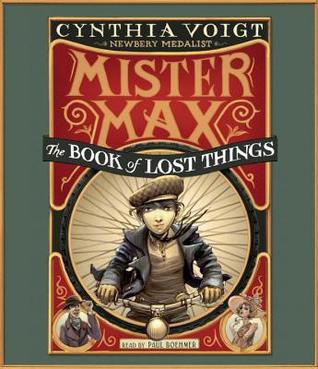
Middle Grade Audio Review: The Book of Lost Things

17978521 


Title: The Book of Lost Things (Mister Max, Book I)
Author: Cynthia Voigt; read by Paul Boehmer
Publisher: Listening Library, 2013. Original Alfred A. Knopf, 2013, 374 pages.
Source: Library (digital resources)

Publisher's Summary:  
Max Starling's theatrical father likes to say that at twelve a boy is independent. He also likes to boast (about his acting skills, his wife's acting skills, a fortune only his family knows is metaphorical), but more than anything he likes to have adventures. Max Starling's equally theatrical mother is not a boaster but she enjoys a good adventure as much as her husband. When these two disappear, what can sort-of-theatrical Max and his not-at-all theatrical grandmother do? They have to wait to find out something, anything, and to worry, and, in Max's case, to figure out how to earn a living at the same time as he maintains his independence. This is the first of three books, all featuring the mysterious Mister Max.

My Review:  
This was a fun story. Though Max faces some serious issues, the book never loses sight of its essentially humorous nature, with characters a little bit over the top and situations that will make you smile even as they keep you reading to see how he'll solve this one. (As a matter of fact, in many ways Voigt has captured pretty much the tone I aim for in The Ninja Librarian, both with the humorous touch and the focus on solving problems). Max is a great character--he has more resources than your average 12-year-old but a realistic set of issues and concerns as well. 

The setting of the story is deliberately left a little vague (again, reminds me a bit of Skunk Corners!), which  overall works very well. I was occasionally a bit frustrated by my tendency to want to know everything, as well as just a bit of desire to sort out what kinds of help and perils he might face. (For those who want to know, it's a 1900-ish setting, though which side of the the Atlantic or what city I couldn't say--quite possibly a port on one of the Great Lakes, but that's not really the point). It feels  like it takes place outside of time and space.

This is the first of a series, and while Max solves most of the problems he encounters, the big problem is only partially addressed, not solved, leaving us poised to leap into Book Two, which I fully intend to do.

The audio narration was excellent. I had no trouble following everything, and characters were nicely distinguished. I can recommend the audio version though may look for the next one in print just to see if I missed anything.

Recommendation:
The writing level is upper elem to middle school, but the content is fine for all ages. I think this would make a great read-aloud for kids from about 7 up, with independent readers from 9 or so able to handle it fine.

Full Disclosure: I checked The Book of Lost Things out of my library, and received nothing from the writer or publisher in exchange for my honest review.  The opinions expressed are my own and those of no one else.  I am disclosing this in accordance with the Federal Trade Commission's 16 CFR, Part 255: "Guides Concerning the Use of Endorsements and Testimonials in Advertising." 

Wednesday, August 5, 2015

Classic Review: Mark Twain's Roughing It

99145 

Title: Roughing It
Author: Mark Twain
Original Publication: 1872. I read a digital copy from the Gutenberg project without page numbers, but paperbacks seem to run around 500 pages.

Discussion:
This is a discussion, and not a review, because who the heck am I to review Mark Twain? Still, reading the book gave me a few thoughts, so you don't get off that easily. I'm just going to throw out a few things it made me think.

My first thought is that although this was fairly early Twain, you can tell. The tendency to stretch the truth, massage reality to fit his idea of humor, exaggerate just a tiny bit...it's all there. And there were a few places that made me laugh aloud.

My next thought is that Twain was more a man of his times than we would really like. It can be very uncomfortable to read what he has to say about persons of other races, particularly Native Americans. It made me want to smack him. I had to remind myself that he couldn't very well help absorbing the attitudes of essentially everyone around him. Then I skimmed quickly on to his next bit of personal misfortune, which was a lot more fun.

I also sort of envied Twain his leisurely 3-month exploration of the Hawaiian Islands, because I've only ever spent 9 days there, and seen only one island. Though at least I didn't have to do it on the back of a balky horse, which I do not envy him. And he didn't get to go snorkeling and see the amazing fish and corals.

Finally, I had to remind myself that when he began this 7-year adventure, he was all of 19 years old. That means he was still only 26 when he finished. No wonder he made bad decisions all along the way. And what was that older brother he left home with thinking, to give him no more guidance than that? (Except if I recall, the brother is maybe 2 years older. Not a lot of good judgement there, either). But a lot of his stupidity--and his prejudice--is more forgivable when you remember that he was just a kid.

Oh, and when he started a forest fire at Lake Tahoe? This resident of a drought-stricken and highly flammable California cringed, hard. 

So, do I recommend this book? Not to everyone. It was an interesting look at the California, Nevada and Hawaii of the time, and there were some good laughs. But I never knew when his history was fiction, which is frustrating, and it took some perseverance to finish, so I'd say it's not for the faint of heart or for slow readers. And there's something in there to offend just about everyone. Proceed at your own risk.

Wednesday, June 17, 2015

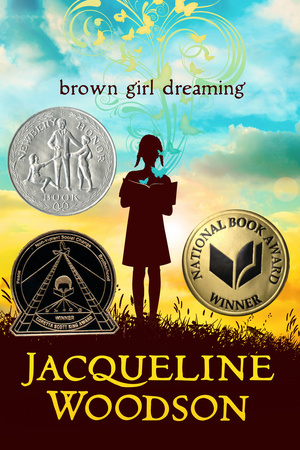
Middle Grade Review: Brown Girl Dreaming

20821284


Title: Brown Girl Dreaming
Author: Jacqueline Woodson
Publisher: Nancy Paulson Books, 2014. 336 pages
Source: Library

Publisher's Summary:
A novel in verse. Raised in South Carolina and New York, Woodson always felt halfway home in each place. In vivid poems, she shares what it was like to grow up as an African American in the 1960s and 1970s, living with the remnants of Jim Crow and her growing awareness of the Civil Rights movement. Touching and powerful, each poem is both accessible and emotionally charged, each line a glimpse into a child’s soul as she searches for her place in the world. Woodson’s eloquent poetry also reflects the joy of finding her voice through writing stories, despite the fact that she struggled with reading as a child. Her love of stories inspired her and stayed with her, creating the first sparks of the gifted writer she was to become.

Review:
Though the summary calls it a novel in verse, my understanding is that Brown Girl Dreaming is in fact a memoir. In any case, it is a moving story, gradually unfolding through the spare free-verse poems that make up the book. Beginning with the author's birth in Columbus, Ohio, each poem tells a key bit of what made young Jacqueline who she was. From South to North and back again, through Jacqueline's eyes the Civil Rights era comes to life in a whole new way.

Each poem is written in the present tense, and the voice is, after the baby years, one appropriate to the child, reflecting both the understanding of the child and the greater understanding of the adult now writing the book.  And gradually the story unfolds, and in the end, we understand a great deal more about what created the author.

 Recommendation:
For older elementary and up. The story has a great deal of life in it, and not all of that life is easy to understand or accept. I'd say from maybe age 10 or 11 useful conversations could come out of it; younger kids might find it all a bit bewildering.

Full Disclosure: I checked Brown Girl Dreaming out of my library, and received nothing from the writer or publisher in exchange for my honest review.  The opinions expressed are my own and those of no one else.  I am disclosing this in accordance with the Federal Trade Commission's 16 CFR, Part 255: "Guides Concerning the Use of Endorsements and Testimonials in Advertising."

Wednesday, October 15, 2014

Picture book review: Moo

http://motherdaughterbookreviews.com/kid-lit-blog-hop-47/
 

Never say never. I say that I never review picture books, but this one was so funny I just had to. I was working the desk at the library while the Storytime Lady was reading it, and thought I was going to die.


Moo!

Title: Moo!
Author: David LaRochelle
Illustrator: Mike Wohnoutka
Publisher: Bloomsbury/Walker, 2013.
Source: Library

The Story:
Moo. That's the whole story. Well, of course, not really, because though the only word in the book is "moo," the story is told in pictures. To put it flatly, a cow decides to take a car for a little drive, and hilarity ensues.

Review:
You would never believe how much you can say with a single word. The story is funny, with a cow that reminds me of Minnie and Moo (Denys Cazet). Cow (Moo?) gets very excited at the idea of a car, and the expressions on her face as she drives off are priceless. But the absolutely best moment is the long paragraph of moos in which she explains it all to the police officer. Anyone who can get through it without giggling is inhuman, or possibly superhuman.

Recommendation:
This is definitely a read-aloud book, as much of the story comes in the expression you put into the various moos. If you are a person who reads in an monotone--maybe not the book for you. But if you like to throw yourself into a bit of dramatic silliness, read it to your kid! If your kid is too old, or you don't have one. . . beg, buy, borrow, bum or steal one so you can read this book!


Full Disclosure: I checked Moo! out of my library, and received nothing from the writer or publisher in exchange for my honest review.  The opinions expressed are my own and those of no one else.  I am disclosing this in accordance with the Federal Trade Commission's 16 CFR, Part 255: "Guides Concerning the Use of Endorsements and Testimonials in Advertising." 
Now go hop around to the other participants in the KLBH--just click on the badge at the top of the page!

Monday, September 8, 2014

Middle Grade Review; The Music of Dolphins by Karen Hesse

The Music of Dolphins


Title: The Music of Dolphins
Author: Karen Hesse
Publisher: Scholastic, 1996. 181 pages.
Source: Library

Summary:
Mila is found on an atoll, and she has been raised by dolphins from the age of 4. When she's taken back to the US, Mila has a lot of learning and adjusting to do, and it doesn't help that the government claims her as a legitimate study subject, rather than as an adolescent with human needs (as well as some rather dolphinish needs).

Review:
Karen Hesse is a fantastic author, and I believe this book won some awards, but I have to admit I didn't really like it. The premise was a bit hard to swallow--exactly how did that work?--though if that is once accepted, the results are logical enough, I guess. The narration is interesting, in the voice of Mila, as a sort of journal. As she learns more and more language she is able to express herself more clearly and we also see her developing a grasp of human nature.

The ending of the book is the source of a large part of my dissatisfaction. Without giving anything away, I will just say that I found it unrealistic and unconvincing as a long-term solution.  Having truly loved many of Hesse's books, I was sorry to find myself unimpressed with this one.

Recommendation:
The book is a quick and engaging read, for those (children?) more willing than I to suspend disbelief.  For any reader, it is an interesting insight into human nature, from the perspective of a virtual outsider.

Full Disclosure: I checked Music of Dolphins out of my local library,, and received nothing from the writer or publisher in exchange for my honest review.  The opinions expressed are my own and those of no one else.  I am disclosing this in accordance with the Federal Trade Commission's 16 CFR, Part 255: "Guides Concerning the Use of Endorsements and Testimonials in Advertising."

###
Don't miss the Pismawallops PTA Back-to-School sale! Ebook just $2.99 until Sept. 10. Visit Amazon or use coupon code PJ97S to get the same price from Smashwords, which sells all formats, including Kindle, Kobo and Nook.
Only two more days! 

Tuesday, May 21, 2013

Book Review: Camping for Kids

Camping for Kids  Today's kid-lit review is non-fiction.  Camping for Kids, by Melanie A. Howard, part of the "Into the Great Outdoors" series from Edge Books.  30 pages, early to middle grades (?).

I stumbled on this book while sorting books at the library, and thought I should take a look, as we have been taking our kids camping, hiking, and backpacking since they were babies.  I should note, however, that this is not a how-to for parents, but more of an introduction to concepts for the kids in five brief chapters. 

The first chapter, "Out in the Wild," offers a brief summary of why people camp and the history of camping for pleasure in the U.S. (interestingly, some people were camping for fun while others were still walking behind their wagons and camping because that was the only way to get from Point A to Point B).  A final paragraph mentions various approaches to camping: bike camping, RVs, boating or hiking.  My only real problem with this chapter is that the lovely opening picture spread shows a tent on a sort of sandspit sticking out into a lake--definitely NOT an acceptable campsite (which should always be at least 100 feet from water, preferably 200 feet).

Chapter Two, "Packed up and Ready to Go," talks a little about essentials, tents, sleeping bags and backpacks.  It discusses water treatments, and finishes with car and RV camping extras.  My reaction to this was that it couldn't make up it's mind if it was for kids or parents.  As a general rule, it is not the children who are making decisions about things like water treatment, type of sleeping bag, or tent purchases, though it helps if the kids understand why they have or do certain things.

Chapter Three, "From Bear Bags to Bandages," covers exactly that, plus fire safety.  Again, I think the focus is off.  For children, it is less important to know that they should hang the food 100 yards from camp than to know that they should NEVER keep food in the tent.  The discussion of fire safety is more on target, as kids are the ones most likely to be paying attention to the fire.  I think it might not hurt to mention that care should be taken when "tending" the fire, based on the things my boys have thought of to do with fires over the years.  On first aid--advising children to "take a first-aid class before your trip" seems completely off, since few such courses would even accept children young enough to be reading this book.

Chapter Four is "We're Here.  Now What?"  This chapter offers a few nice suggestions about what you might do in and around camp, helpful for those who've never been outdoors enough to figure it out for themselves.

The final chapter, "Leave No Trace,"  outlines a few basic Leave No Trace (LNT) principles, like leaving no trash, camping on durable surfaces, and not taking anything from the wilderness.

My take on the book is that it can't make up it's mind what it's doing.  The writing is very simplistic, as for kids in about grade 3-5.  But the content deals at least half the time with matters that such children would not be managing.  Perhaps it's meant to give kids the info they need to get their parents to learn enough to take them camping?  If I were to write the book, I have to say that my focus would be more on showing kids why they want to go, and how to be safe and happy, using the gear their parents provide--tips like "bring a small favorite stuffy" will probably do more to help a child have a good sleep in the backcountry than a learned debate on the merits of down vs. synthetic sleeping bags.

2.5 stars

*********
 Here's the other result of my reaction to this book.  Many years ago I put together a little picture book and shared it with my friends.  I called it A is for Alpine, An Alphabet Book for Little Hikers.  After reading this "kids' camping guide," I have decided to dust off the alphabet, upload to Smashwords, and offer the book for 99 cents to anyone who wishes to have something to share with small children who may be camping for backpacking for the first time.  It doesn't do the same thing as Camping for Kids, exactly, and while maybe it's not brilliant,  I think it will help little ones and their parents get excited about getting outdoors.  Plus: pretty pictures, all from real packtrips we've taken with our real kids.  Who really don't care what their sleeping bags are made of as long as they are warm, and get candy.

I'll even put up the paperback on Amazon, though I sadly have to charge more for that, due to printing costs for color pages.

So watch this space for more information about A is for Alpine, and happy hiking!

I've put it up--still fussing with some issues, but it's on Smashwords now, for 99 cents, and will soon be available as a paperback at Amazon for $6.99!


Monday, April 22, 2013

S: Dorothy Sayers

First, I want to take a moment to acknowledge a nice (meaningless) threshold, which is that sometime over Saturday night I passed the 10,000 page views mark.  Unfortunately, since Blogger doesn't sift out the robovisits, I think a significant portion were due to Russian sites of dubious virtue checking out that "old-fashioned girl" post.  Still.  Ten thousand views.

And I only need 13 more members to hit the 50 follower mark!


Now for our regularly scheduled Mystery Monday post: Dorothy Sayers and the Lord Peter Wimsey mysteries.

First I want to say that Ms. Sayers was a serious scholar and she herself considered her Lord Peter stories (and other unrelated mysteries) as a sort of sell-out.  But, let's be frank: who reads her theological works today?  A whole lot fewer than read her mysteries, that's for sure (for the record, I have read at least one of her non-fiction works, The Mind of the Maker, and it is an excellent exploration of the relationship between the creativity of God and the creativity of the artist, for those who think in those terms.  The woman could write, whatever her subject matter).

The 12 Lord Peter novels (and 3 collections of short stories) are definitely products of their period (the 1920s and 30s), being more intellectual than action-oriented.  The series is also slightly schizophrenic.  In 8 of those 12 books, Lord Peter appears alone, and the books are classic intellectual puzzles.  In Strong Poison, she introduces Harriet Vane, and (after ignoring her existence in intervening books) develops a complex love interest in Have His Carcase, which erupts into the central place in the last two books, Gaudy Night and Busman's Honeymoon.  Gaudy Night in particular stands out because the entire story is from the perspective of Harriet Vane, and we finally truly see Peter through another's eyes.  Busman's Honeymoon shifts perspectives, but her view again predominates, leaving me to wonder what kind of change in the nature of her mysteries, or maybe in the mystery novel, Ms. Sayers was contemplating.

Gaudy Night, in particular, is a great read for a writer, as Harriet is (just by chance, of course!) a writer of mysteries.  In many ways the book (which contains a perplexing mystery but lacks a corpse) is a meditation on marriage and work, for women (and especially the woman artist), as well as on the value of writing as work.  It is a theme that I think Sayers would have further developed had she continued to write, and in fact is developed in Jill Paton Walsh's completion of Sayers' unfinished final novel, Thrones, Dominations.  It is unclear in that work what is Sayers and what is Walsh, but I suspect that the concern with the difficulty Harriet has with her writing was planned by Sayers.

I can heartily recommend any and all of the Lord Peter books, though a couple get a little dense and dry (The Five Red Herrings according to rumor was written to demonstrate the perfect construction of red herrings, and I could believe it).  The books can be read in any order, as they are only very loosely tied, though I think a little sense of development is gained from reading them in the order written.  Other details of Lord Peter's life are added by reading the short stories, though any effort to construct a timeline would, I think, lead to madness and despair.

Oh, and one final reason I like the books?  Lord Peter is addicted to word play.

Whose Body?  (Lord Peter Wimsey Mysteries, #1)

Thursday, April 18, 2013

P: Progressive Book Club


This month's PBC book is The End of Your Life Bookclub, by Will Schwalbe, and I'm a day late again--on purpose, since that made it come on "P."

This book affected me on a number of levels.  Although the book is in no way morbid or even, in some sense, about death, it is never far from the reader's mind that this is a narrative of the dying of the author's mother.  Though Schwalbe and his mother have always talked about the books they read, in a sort of accidental development, they began deliberately reading the same books at the same time, and discussing them (usually while she underwent her chemo or they waited for doctor appointments).  So, as a middle-aged adult who has already lost one parent (also to cancer), I was a bit gob-smacked by that aspect of the book.  As when I read Bill McKibben's Long Distance: A Year of Living Strenuously which also narrates the gradual death of a parent, I was treated to all my own feelings about losing a parent, including guilt that I wasn't able to be present for my Dad in the way that these authors were for their parents.

Mary Anne Schwalbe was an amazing person who dedicated much of her life to helping people in places where most of us won't even consider going.  She was all over the world, in and out of war zones, working in refugee camps and pushing charities to help the refugees.  Through it all, she remained a caring person who connected on a personal and individual level with everyone she met (in this way she reminds me of my own mother, who would make no difference in how she'd chat with the queen or the queen's charwoman).  So I also felt a bit of a jab at how little I've done in my life to make a difference (and occasionally felt a snarky urge to point out that a lot of what the author's family could do came of their rather obviously coming from money).  Mostly it's inspiring, though.

Then there were the books.  These two and their book discussions make me want to be a better reader, to resume reading more serious fiction (the stuff that I probably too often avoid as grim and depressing).  I actually would have felt a bit better if they'd occasionally trashed a book.  I'm not sure if they did a very good job of filtering their reading list to contain only books that they could truly appreciate, or if Schwalbe just didn't discuss the failures.

In the end, the best I can do is share some random quotes that I liked.

Early on there's a discussion of print books vs. electronic that totally tickled me:
Electronic books live out of sight and out of mind.  But printed books have body, presence. . . . they'll confront you, and you'll literally stumble over some tomes you hadn't thought about in weeks or years.  I often seek electronic books, but they never come after me.  They may make me feel, but I can't feel them.  They are all soul and no flesh, no texture, and no weight.  They can get in your head but can't whack you upside it.

Another great bit, on the value of reading for children:
There was one sure way to avoid being assigned an impromptu chore in our house. . . and that was to have your face buried in a book.  Like churches during the Middle Ages, books conferred instant sanctuary.  Once you entered one, you couldn't be disturbed.

As the book progresses, I am forced to think more about what it is saying about watching a parent die.  I am struck by a line:
So often over the course of Mom's dying, I noted how people would avoid touching Mom or talking to her, addressing comments and queries to us, even when she was right there. ("Does your mother want something to drink?").
I have been there briefly, just once, when my grandmother (then pushing 90) was taken ill, and the usual suspects (the older cousins) were for some reason not available to go to the hospital.  They finally phoned my older brother, but he was away and I was staying at his house.  So I drove 30 miles to the hospital, largely to provide Grandma with transport home.  But as soon as I was there, people started talking to me instead of her (not helped by her poor hearing--but she was totally present mentally, and could hear well enough if she could see them and lip-read some too).  I knew nothing of her meds, routines. . . and had to keep saying so, directing them to speak to her.  It's a sort of infantilization of the elderly, and a giant discourtesy.

Again, on how we see our parents, compared to how others do:
A friend's father introduces himself to the waiter at the start of every New York restaurant meal by saying: "Hi, I'm Eric, and this is Susie, and we're from Vermont."  My friend cringes ever so slightly whenever his dad does this.  I cringe a little when Mom is talking to Curt, thinking that he doesn't want to chat; he's trying to concentrate; she's just another old person dying of cancer.  But this isn't true--it's just the childish embarrassment we all develop about our parents: they are too effusive, try too hard; they just aren't being cool.

And, finally, there is the harsh truth:
I'd seen so many movies where characters sit by beds as their loved ones die.  They give speeches, hold hands, and say, "It's okay--you can let go."  What none of those books and movies conveys is how tedious it is.

What Schwalbe manages to convey is how much life a person can still have and share while dying.  Showing it through the insights he and his mother brought to and took from the books they read reminds us all of the power of the written word, as well as through the effort she continued to put into her current project (a library and mobile libraries for Afghanistan) right up until her death.

A final thought: the first two books we read for the PBC were about writing.  This book is about reading.  But without reading, there is no writing--reading by those for whom we write, and reading by those of us who also write.  This is a great book for writers, because it makes us think about how we read.

Monday, December 31, 2012

Happy New Year!

Okay, this day snuck up on me.  I just posted yesterday and here I am needing to say something pithy and profound and summative about the year that is rapidly heading toward extinction.  And I need to say it quickly, because I went for a lovely ride on this cold, crisp afternoon and now I can't stay awake.  I'll be lucky to make it to midnight East Coast time, and I live several times zones west of that one. . . (Guaranteed insomnia cure: exercise until you're frozen, come in and thaw out and eat a large dinner and then just TRY to stay awake!).

Okay, wise cracks out of the way, I do want to look back over the year.  At the beginning of 2012, my writing was just about where it is now. . . except it was the first Ninja Librarian book I was trying to polish up, and now it's the second.  Over the course of the year, I've seen my book in print, done author readings, and been recognized in the grocery store as a writer

I have developed as a writer, doing a much better job of believing that it's a real job, and therefore should take precedent over many other things, including sweeping the floor.  Not always there, but getting better.  I've learned more about marketing than I ever guessed I would ever need to, and just enough to tell me that I've only scratched the surface.  I've also learned that nothing about my new published status has made me any more eager to sit down with a flawed MS and do the hard work of turning it into a publishable book, but that having people waiting for the new book can inspire me to do even that.  I think that's part of what it means to be a professional.

I have also learned that I can write short stories just for fun, and share them so that others can have fun too.

In my personal life, I have watched my boys get another year older, and seen my Eldest Son putting me to shame for his ability to write under nearly any conditions.  While I want to crawl off alone, he sat in the middle of the family Xmas bash with his computer in front of him, and added page after page to his first novel.  It's pretty good, too.  I don't know whether to be a proud parent, or just chagrined that he manages to write, and well, under circumstances that made me give up (twelve people in our dinky house over the holidays, for example).

I have also done some great trips, including my first visit to Hawaii and a seven-day backpack trip in the Wind River Mountains of Wyoming (here and here).  That was one of the most scenic I've done, and the longest single backpack since I was 27 and hiked 200 miles of the Pacific Crest Trail.  It was a lot more fun doing it with my family than alone, as I did back then.  

What do I wish for 2013?  Aside, that is, from peace and love and general good stuff for all humanity.  Let's stick with the personal here.  Mostly, let's stick with what the writer wants.

1.  Make writing a featured part of every day.  Write like a professional.  Except on Zero days.
2.  Bring out the sequel to the Ninja Librarian (still mostly on track for Feb., though we are looking at the end of the month, not the beginning).
3.  Either finish and publish my "PTA Murder" novel, or decide it has no future and start a new one.
4.  Sell more books each month, find more followers for this blog, and discover more great reads for myself.  Which I'll share if you are good.
5.  Go for another backpack trip as glorious as last summer's.  Swim even more, ride even more, and--the gods willing--become a runner again when my about-to-be-operated-on toe heals.

Tuesday, October 16, 2012

Nothing Daunted--Book Review

Nothing Daunted, by Dorothy Wickenden.  Biography.

Nothing Daunted is a biography of the author's grandmother and her best friend, who left New York state in 1916 to spend a year teaching school in the wilds of Colorado.  Thoroughly researched, the story makes use of copious family letters as well as a great deal of background research.

In fact, I would argue that the story makes too much use of the background research.  Although all of the information provided does help to set the scene, at times it becomes a bit. . . daunting.  History comes at us from all angles, history of Hayden, CO and environs, and history of Auburn, NY, and of the families of the two young women.  I was further put off by the organization of the book, with bits of the main story dropped in and then ignored through long stretches of backstory and local color.

The book really comes to life when the author brings us to the women's trip West and the life they find in Colorado.  Intrusions are greatly reduced once we are ensconced in the mountains, and begin teaching--something for which neither woman is specifically trained, though they did a good job of preparing themselves in the months before departure.  Fortunately, Dorothy Woodruff, the author's grandmother, wrote lots of letters, as did her friend Rosamond--Ros--Underwood.

Probably the most striking thing to emerge from the story is the contrast between life in an eastern city--it is 1916, and the modern age has definitely begun--and life in the Colorado mountains, where things seem firmly stuck in the pioneer age, including the schooling.  But these women didn't take the adventure wholly as a lark.  They were 28 years old, and unhappy with the lot that society seemed to have destined for them (marry and be a society wife).  Going to Colorado was something of a whim and an adventure, but it was also a serious attempt to find a place where they could make a difference.

What the young women don't know, at least not at first, is that part of the reason that the well-to-do sponsor of the school has advertised for young women from the east is that he hopes to bring marriageable women into the community, which suffers from a lack of brides.  This mission reads in the beginning like a joke, but it becomes clear that this is a serious goal, and a genuine need in the community.

Altogether, the strengths of the book--the genuine story with it's own narrative arc and romantic interests--outweigh the weaknesses.  For me, at least, with a strong interest in the history of the settlement of the West and particularly the role of women there, Nothing Daunted  offers a unique snapshot of a time and region about which I know relatively little.

Three point five stars.