Showing posts with label Louisa May Alcott. Show all posts

Thursday, November 22, 2018

Photo Friday: Minuteman National Historical Park

Last week I had a couple of days to kill in the Boston area, and since I was in the neighborhood, I decided to check out Concord and the Minuteman National Historical Park. This had the advantage of also offering me a chance to check out the home--and grave--of Louisa May Alcott (1832-1888), the author of Little Women and about 30 other books. Alcott's home isn't part of the park, but since it's right next door, it might as well be. I'll start with Louisa, for the literary side of this blog :)
At the far left, you can see the "Hillside Chapel," built by Bronson Alcott and used for one of his schools. I believe it is once again being used for educational programs.
The Alcott family, as many of my readers may know, did a lot of moving around when Louisa was young. They kept returning to the Concord area, however, and in 1858 moved into Orchard House (the tour guide there implied that Emerson may have bought the house for them; I suspect that may be true, as Bronson Alcott had never before managed to keep up payments on a home). This was their home until 1877, and it was here that Louisa wrote Little Women and most of her other books.

Alcott used Orchard House as the setting for the March family, though when the girls were the ages of her characters, they lived next door in the home Hawthorne later named "Wayside."
Wayside. Hawthorne built the lookout on top as his writer shed. I'm envious!
I presume that leaving a pen will bring one luck as a writer.
I enjoyed the tour of Orchard House very much, but as photos are not allowed inside I can't share the experience! The house is, however, furnished with authentic period furnishings, and the web site says that about 75% of them actually did belong to the family. Many of May Alcott's paintings and drawings hang on the walls, or were in fact painted or drawn right on the walls and window frames (the painted wood obviously made a better canvas than the plastered and papered walls, though I wonder how "Marmee" felt about that, especially in the early days).

I also took a look in the Sleepy Hollow Cemetery (yes, it really is!) and located the graves of Alcott, Emerson, and Thoreau.
I was intrigued by the way in which Louisa's and Henry's graves have been turned into shrines, or maybe wishing wells for writers.
Henry David Thoreau's final resting place

Being in need of a good walk, I also visited the two units of the Minuteman National Historical Park, starting with the Old North Bridge, the site of the first shot fired by the colonials at the British troops (who, I will note, fired first). At the centennial of that battle, a statue of the idealized Minuteman was installed across the creek from a monument installed in 1836. It was for the 1837 dedication of that obelisk that Ralph Waldo Emerson wrote his "Concord Hymn," the opening lines of which many of us learned off by heart in school, and were inscribed on the base of the 1875 statue:
By the rude bridge that arched the flood,
   Their flag to April’s breeze unfurled,
Here once the embattled farmers stood
   And fired the shot heard round the world.
The minuteman.
In 1910, a plaque was also installed honoring the British soldiers who died there, with a pointed lines from a poem by James Russell Lowell, written in 1849. 
Lowell said of the two militia men who died here, "’Twas for the Future that they fought," in contrast to the redcoats who fought for the past.
 The bridge is a modern restoration, but built to match the pictures of the original. That "rude bridge," being made for immediate use, didn't last the ages.

The other section of the park, on the other side of town, is a narrow strip surrounding 5 miles of the "Battle Road," the 16 mile road by which the British retreated to Boston, harassed and attacked by the colonists the whole way. Had the rifles of the time not been so unwieldy to load and shoot, and so inaccurate, they would have probably all died.
The stone walls that lined the fields along the way provided excellent cover for the colonials, who practiced the guerilla warfare they'd learned from their battles with the Indians. The British, trained to march upright and in order, didn't make much use of them.
The Park Service has created a path that alternately follows the "Battle Road" (now mostly Rte 2A from Concord to Lexington) and the route through the fields and forests that the colonial militia took in their guerilla-style attacks. Periodic placards tell of the history of that day, which also represents an impressive day's hike: the British troops left Boston on the night of the 18th of April, marched through the night to arrive in Lexington at 5 a.m. and kill 8 militia men. The "shot heard round the world" was fired about 9:30 a.m., and the retreat began about 12:30 p.m. The surviving British (saved and reinforced by troops in Lexington) arrived back at Boston Harbor about dark, having hiked 16 miles in about 5 hours, while fighting a running battle.

Today, the path is disconcertingly peaceful, winding between fields and over wooded hills, past several historical homes and the Hartwell Tavern. It takes a great deal of imagination to hear the shots, shouts, and the cries of the mortally wounded. But many of the rock walls that line the path are the very walls behind which colonial soldiers took shelter to fire on the British, and several more gravestones remind us that men died there, 243 years ago.
The deceptive peace of the location is reflected in the still pools of water on a late-autumn afternoon.
 The Hartwell Tavern "witnessed" the fight, though there is no record (oddly, to my thinking) of soldiers from either side using it for shelter or refuge. It was lived in continuously from its construction in 1732 until the Park Service bought it in 1967. They restored it in large degree to the 1775 look (though retaining some early 19th-Century additions to the house), and in the summer season it's set up as a museum.
The figure on the sign makes me think of Chaucer on the road to Canterbury. I wonder if that's my medievalist mind or if the sign painter--whether historic or modern--had that historic journey in mind when painting it?
 Since it was the off-season, I could only peek through the windows.
The kitchen. Note the massive fireplace--which was all the "kitchen range" they had to work with.
In the end, I could only enjoy my beautiful day, and meditate on the march for their lives made by the British soldiers

Pine needles and leaves frozen into the surface of a vernal pool near the Hartwell Tavern.

Thanks for coming on an historical walk with me! And apologies to my British friends for all the musket balls. Rebellious teens can be a real pain :)

 ©Rebecca M. Douglass, 2018
 As always, please ask permission to use any photos or text. Link-backs appreciated.

Monday, June 1, 2015

Historical review: Hospital Sketches by Louise May Alcott

1060688


Title: Hospital Sketches
Author: Louisa May Alcott; Introduction and notes by Alice Fahs
Publisher: Bedford/St. Martins, 2003 (orig. published 1863), 138 pages
Source:  Library book sale

Summary:
During the winter of 1862-3, Louisa May Alcott, burning to do something useful in the war effort, traveled to Washington D.C. and took a job as a nurse in a military hospital. With no real training or experience, Alcott learned a lot in a hurry, including just how miserable a job of treating the wounded men the army was doing. The fictionalized account of the 3 months she worked before becoming too ill to continue was the book that finally gave her the "big break" all authors seek.

Review:
Written with Alcott's usual wit and hyperbole, not to mention sentiment, the Sketches make for easy reading, and offer in a very small package a great deal of insight into not only the conditions of military hospitals  (a new idea largely developed during the Civil War) but also society in general. Alcott was a rabid abolitionist, and you can see in her more known works (Little Women, Little Men and Jo's Boys in particular, I think) both her desire for a non-racist society and the deeply ingrained racism that prevented even the most "advanced" thinkers from truly putting the recently-freed slaves on an even footing.

Ms. Fahs' Introduction and notes set the scene quite well and clarify the many cultural and literary references that Alcott throws about with abandon (sometimes a bit too minutely for my taste, but helpful for many, especially those less into history and literature than I am).

In Tribulation Periwinkle, the character Alcott invents to stand in her place in these narratives, you can definitely see the roots of Jo March as well as the restlessness and ambition of the author herself. And the style, mixing humor and (as noted) sentiment verging on the maudlin (a weakness of the period, I fear), is equally familiar.

Recommendation:
I found this little book (the actual Sketches are only about 70 pages) a fascinating read for both the historical value and for the look into Alcott's developing art (for more on that, look up her first novel, The Inheritance, which was only published in 1997, or the Gothic A Long, Fatal Love Chase, serialized under a pseudonym right after the Civil War). Anyone interested in either the Civil War or Alcott will want to take a look at this book.

Full Disclosure: I bought Hospital Sketches, and should scarcely need to note that I received nothing from the writer or publisher in exchange for my honest review.  The opinions expressed are my own and those of no one else.  I am disclosing this in accordance with the Federal Trade Commission's 16 CFR, Part 255: "Guides Concerning the Use of Endorsements and Testimonials in Advertising."

Thursday, January 2, 2014

Classic Kids review: Kitty's Class Day by Louisa May Alcott


17850572


Title: Kitty's Class Day and Other Proverb Stories, by Louisa May Alcott, 189 pages
Publisher: Duke Classics, Open Library edition.  Orig. publication 1882.
Source: Library, on-line ebook collection

Note: The edition I read retained the original title, unlike the cover I'm showing here (i.e., included the "proverb stories" part).

Summary: Contains eight stories of various lengths, but most if not all with pretty transparent "lessons" for the young reader.  Stories are:
Kitty's Class Day
Aunt Kipp
Psyche's Art
A Country Christmas
On Picket Duty
The Baron's Gloves; or, Amy's Romance
My Red Cap
What the Bells Saw and Said

Review:
It is always challenging to review books from another age.  My reaction to the moralizing tone of these stories is not the same, I'm sure, as the reaction of the young reading of 1882.  But for my readers, who are more modern, be warned: these are, indeed, "proverb" stories, and the lessons range from well-mixed in the story to hit-you-over-the-head (see final story, "What the Bells Saw and Said," which is pretty much a critique of a self-centered and materialistic society.  If it hadn't been interesting from a "plus ca change" perspective, it would have been unreadable).

My favorite story was probably "Psyche's Art," wherein the girl learns that she is only able to be the artist she feels herself to be after taking care of home responsibilities (not a lesson I'm completely comfortable with as she set it, but the point is largely valid, I think).  Best, at the end, Alcott's own carefully hidden feminism comes to the fore, and she ends by leaving it to the reader to choose if she and the hero fell in love, married, and lived happily ever after or, if "those who can conceive of a world outside of a wedding-ring may believe that the friends remained faithful friends all their lives" and Psyche was quite happy with her art and her home, no man apparently necessary.

I don't think I would particularly recommend this book for children (I am frankly unsure if I recommend any of Alcott for young girls; there is an awfully strong sense that marriage and family are the highest goal for the female of the species, only occasionally challenged by a character who proves otherwise.  I think from Alcott's biography that she was a little afraid to be as feminist as she felt).  But like many books from the period, which was near the beginning of the creation of books purely for children, it is interesting and educational for the student of history and culture.

Disclaimer: I checked Kitty's Class Day out from my public (digital) library, and received nothing from the publisher or author in exchange for my honest review.  The opinions expressed herein are my own and those of no one else. 

Wednesday, April 17, 2013

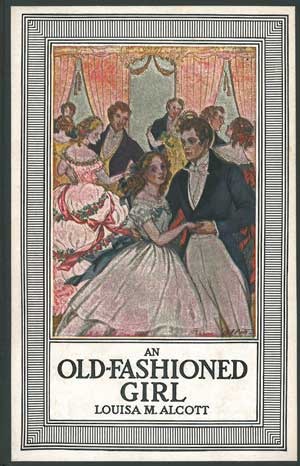
O: An Old-Fashioned Girl


I waffled a lot about this post, because I couldn't come up with an "O" book I wanted to review.  I finally decided to take a book that was already old when I read it as a kid, and look at it with a modern, critical (adult) eye to see how it held up.  So I reread Louise May Alcott's An Old-Fashioned Girl.  First, a quick synopsis:

 Polly Mason is the "old-fashioned girl" of the title, and the story narrates her relationship with her wealthy, and urban, friends the Shaws.  The story is divided into two parts, the first taking place when Polly and Fanny Shaw are about 14, and the second six years later when a now-adult Polly moves to the city to pursue a career as a music teacher.  The first portion was serialized in 1869, then expanded with the second portion and published as a book in 1870.

Now for some things I noticed.  Right off I was struck by the narrative voice.  Ms. Alcott is definitely present, not only occasionally addressing the reader directly, but also as a moral arbiter.  I am fairly certain this is the result of both common practice at the time and her desire, perhaps especially in this book (but on reflection probably in all her books), to model a world and set of behaviors she wishes were true.

An Old-Fashioned GirlAnd that voice, which is far too often preachy, leads us to the other thing I noticed right off, which is Alcott's conviction that the country or the village is superior in pretty much every way to the city.  Having read her biography, I find this interesting, because Alcott herself was clearly ambivalent.  Her father was 100% clear: healthy bodies and healthy minds were made through outdoor work and play far from the city.  Louisa seems to have tried very hard to go with that, but spent much of her life moving to and from the city, where she in fact found better inspiration for her writing.

To return to the Old Fashioned-Girl.  As I watch the story develop from the arrival of Polly Milton (a name I think not at all chosen at random) in the city, awed and prepared to admire all she sees, through her disillusionment and struggle to find a place for herself there, I think that modern children (okay, girls) will both enjoy Polly and find her too good.  The old-fashioned values will seem as strange and absurd in many ways as do the values of the fashionable girls (and I wonder if a child will see, as I do, the universality of the the absurdity of fashion!).  Thus the first half of the book.

The second half takes on, for me, a very different tone and purpose.  When Polly returns to the city as a working girl, she lands smack in the middle of one of Alcott's pet topics, class (for want of a better word).  While the young reader will see this section as part coming-of-age and part love story, I see it as an exploration of class, work, and the place of women in a society that Alcott found unacceptably repressive, not to mention grossly unfair.  In that, I think that the second half is a much more interesting book than the first, which reads much more as a sermon.

As a side note: I don't think any of Alcott's books fails to include the death of a loved parent, sibling or other important person.  She was not merely unafraid of tackling a subject that I think was more in-your-face in those days, when far more children died and far more lost parents, but I think determined to help make it less frightening and devastating.  Her books advocate for a fairly orthodox Christian belief in a deity and and afterlife, despite the rather less orthodox ideas her father explored.  I've never been sure if Alcott was a true believer or merely knew what had to be said to sell, but she does at times adopt the standard line and religious tone, which grates a bit on my modern agnostic sensibilities.

Finally, here's one bit that I can totally identify with:
. . . she had nothing to do but lounge and gossip, read novels, parade the streets, and dress; and before a week was gone, she was as heartily sick of all this, as a healthy person would be who attempted to live on confectionery.  (p. 35)
Kind of how I feel about many people's idea of vacation, lying on beaches or sitting around on cruise ships or the like.  I go nuts if I can't get exercise!  Alcott clearly was right about one thing, given what we know now about the value of exercise, for people of all ages and genders.

So do I think that Alcott's book stands up to the passage of time?  Yes, and no.  I think many modern children will find the language a little challenging (not that that's all bad!), and many will also find the tone preachy, though it's less clear to me that that stops children--the Berenstain Bears and Mrs. Piggle-Wiggle both have great circ at the library, and to me they are both preachy as all-get-out.