Showing posts with label nursing. Show all posts

Monday, November 2, 2015

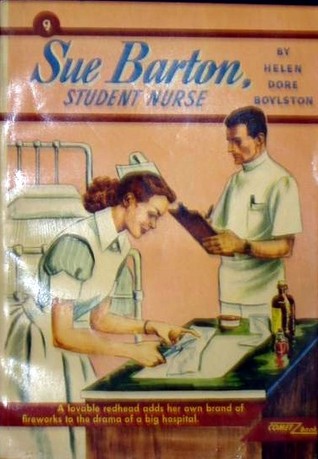
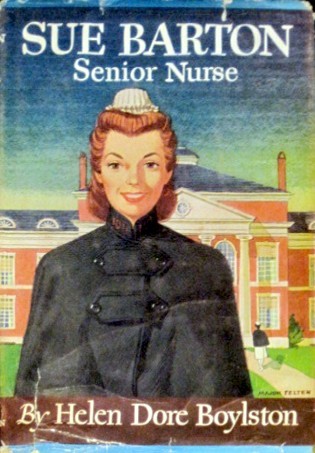
Children's Classic Series: Sue Barton

9786432 9786347 578871  1653359

The Sue Barton nursing series, by Helen Dore Boylston

When I was a kid, I absolutely loved the Sue Barton books. They were already horribly dated even then; the first book in the series was published in 1936. That apparently only increased their mystique, because when Sue talks about the wonders of the old operating theater in the hospital where she trains, it is a room that harks back to the Civil War era or thereabouts--truly medicine in a different era. Even as a child I knew that neither medicine nor a nurse's training were like Sue experienced, but the stories remained, for some reason, utterly engaging.

Not that they made me want to become a nurse (though I know more than one woman who was influenced in career choice by Sue and by Cherry Ames, another nursing student whose books I never read but may yet). I think I was just fascinated by the historical setting (which of course wasn't "historical" when written) and possibly the sense of Sue as both grown-up and yet somehow easily related to by a kid.

That creates space for more thoughts on the age of protagonists in children's books. For the most part, we do expect the heroes and heroines of middle-grade fiction to be children themselves. Yet there are plenty of stories like these, including some being written today, that feature older protagonists. In some cases (think Harry Potter), the character begins a series as an 11-year-old and grows up. In other cases--as with Sue Barton or the more recent Boston Jane books by Jennifer L. Holm--the main character is at least on the cusp of adulthood when the series begins. Clearly it can be done, and I think it's not just the adults who enjoy the stories that trace and entire life.

But the move can be tricky, too, and in today's world such books often end up being more "YA" than "middle grade." Tamora Pierce's wonderful fantasies begin in many cases with children, but end with grown women, or mostly grown, who are making decisions and acting on them in adult ways, if you know what I mean. Yet because the series begin with books about 11-year-olds, they remain in the children's section at the library (Sue Barton gets married and bears several children, but does it, like Anne Shirley, without ever, apparently, having sex).

What are your thoughts on book series for kids that follow the main character on into adulthood? Which do you love now? What did you read as a kid that featured adult characters?

If that question doesn't do it for you, there is another whole area for thought about gender roles in classic children's books--maybe I'll ask that question tomorrow!

I have been re-reading the series by finding the books in the library, physical or digital (plus one that is on my shelf, picked up at some long-ago book sale). Neither the publisher nor the author really gives a hoot about my review, as the author died in 1987 and the books are out of print.

Monday, June 1, 2015

Historical review: Hospital Sketches by Louise May Alcott

1060688


Title: Hospital Sketches
Author: Louisa May Alcott; Introduction and notes by Alice Fahs
Publisher: Bedford/St. Martins, 2003 (orig. published 1863), 138 pages
Source:  Library book sale

Summary:
During the winter of 1862-3, Louisa May Alcott, burning to do something useful in the war effort, traveled to Washington D.C. and took a job as a nurse in a military hospital. With no real training or experience, Alcott learned a lot in a hurry, including just how miserable a job of treating the wounded men the army was doing. The fictionalized account of the 3 months she worked before becoming too ill to continue was the book that finally gave her the "big break" all authors seek.

Review:
Written with Alcott's usual wit and hyperbole, not to mention sentiment, the Sketches make for easy reading, and offer in a very small package a great deal of insight into not only the conditions of military hospitals  (a new idea largely developed during the Civil War) but also society in general. Alcott was a rabid abolitionist, and you can see in her more known works (Little Women, Little Men and Jo's Boys in particular, I think) both her desire for a non-racist society and the deeply ingrained racism that prevented even the most "advanced" thinkers from truly putting the recently-freed slaves on an even footing.

Ms. Fahs' Introduction and notes set the scene quite well and clarify the many cultural and literary references that Alcott throws about with abandon (sometimes a bit too minutely for my taste, but helpful for many, especially those less into history and literature than I am).

In Tribulation Periwinkle, the character Alcott invents to stand in her place in these narratives, you can definitely see the roots of Jo March as well as the restlessness and ambition of the author herself. And the style, mixing humor and (as noted) sentiment verging on the maudlin (a weakness of the period, I fear), is equally familiar.

Recommendation:
I found this little book (the actual Sketches are only about 70 pages) a fascinating read for both the historical value and for the look into Alcott's developing art (for more on that, look up her first novel, The Inheritance, which was only published in 1997, or the Gothic A Long, Fatal Love Chase, serialized under a pseudonym right after the Civil War). Anyone interested in either the Civil War or Alcott will want to take a look at this book.

Full Disclosure: I bought Hospital Sketches, and should scarcely need to note that I received nothing from the writer or publisher in exchange for my honest review.  The opinions expressed are my own and those of no one else.  I am disclosing this in accordance with the Federal Trade Commission's 16 CFR, Part 255: "Guides Concerning the Use of Endorsements and Testimonials in Advertising."