Showing posts with label Jacqueline Winspear. Show all posts

Monday, March 1, 2021

Audiobook Review: This Time Next Year We'll Be Laughing

55757360. sx318


Title: This Time Next Year We'll Be Laughing: A Memoir
Author: Jacqueline Winspear. Read by the author.
Publication Info: Audible Audio, 2020; 10 hours.   Hardcover Soho Press, 2020. 303 pages.
Source: Library Digital Resources
Publisher’s Blurb:
After sixteen novels, Jacqueline Winspear has taken the bold step of turning to memoir, revealing the hardships and joys of her family history. Both shockingly frank and deftly restrained, her memoir tackles such difficult, poignant, and fascinating family memories as her paternal grandfather's shellshock, her mother's evacuation from London during the Blitz; her soft-spoken animal-loving father's torturous assignment to an explosives team during WWII; her parents’ years living with Romani Gypsies; and Jacqueline’s own childhood working on farms in rural Kent, capturing her ties to the land and her dream of being a writer at its very inception.

An eye-opening and heartfelt portrayal of a post-War England we rarely see, This Time Next Year We'll Be Laughing is the story of a childhood in the English countryside, of working class indomitability and family secrets, of artistic inspiration and the price of memory.
 

My Review:
Jacqueline Winspear is the author of the Maisie Dobbs mysteries, a series that began in the period right after WWI and has continued on into the Second World War. It is probably the best historical mystery series I've found. Now I know why. In addition to being a meticulous researcher, Winspear developed a real sense of what the war times were like through her own family and the stories they told. 

Not exactly the story I expected for the author's life, the tale she gives us here is gripping, compelling, and (no surprise) very well written. Her reading of the memoir is also fantastic, so that I felt rather as though I had her in my living room telling me the story of her childhood. And, as with a conversation, the book twists and doubles back in places, picking up a thread as though she just remembered another thing. Nonetheless, the overall arc is from the beginning to her departure to the US as a young woman ready to start a career as a writer, and the progression is spot on.

Winspear is only a few years older than I am. I often feel like I grew up in an earlier era than I did (thanks to some formative years in a place that wasn't really in step with the times), but her childhood feels like something from a much earlier period still, in ways that are fascinating to this child of the American West.

My Recommendation:
I can recommend this not only for fans of Ms. Winspear's novels, but also for anyone interested in a well-written memoir of an unusual childhood. I have to recommend the audio book, because while there may be pictures and things in the print book (I don't know. Are there?), her reading of the book is not to be missed.

 

Monday, July 6, 2015

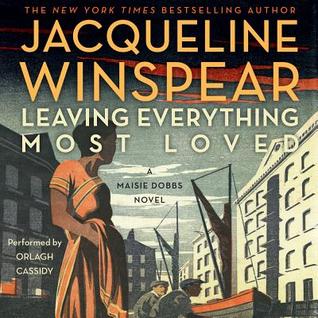
Mystery Review: Leaving Everything Most Loved

15820820


Title: Leaving Everything Most Loved
Author: Jacqueline Winspear; narrated by Orlagh Cassidy
Publisher: Orig: Harper, 2013, 336 pages. Audiobook by HarperAudio, 2013.
Source: Library (digital).

Publisher's Summary:
London, 1933. Two months after the body of an Indian woman named Usha Pramal is found in the brackish water of a South London canal, her brother, newly arrived in England, turns to Maisie Dobbs to find out the truth about her death. Not only has Scotland Yard made no arrests, evidence indicates that they failed to conduct a full and thorough investigation.

Before her death, Usha was staying at an ayah's hostel alongside Indian women whose British employers turned them out into the street--penniless and far from their homeland--when their services were no longer needed. As Maisie soon learns, Usha was different from the hostel's other lodgers. But with this discovery comes new danger: another Indian woman who had information about Usha is found murdered before she can talk to Maisie.

As Maisie is pulled deeper into an unfamiliar yet captivating subculture, her investigation becomes clouded by the unfinished business of a previous case as well as a growing desire to see more of the world, following in the footsteps of her former mentor, Maurice Blanche. And there is her lover, James Compton, who gives her an ultimatum she cannot ignore.


My Review:
As usual with this series, I enjoyed the book very much. I have been listening to many of these books, and Orlagh Cassidy does a very nice job of reading and voicing the characters. In a British novel of this period (or any?) the accents of the characters say so much about them, and I thought she did a great job, though I'm no expert.

The story is complex and intricate, and deals with a number of timely issues about prejudice and discrimination (and about colonization and imperialism). There is throughout the book a sense that everything is changing, and characters are spinning off into their own lives, as may happen. I had some amorphous feelings of dissatisfaction while reading, and on reflection think they are due to these changes. I've gotten used to a certain structure of relationships, and apparently don't like change. Clearly the author has some new plans for Maisie; I was a little worried this might be an end to the series, but observe that the next book is already out, so that's safe.

In the end, I found the book very well-written, and the mystery convincing. There is no easy solution, and the challenge that her discoveries presents Maisie and the reader is part of what gives the story meat. 

Recommendation:
I strongly recommend this series for those who like mysteries that are character-driven but dig into a serious and challenging puzzle as well. Winspear doesn't pull any punches about social issues, not all of which are limited to the 1930s. I recommend reading the series in order, as the characters and relationships grow and develop throughout and may be a bit confusing if you start in the middle.

Full Disclosure: I checked Leaving Everything Most Loved out of my library, and received nothing from the writer or publisher in exchange for my honest review.  The opinions expressed are my own and those of no one else.  I am disclosing this in accordance with the Federal Trade Commission's 16 CFR, Part 255: "Guides Concerning the Use of Endorsements and Testimonials in Advertising."

Monday, September 15, 2014

Historical Fiction: The Care and Management of Lies

18695272 

Title: The Care and Management of Lies
Author:  Jacqueline Winspear
Publisher: Harper Collins, 2014. 319 pages.

Summary:
This book is subtitled "A novel of the Great War," and Ms. Winspear has made a study of WWI in England. In this novel she tells the story of one family, and how the war affected them. Kezia Marchant and Dorrit Brissenden have been friends since their schoolgirl days, and as the novel opens, Kezia is about to marry Dorrit's brother Tom. Much is changing between the two young women, who have chosen different paths, and their struggle is represented by Dorrit--Dorothy--changing her name to a different diminutive, Thea. That change represents her dive into the world of women's suffrage and, while Kezia shifts from parson's daughter and self-supporting teacher to farmer's wife. When war breaks out only months after the marriage, everything shifts again, and the heart of the story is how they all cope.

Review:
Ms. Winspear couldn't write a bad book, but this is a bit unexpected for fans of her Maisie Dobbs mysteries. It took me a bit to engage with the characters, and to find the rhythm and direction of the story. Once the war begins, and (this is no spoiler, really--it's the inevitable plot development) Tom goes to fight, the book began to fall into place for me. The "lies" of the title are the letters each writes to the other, making light of their struggles and creating a comforting fiction for the other. In particular, Kezia keeps up Tom's spirits by describing the meals she is cooking for him--completely imaginary meals, as shortages leave her with little food. What Winspear does with those "lies" is imaginative and powerful.

Ms. Winspear depicts the war from both sides--the trenches and the "home front"--very well, and this may be the strongest aspect of the book. The story is about the three-way relationship between the two girls and the man they both love, but I admit those relationships felt a bit thin to me. I didn't quite believe in them, but I completely believed the world and the lives Winspear painted. That's almost enough.

Recommendation:
Though I felt that something was a bit off in the book, and I was discontented with the ending (not necessarily because it was bad, but because it wasn't the one I wanted), The Care and Management of Lies is a moving look at the Great War, and well worth the reading. Just don't look for Maisie Dobbs here. This is a different kind of book, meant for those who like more serious fiction and for those who (like me) are fascinated by that period of history.

Full Disclosure: I checked The Care and Management of Lies out of my library, and received nothing from the writer or publisher in exchange for my honest review.  The opinions expressed are my own and those of no one else.  I am disclosing this in accordance with the Federal Trade Commission's 16 CFR, Part 255: "Guides Concerning the Use of Endorsements and Testimonials in Advertising."