Showing posts with label British mysteries. Show all posts

Monday, May 14, 2018

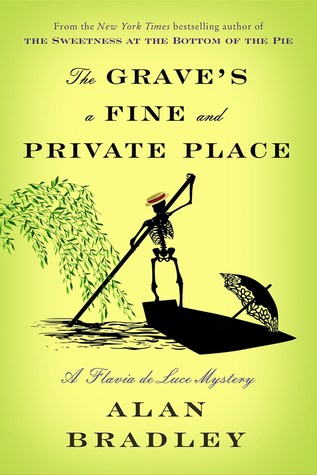
Mystery review: The Grave's a Fine and Private Place

34837078 

Title: The Grave's a Fine and Private Place
Author: Alan Bradley
Publisher: Delacorte Press, 2018 (US edition). 363 pages
Source: Library

Publisher's Summary:
Flavia is enjoying the summer, spending her days punting along the river with her reluctant family. Languishing in boredom, she drags a slack hand in the water, and catches her fingers in the open mouth of a drowned corpse.

Brought to shore, the dead man is found to be dressed in blue silk with ribbons at the knee, and wearing a single red ballet slipper.

Flavia needs to put her super-sleuthing skills to the test to investigate the murder of three gossips in the local church, and to keep her sisters out of danger. But what could possibly connect the son of an executed killer, a far too canny police constable, a travelling circus, and the publican's mysteriously talented wife?
 

My Review:  
Okay, Flavia is not enjoying the summer. She hasn't been enjoying anything for about 6 months (I won't go into details that would be spoilers for the previous book). But the discovery of a corpse is just the tonic she needs, because Flavia is delightfully unlike most of us, and considers nothing so uplifting as a corpse. Better still if she thinks that corpse got that way with help.

Flavia has been doing some growing up in the past 6 months, I think, as is mostly betokened by the fact that she seems rather less of a know-it-all and more appreciative of her confederates. But her quick wit and knowledge of chemistry help fill in the gaps left by her lack of understanding of poetry or love, and as a narrator she is a delight. I like the new, less brash version of Flavia. She's not tamed; she's just gained some humanity. Relationships that have been left pretty undeveloped through the series are suddenly becoming important, and more nuanced.

The mystery is good fun this time, too. It's not completely certain that Flavia's corpse was murdered, but there is a history of murder in the town, and that provides lots for her to investigate. I was also very interested in how Bradley managed her researches in a place not her own home town, where the players aren't so well known to her. She does seem to have a grip on how to get information where she needs it, and uses well the reality that no one pays much attention to children.

My Recommendation:
I call this a solid addition to the series, and goes a ways toward making me forgive the author for the heartbreak of the last book. There is some debate whether the series is for middle grades or adults; my library classifies it with adult mysteries, and I agree. Flavia may be 11, but the things she's investigating aren't for kids. Your child may disagree.

FTC Disclosure: I checked The Grave's a Fine and Private Place out of my library, and received nothing from the writer or publisher for my honest review.  The opinions expressed are my own and those of no one else.  I am disclosing this in accordance with the Federal Trade Commission's 16 CFR, Part 255: "Guides Concerning the Use of Endorsements and Testimonials in Advertising."  

Monday, January 23, 2017

Mystery Monday: Thrice the Brinded Cat Hath Mew'd

28961295


Title: Thrice the Brinded Cat Hath Mew'd
Author: Alan Bradley; read by Jayne Entwistle
Publisher: Books on Tape, 2016. Original by Delacourt Press, 331 pages
Source: Library digital services

Publisher's Summary:
In spite of being ejected from Miss Bodycote’s Female Academy in Canada, twelve-year-old Flavia de Luce is excited to be sailing home to England. But instead of a joyous homecoming, she is greeted on the docks with unfortunate news: Her father has fallen ill, and a hospital visit will have to wait while he rests. But with Flavia’s blasted sisters and insufferable cousin underfoot, Buckshaw now seems both too empty—and not empty enough. Only too eager to run an errand for the vicar’s wife, Flavia hops on her trusty bicycle, Gladys, to deliver a message to a reclusive wood-carver. Finding the front door ajar, Flavia enters and stumbles upon the poor man’s body hanging upside down on the back of his bedroom door. The only living creature in the house is a feline that shows little interest in the disturbing scene. Curiosity may not kill this cat, but Flavia is energized at the prospect of a new investigation. It’s amazing what the discovery of a corpse can do for one’s spirits. But what awaits Flavia will shake her to the very core.
My Review:
Alan Bradley's Flavia de Luce  books remain one of my favorite series, and I particularly enjoy listening to them as read by Ms. Entwistle. Despite the age of the heroine, these are not children's books, but fully-developed mysteries for the discerning adult. Since the blurb doesn't indicate, I will note that they are set in the 1950s.

In this book, I  found myself not enjoying matters as much as usual, perhaps because Flavia's family situation was both dire and often ignored. It certainly lent and air of gathering doom, and perhaps this wasn't just the best time for me to be wallowing in that. Nonetheless, the mystery is unusual and well put together (though I put a few things together long before Flavia or anyone else, with my advantage of knowing that things are apt to fit together in a book just a little better than they do in real life).

Chemistry didn't play as large a role in this book as in some--Flavia is an accomplished chemist (hard to say, though, if she's as accomplished as she thinks she is). I do love that she is so very unconventional in that way, and gets real pleasure and comfort from turning to her lab.

This is a book where it is hard to discuss my reactions without including spoilers, so I will just say that while it was as well-written as any, I hated the ending, which, alas, I saw coming.

My Recommendation: 
Absolutely if you are reading the series, get this book. And if you are not reading the series, get hold of the first one (The Sweetness in the Bottom of the Pie), and start now. Read them in order, from the beginning. And if you like audio books at all, feel free to listen to them, because the recordings are good.  (I notice, looking back at the first one I reviewed, which was Book 4, that I have not always been raving about the books. But as a series...yeah, I think it's fantastic, and despite the challenges this book presents, getting better).

FTC Disclosure: I checked Thrice the Brinded Cat Hath Mew'd out of my library, and received nothing from the writer or publisher for my honest review.  The opinions expressed are my own and those of no one else.  I am disclosing this in accordance with the Federal Trade Commission's 16 CFR, Part 255: "Guides Concerning the Use of Endorsements and Testimonials in Advertising." 

Monday, January 2, 2017

Mystery Review: A Pinch of Poison, by Alyssa Maxwell

29857433 

Title: A Pinch of Poison (A Lady & Lady's Maid Mystery, #2)
Author: Alyssa Maxwell
Publisher: Kensington, expected release Jan. 2017. 304 pages
Source: Electronic ARC from publisher in exchange for my honest review 

Publisher's Blurb:
In post–World War I England, Lady Phoebe Renshaw and her lady’s maid, Eva Huntford, encounter an uncharitable killer at a charity luncheon sponsored by a posh school for girls . . .

Good deeds build good character, and good character is what the Haverleigh School for Young Ladies is all about. Lady Phoebe—with the tireless assistance of Eva—has organized a luncheon at the school to benefit wounded veterans of the Great War, encouraging the students to participate in the cooking and the baking. But too many cooks do more than spoil the broth—they add up to a recipe for disaster when the school’s headmistress, Miss Finch, is poisoned.

The girls at Haverleigh all come from highly respected families, none of whom will countenance their darling daughters being harassed like common criminals by the local police. So Lady Phoebe steps in to handle the wealthy young debutantes with tact and discretion, while Eva cozies up to the staff. Did one of the girls resent the headmistress enough to do her in? Did a teacher bear a grudge? What about the school nurse, clearly shell shocked from her service in the war? No one is above suspicion, not even members of the school’s governing body, some of whom objected to Miss Finch’s “modern” methods.

But Lady Phoebe and Eva will have to sleuth with great stealth—or the cornered killer may try to teach someone else a lethal lesson.

My Review:
First the business: I was approached by the publisher with the offer to recieve an advance review copy of this book because I reviewed the first in the series, Murder Most Malicious last December, through a Great Escapes Free Tour. In neither case did I receive any payment beyond the electronic ARC. I'm scheduling this for Jan. 2, as the release date is supposed to be Jan. 1.

Okay, on to the good stuff. I enjoyed the first in this series, though I had some issues with it (see review). This second book is, I think, an even stronger work. The author is working in one of my favorite times and places (England between the wars), and has done her research well. Fans of the first couple of seasons of Downton Abbey will probably enjoy this, and will be able to bring the visuals from that series to mind to add color to the setting. Ms. Maxwell has done her research, and presents the period well, and I was not struck by any anomalies or anachronisms.

I noted in my review of the first book that I had some trouble with sorting out characters in the beginning and with the POV switches between Lady Phoebe and her maid, Eva. Both of those problems were gone this time (and might have been more my problem than the writer's in the first book). I had forgotten most of the details of Murder Most Malicious, but the author provides enough context that it would work to start with this one, though I always advocate reading a series in order if possible. The author focused well on a few characters, and that I think is a strength, as anyone who really matters is well-drawn, to the extent of the understanding of Phoebe and Eva (so the male leads, as it were, are a little opaque, because the girls are still trying to figure them out). The suspects are nicely developed, and get more so as Phoebe and Eva come to understand them better.

It's worth a comment on the narration, which is third person limited throughout, but alternates point of view chapter by chapter between Phoebe and Eva, with occasional shifts between scenes in the same chapter. The author has handled this well, and there are cues given each time the shift takes place, to keep it clear. I enjoy seeing the different ways the two young women view other people--they are very much influenced by their stations in life, even as each tries hard to see beyond those limits. There is a very nice thread of early feminism as well.

And what of the mystery? It is solid, with a number of convincing suspects and lots of secrets, lies and motives. I saw my way to a very small part of the truth early on, but missed the perp and a lot of the complexity of motives. Most of the lies and secrets tied in to the murder one way or another, but just enough didn't to keep it believable--not every lie comes from a fear of being implicated in murder.

My Recommendation:
This is shaping into a strong cozy series, and anyone who enjoys the classic British country house mystery will enjoy it. Also recommended to fans of Downton Abbey, the 1920s in general, and mysteries that showcase developing relations of all sorts, not just romance (so far, the romance is pretty secondary, with signs that it will ramp up in future).

About The Author

Alyssa Maxwell has worked in publishing as an assistant editor and a ghost writer, but knew from an early age that being a novelist was what she wanted most. Growing up in New England and traveling to Great Britain fueled a passion for history, while a love of puzzles of all kinds drew her to the mystery genre. She lives in South Florida in the current year, but confesses to spending most of her time in the Victorian, Edwardian, and post WWI eras. In addition to fantasizing about wearing Worth gowns while strolling manor house gardens, she loves to watch BBC and other period productions and sip tea in the afternoons.


FTC Disclosure: I received an ARC of A Pinch of Poison from the publisher, and received nothing further from the writer or publisher in exchange for my honest review.  The opinions expressed are my own and those of no one else.  I am disclosing this in accordance with the Federal Trade Commission's 16 CFR, Part 255: "Guides Concerning the Use of Endorsements and Testimonials in Advertising." 

Monday, December 5, 2016

Mystery Monday: Death Comes to Pemberly


13270692

Title: Death Comes to Pemberley
Author: P.D. James; read by Rosalyn Landor
Publisher: Books on Tape (original: Alfred Knopf, 2011, 291 pages).
Source: Library digital services

Publisher's Summary:
It is 1803, six years since Elizabeth and Darcy embarked on their life together at Pemberley, Darcy’s magnificent estate. Their peaceful, orderly world seems almost unassailable. Elizabeth has found her footing as the chatelaine of the great house. They have two fine sons, Fitzwilliam and Charles. Elizabeth’s sister Jane and her husband, Bingley, live nearby; her father visits often; there is optimistic talk about the prospects of marriage for Darcy’s sister Georgiana. And preparations are under way for their much-anticipated annual autumn ball.

Then, on the eve of the ball, the patrician idyll is shattered. A coach careens up the drive carrying Lydia, Elizabeth’s disgraced sister, who with her husband, the very dubious Wickham, has been banned from Pemberley. She stumbles out of the carriage, hysterical, shrieking that Wickham has been murdered. With shocking suddenness, Pemberley is plunged into a frightening mystery.

Inspired by a lifelong passion for Austen, P.D. James masterfully re-creates the world of Pride and Prejudice, electrifying it with the excitement and suspense of a brilliantly crafted crime story, as only she can write it.


My Review:
I suppose this is fan fiction, only that sounds absurd when the writer is one of as much stature as P. D. James! Still, the book seems to stand in an in-between space between James' own work and an effort to sound like Jane Austen. And the book sits somewhere between a mystery and an Austen novel. There is a murder, but Darcy and Elizabeth are not sleuths, even amateur ones. The mystery unfolds on its own, in fact, without any sleuth at all, and in the end I felt...cheated.

That's not to say I didn't enjoy the book, because I did. I love Jane Austen, and it was fun to dive back into her world. It was also a pleasure, if a somewhat guilty one, to see how that match between Darcy and Elizabeth works out. The prose is a good match though at some points it feels like it's working too hard to match, and the narrator is excellent. It's just that in the end, it isn't Jane Austen. And it didn't feel like it was PD James, either, because the book doesn't really do what James did best, either: it didn't present a complex and satisfying mystery.

Recommendation: 
It's a bit of a tricky call. It's a pretty good story, so if you are a fan of either Austen or James, and open to having them both a bit shifted from their usual natures, it might be a go. But if you are like me, you might want to go on imagining your own future for Darcy & Elizabeth.


FTC Disclosure: I checked Death Comes to Pemberley out of my library, and received nothing from the writer or publisher for my honest review.  The opinions expressed are my own and those of no one else.  I am disclosing this in accordance with the Federal Trade Commission's 16 CFR, Part 255: "Guides Concerning the Use of Endorsements and Testimonials in Advertising." 


Monday, October 19, 2015

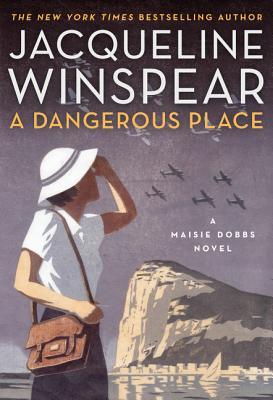
Mystery Monday: A Dangerous Place

22693178 
 Title: A Dangerous Place (A Maisie Dobbs Novel)
Author: Jacqueline Winspear
Publisher: Harper Collins, 2015. 308 pages.
Source:  Library

Summary:
Four years after the end of the previous book (Leaving Everything Most Loved), we catch up with Maisie, on her way back to England at last. Devastated by great loss, she is unable to face a return to family and familiar places, and leaves the boat at Gibraltar, where she finds herself investigating a brutal murder. 

Review:
 Jumping ahead in time four years gave me a jolt, and seems to have shifted Maisie's story onto another plane. Yes, this is still a mystery, but Winspear is moving more and more into novel territory. The real investigation in this story is into Maisie's own state of being, which is fragile in the extreme in her grief--and into the condition of Europe on the brink of WWII (it is 1937), and more particularly, Spain in the grip of the Civil War.

Winspear spins a gripping tale in which the personal--both Maisie's loss and the lives touched by the death of the man whose body she finds--and the political share importance. The questions raised about Britain's role in the mess that was the 1930s are interesting and well-researched, leading to a sense of foreboding. At the same time, it is fascinating to watch Maisie gain strength and confidence from her old calling, untwisting the threads that lead to murder.

Recommendation:
I was at first taken aback by the changes that Winspear wrought in Maisie's life, and the feel of the book is different (especially from the earlier mysteries in the series). But in the end I felt that it was also a more complete and complex book for that reason (not that the series has ever felt shallow; these mysteries have all been more novelistic and less formulaic than most). It was painful to see Maisie, who has always been such a strong character, reduced to serious mental and physical weakness. But it was good to see her find her way out of it to some kind of recovery.  I recommend the book both to followers of the series and to those who simply want to read a good period novel (though a reader new to Maise Dobbs may occasionally feel they are missing something).

Full Disclosure: I borrowed A Dangerous Place  from my library, and received nothing from the author or the publisher in exchange for my honest review. The opinions expressed are my own and those of no one else. I am disclosing this in accordance with the Federal Trade Commission's 16 CFR, Part 255: "Guides Concerning the Use of Endorsements and Testimonials in Advertising."  

Monday, July 6, 2015

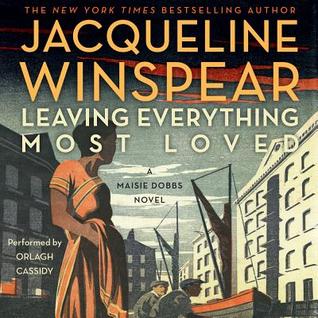
Mystery Review: Leaving Everything Most Loved

15820820


Title: Leaving Everything Most Loved
Author: Jacqueline Winspear; narrated by Orlagh Cassidy
Publisher: Orig: Harper, 2013, 336 pages. Audiobook by HarperAudio, 2013.
Source: Library (digital).

Publisher's Summary:
London, 1933. Two months after the body of an Indian woman named Usha Pramal is found in the brackish water of a South London canal, her brother, newly arrived in England, turns to Maisie Dobbs to find out the truth about her death. Not only has Scotland Yard made no arrests, evidence indicates that they failed to conduct a full and thorough investigation.

Before her death, Usha was staying at an ayah's hostel alongside Indian women whose British employers turned them out into the street--penniless and far from their homeland--when their services were no longer needed. As Maisie soon learns, Usha was different from the hostel's other lodgers. But with this discovery comes new danger: another Indian woman who had information about Usha is found murdered before she can talk to Maisie.

As Maisie is pulled deeper into an unfamiliar yet captivating subculture, her investigation becomes clouded by the unfinished business of a previous case as well as a growing desire to see more of the world, following in the footsteps of her former mentor, Maurice Blanche. And there is her lover, James Compton, who gives her an ultimatum she cannot ignore.


My Review:
As usual with this series, I enjoyed the book very much. I have been listening to many of these books, and Orlagh Cassidy does a very nice job of reading and voicing the characters. In a British novel of this period (or any?) the accents of the characters say so much about them, and I thought she did a great job, though I'm no expert.

The story is complex and intricate, and deals with a number of timely issues about prejudice and discrimination (and about colonization and imperialism). There is throughout the book a sense that everything is changing, and characters are spinning off into their own lives, as may happen. I had some amorphous feelings of dissatisfaction while reading, and on reflection think they are due to these changes. I've gotten used to a certain structure of relationships, and apparently don't like change. Clearly the author has some new plans for Maisie; I was a little worried this might be an end to the series, but observe that the next book is already out, so that's safe.

In the end, I found the book very well-written, and the mystery convincing. There is no easy solution, and the challenge that her discoveries presents Maisie and the reader is part of what gives the story meat. 

Recommendation:
I strongly recommend this series for those who like mysteries that are character-driven but dig into a serious and challenging puzzle as well. Winspear doesn't pull any punches about social issues, not all of which are limited to the 1930s. I recommend reading the series in order, as the characters and relationships grow and develop throughout and may be a bit confusing if you start in the middle.

Full Disclosure: I checked Leaving Everything Most Loved out of my library, and received nothing from the writer or publisher in exchange for my honest review.  The opinions expressed are my own and those of no one else.  I am disclosing this in accordance with the Federal Trade Commission's 16 CFR, Part 255: "Guides Concerning the Use of Endorsements and Testimonials in Advertising."

Monday, October 6, 2014

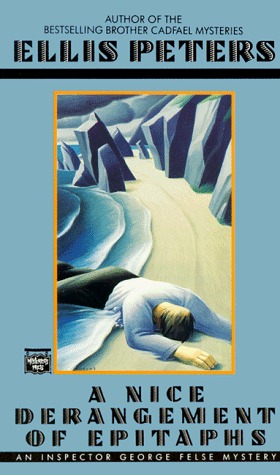
Mystery Monday: A Nice Derangement of Epitaphs


Time for a Classic Mystery!


847881
Title: A Nice Derangement of Epitaphs
Author: Ellis Peters (Edith Pargeter)
Publisher: My edition: Warner Books, 1992, 196 pages. Originally published 1965 by Collins.
Source: Been on my bookshelf for ages; yes, I've read it before.

Summary:
This is the 4th book about Detective Inspector George Felse. He and his family (wife Bunty and 18-year-old son Dominic) are vacationing in Cornwall and get caught up in the local excitement--the opening of the grave of 18th-Century local squire and  poet (and smuggler, if not pirate) in search of his lost poetry. What they find--and don't find--in the grave sets off a series of events that draw in not only George, but also Dominic.

Review:
I'm very fond of Peters' writing. Many people know about her 12th-Century monk, Brother Cadfael. Fewer know the Felse family, but they are well worth investigating if you can get your hands on the books (I think they've all gone out of print).  Bunty tends to get short shrift (in apology, Peters wrote The Grass-Widow's Tale, which is Bunty's own adventure and mystery to solve on her own), but Dom is usually in it up to his neck, and this book is no exception; the book is as much his story as anyone's.

Peters knows how to put a story together, with the right mix of the unexpected and solid police work, mystery and human nature. Her tone in these books, however, I suspect is not for everyone. There is a certain quality (which I am having trouble defining or describing. Wonder, maybe) which give the books an almost mystical air, even when firmly anchored in the real world. Or maybe the coast of Cornwall is a bit removed from the real world in any case. I think that Peters' biggest weakness is the tenderness with which she treats lovers and the young. I have the feeling she never had children, because the children she writes are just a little too amazing, and can always be trusted to be on the side of the angels, even if full of mischief. Maybe she was just writing in a more innocent time. For all that, I love both the characters and the writer.

Recommendation:
For fans of classic British whodunnits and the precursors of the cozy genre. It doesn't hurt if you like a bit of word play, as the title suggests.

Full Disclosure: I checked A Nice Derangement of Epitaphs out of my library, and received nothing from the writer or publisher in exchange for my honest review.  The opinions expressed are my own and those of no one else.  I am disclosing this in accordance with the Federal Trade Commission's 16 CFR, Part 255: "Guides Concerning the Use of Endorsements and Testimonials in Advertising."