Showing posts with label settlers. Show all posts

Sunday, September 30, 2018

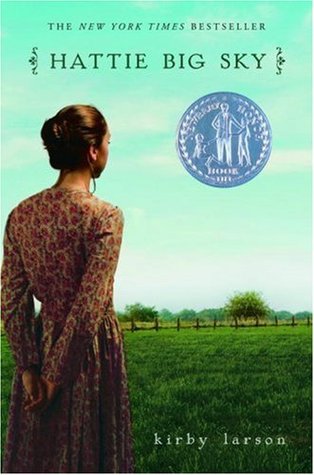
Middle Grade Monday: Hattie Big Sky/Hattie Ever After

207798  15760528
Audio book reviews.

Title: Hattie Big Sky and Hattie Ever After

Author: Kirby Larson. Read by Kristen Potter

Publication Info: 2007 and 2013 by Delacourt Press (hardback) and Listening Library (audio). 289 and 240 pages respectively.

Source: Library digital resources


Publisher's Blurbs:
Hattie Big Sky:
After inheriting her uncle's homesteading claim in Montana, 16-year-old orphan Hattie Brooks travels from Iowa in 1917 to make a home for herself and encounters some unexpected problems related to the war being fought in Europe.

Hattie Ever After:
After leaving Uncle Chester's homestead claim, orphan Hattie Brooks throws a lasso around a new dream, even bigger than the Montana sky. She wants to be a reporter, knowing full well that a few pieces published in the Arlington News will not suffice. Real reporters must go to Grand Places, and do Grand Things, like Hattie's hero Nellie Bly. Another girl might be stymied by this, but Hattie has faced down a hungry wolf and stood up to a mob of angry men. Nothing can squash her desire to write for a big city newspaper. A letter and love token from Uncle Chester's old flame in San Francisco fuels that desire and Hattie jumps at the opportunity to get there by working as a seamstress for a traveling acting troupe. This could be her chance to solve the mystery of her "scoundrel" uncle and, in the process, help her learn more about herself. But Hattie must first tell Charlie that she will not join him in Seattle. Even though her heart approves of Charlie's plan for their marriage, her mind fears that saying yes to him would be saying no to herself. Hattie holds her own in the big city, literally pitching her way to a byline, and a career that could be even bigger than Nellie Bly's. But can making headlines compensate for the pain of betrayal and lost love? Hattie must dig deep to find her own true place in the world. Kirby Larson once again creates a lovingly written novel about the remarkable and resilient young orphan, Hattie Inez Brooks.  

My Review:
By the age of the protagonist, these should be young adult novels, but they are rightly cataloged as middle grade. Hattie's struggles and the issues she faces are real and adult, but the author has written it in such a manner that the story will appeal to children, while still absorbing this undeniably non-juvenile reader.

I am of course fascinated by the whole process of settling the western US, and Hattie is the same age as my own grandmother, who also helped settle the west during that time of transition from the frontier to the 20th Century. Hattie has to face her life choices and struggles more or less alone, though I think that the important lesson she learns in each book (it takes a couple of times for her to get the lesson, and who among us hasn't had that problem, too?) is that she isn't alone, unless she chooses to be. In each book, she makes it through because others reach out to help her, and because eventually she reaches out to accept that help.

Since one of the big appeals is that Hattie is so strong-willed and independent, and determined to make a career for herself, I would love to see a 3rd book that shows how she manages her "work-life balance," as we say nowadays. Otherwise, we are left with the feeling that I so often get from books set in this era or earlier, a bit of disappointment that the female protagonist may be forced to compromise too much. So often the books fall on the side of love and marriage, as though somehow a year or so of independence was enough to last a lifetime. I'm in favor of more independent spinsters in books for girls, even though (or because?) I didn't choose that path!

I've wandered a bit from the point of the review, but suffice to say that I enjoyed the books a great deal, and checked out the second immediately on finishing the first, because I hadn't had enough of Hattie's humor, independence, and occasional blunders!

My Recommendation:
This is good for readers probably from about 8 up through adulthood. The view of the homesteading life is rich and realistic, and the intrusion of WWI into Hattie's dream adds an element that forces readers to think about prejudice and nationalism. The second book feels less weighty to me, but as mentioned, it touches on the very real issues of women's rights that were just coming into force after WWI.

Full Disclosure: I borrowed electronic copies of Hattie Big Sky and Hattie Ever After from my library, and received nothing from the author or the publisher in exchange for my honest review. The opinions expressed are my own and those of no one else. I am disclosing this in accordance with the Federal Trade Commission's 16 CFR, Part 255: "Guides Concerning the Use of Endorsements and Testimonials in Advertising."   

Thursday, September 19, 2013

Flash Fiction Friday: The Machines of Jest

Time for another Flash Fiction challenge from Chuck Wendig, king of brilliant and profane writing advice, and home of the best weekly writing challenges.  This week, he gave us a list of 20 potential sources of conflict for a story, and I spun the virtual wheel of fortune.  Change gave me "machines are taking over."  So I give you. . . 


The Machines of Jest
I may be the only living person who really knows what happened on Surely You Jest.  The planet, originally 165432Bb, was named by the first settlers for their reaction to its rocky surface.  It had been classed as suitable for human habitation, but it clearly wasn’t going to be anyone’s vacation paradise.  Later, when 165432Bc was settled and found to be marginally more pleasant, the settlers named it Don’t Call Me Shirley.  Naturally, the two became known as Jest and Shirley.

The effort required to make Jest genuinely habitable was immense.  To meet it, the settlers developed and deployed machines on a scale that at that time had been tried nowhere in the galaxy, and they were sophisticated machines.  An ordinary tractor-bot couldn’t handle the rocks or the slopes.  Jest tractors had what amounted to human reflexes to stabilize them.  And so on.  Since the incident on Jest, I think they make settlement machines a little differently, and usually send them in alone.  But back then, they dumped off settlers on any habitable world with a selection of resources, and left them to figure out how to make a go of it.

By the time the region around the original settlement, Jester, was rendered both habitable and arable, the residents had figured out how they could inside and do the work remotely.  Right from the start, in the manner of humans everywhere, the Jesterites had worked to make the machines more independent, to free the operators to do other things.  Early models required a driver on board, directly controlling operations.  Then they started to drive them remotely, but still in real time.  Gradually, they learned to program the machines for a full day’s work and just let them run.

At some point, several generations from Landing, someone realized that no one was programming the machines at all anymore.  They didn’t make a big deal about it.  Some worried a bit, but most agreed that it was a good thing, freeing the citizens to create a rich culture.  And it was proof of their own skills, to be the first in the galaxy to make truly independent machines.

I learned all this from the Galactic Records library while I was on my way to Jest with a load of—well, never mind what.  I always read up about my destinations, and I the idea of independent machines made me a little uncomfortable.  But, I’m from Last Stop, where we always keep our fingers on the buttons and figure work is a good thing.  At least, the Elders think that about work.  I figured adventure was a better thing, so I took to space freighting.  I’m Indie, so I get around, wherever the cargos want hauling and the price is right.  But I’ve only gone to Jest once.

A thousand square miles of terra-formed farmland surrounded the city of Jester, providing everything they needed.  And not one single human moved in all that land.  Just the machines, going about their business.  It bugged me.  I felt a bit squirmy even before I landed.

Last Stop, which was actually a rather early stop in terms of galactic settlements, had been inhabited for about 100 generations.  Jest has only been human space for five.  Five generations maybe wasn’t enough to forget that the first generation had short, nasty lives, cut off by lung disease from the dust and cancers from the radiation of 165432B, which was stronger than that of Sol on Earth.  People who stayed inside lived longer.  It’s not so surprising that staying inside became a goal for most inhabitants.

It only took me a couple of days in Jester to see it, though.  The machines were up to something.  There was less work being done, and a surprising stream of machines coming in with repair requests.  Sometimes the Techs couldn’t even recall what the machines had needed.

I watched a machine go back out after “repairs.”  It headed straight for the horizon and disappeared.  Maybe it worked out there.

An hour later, another did the same.  After the third machine in as many hours had followed the same path, I got out my ground scooter, the one-man air bike with double hover, and followed.  Two hours of fast travel bought me an answer I wasn’t sure I wanted.

Forty-six large machines congregated in a valley far from Jester.  While I watched from what I hoped was a hidden point, a forty-seventh joined them.  They all looked like they were designed to destroy things.  I figured they were supposed to be the ones pushing the frontiers, turning Jest’s rock into soil.  I moved a little closer.

One of the machines rotated its scanning cameras to view me, and rotated slightly to improve the view.  Immediately dozens of scanners locked on me, and I began to sweat.  When the first one moved, I hit the rocket-boost on my bike and got out of there.  I stayed as high as the bike would fly all the way back to the city.
#

I couldn’t convince anyone in Jester that there was a problem.  None of the techs could recall exactly what they’d done to the machines, besides “routine maintenance,” but that didn’t seem to bother them.  In the end, I did the only thing I could do.

I got out of there and left Jest to its fate.

Oh, I notified the Galactic Central Settlement Commission, but I doubted they would do much.  Bureaucracies move slowly, and I had a feeling the situation on Jest was going to change fast. Maybe they’d be in time to evacuate some of the people to Shirley, if they could convince any they needed to go.

As for me, I’m not taking any more commissions to that system.  The machines are taking over, and I don’t want to think what might happen if the contagion spreads.


________________

 This work and all contents of the Ninja Librarian blog is the sole property of Rebecca Douglass and in protected by copyright.  Please feel free to link to any page, but please ask permission to copy blog contents or fiction.  Thank you.