I've been playing with making Wednesday posts more about writing and being a writer, and posting fewer reviews (partly because I'm busy and can't read as many books, and partly to keep reminding myself and you that I'm a writer). I can't do updates on my progress every week, though, so I'm going to share thoughts on my writing process. I can't claim it's wisdom; I can't even claim any of it will be applicable to anyone but me. But maybe someone will get something useful out of it.
I'm currently in the process of planning my next mystery, and I've talked about that process before (see below). But something I'm thinking about this time around is the structure of the novel. My last book got a comment from an editor about there being too much that happens before the murder, and that got me thinking about the right place for a corpse. Of course, when I looked hard at the draft of that book (and got feedback from another editor), what was really wrong was that there was too much *unimportant* stuff before the murder--too much detail of every move JJ made. But the fact that the first reader argued that the corpse should show up in the first chapter gave me pause.
Of course, a quick look at the cozy mysteries I read tells me that the rule is nothing like that hard and fast. I've seen books that started with the body on page one, and others that take half a book to get there (I'll admit that those usually frustrate me a bit; it is supposed to be a mystery, after all; the sweet spot may lie somewhere in between, and I'll bet it's in a different place for every book).
There's another issue, too: we are expected to open with some event significant and exciting/dramatic enough to grab the reader and make them need to keep reading. A corpse is a pretty good way to do that. But lots of things are important to the main character, so maybe a broken coffee-maker spewing grounds all over the counter is a good dramatic opening, too.
As you can see, I'm rambling, trying to sort out some ideas and see what flies. Let me know what you think: must a cozy mystery open with a major dramatic event, and at what point should/must the corpse show?
***
I had originally though I'd write this about outlining/plotting, since that's what I'm doing right now. I was bemused to see that I have written posts on this subject 3 times. My approach has evolved.
The first time was in Feb. 2013. This post refers to a novel called "Murder Stalks the PTA." That evolved into Death By Ice Cream, the first of the Pismawallops PTA novels. That evolution was one of the things that convinced me the process I discussed in this post needed work. Up to that point, I'd been an unthinking pantser, taking the nugget of an idea and just jumping in and writing.
The second time was in September that same year, and I was starting to develop the outlining approach that I have more or less stuck to since, having struggled with the revisions of that novel.
The third time was in October 2015, as I was preparing to write Death By Trombone. Reviewing that was good--it reminds me of some things I'll want to do on the way to getting ready to write Death By Library.
Showing posts with label plot structure. Show all posts
Showing posts with label plot structure. Show all posts
Tuesday, September 25, 2018

Wednesday, February 19, 2014
Progressive Book Club! Analysis: Fire and Ice by Dana Stabenow

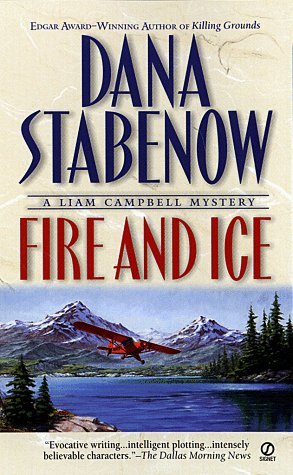
This week, instead of reading a mystery just for review, I read with the intention of studying how the story was laid out and developed. I'll admit that, since I kept getting caught up in the story, it only partly worked. Dana Stabenow is a good writer; it's hard to ignore the story and study the structure even in a book I've already read (I chose a re-read so I could pay more attention. Maybe I should have done one I read last week, not a few years ago!).
NOTE: THIS ANALYSIS DOES INCLUDE MILD SPOILERS!
Here's the scoop on the book I read, since this does amount to a review of sorts:
Title: Fire and Ice, by Dana Stabenow
Publisher: Signet, 1999, 286 pages (paperback).
Source: Library
The Plan:
My plan was to read the book and note plot and character development, creation and destruction of red herrings, means of inserting back story, etc. I was doing this in the interests of improving my own craft as I'm nearing completion of my first mystery and starting to rewrite my second (yes, I am aware that this would have been a good thing to do before I started writing either book. Isn't hindsight a wonderful thing?). As noted, the plan suffered a bit because the book was too good to read purely as an exercise in the construction of a mystery novel. Maybe I should have dissected a bad mystery.
The Lessons:
1. We start with a bang, almost. In fact, the first 3.5 pages are scene-setting, establishing the nature of the main character, Alaska State Trooper Liam Campbell, through his assessments of his fellow-passengers on the flight to his new posting (most of whom turn out, of course, to be his new neighbors). We also get the geography by watching the flight with Liam. Then we are let a little into his history, so that we know right off that there's a problem with his personal life and maybe in his professional life. Then, on page 5, we get a corpse.
My assessment: it's a bit chancy, even 3.5 pages of scene-setting. Stabenow can do it, because she's a known writer and her readers know she'll make use of this. But the beginning is actually kind of passive, and there's quite of bit of exposition. I'd love to be able to offer exposition like that, that makes you wonder only how it's going to play out in the story, not if. But that might be something you need to be trusted to get away with.
2. Keep things moving. Campbell is hustled from crisis to crisis, and neither his investigation nor his personal life is allowed to do anything the easy way, though once or twice it looks like it might.
This is where Stabenow brings in the humor that is her hallmark; the things that complicate Liam Campbell's life are almost absurd, yet still real. The murder investigation is never funny.
3. Everyone is lying. I've seen this noted before in discussions of writing mysteries, and it seems to be true here. Everyone is lying, hiding something, or just unwilling to talk to a Trooper. That makes nearly everyone a suspect at least until their lies have been sorted out, and maybe after, too.
Don't be nice to your characters. Campbell has to deal with the fact that the one person he most trusts and most wants to be innocent is lying to him right and left.
4. Keep the pressure on. Campbell can remove a few suspects from the list, but he can't remove the ones that most matter. And at the same time he can see a growing threat to other people.
SPOILER!
5. Killing off the bad guys is tidy, but not always totally satisfying. Stabenow deals with the perps in this one by having them end up dead, and that leaves some questions hanging. Maybe okay. I'd use it with caution. It also makes for a pretty high body count, which is okay for her, but not so good in a cozy (what I write). The mystery is wrapped up just enough, and in this case there is a nice circularity to the deaths. Campbell's personal life shows modest forward movement but is still a mess--we are clearly left expecting more about him. This is in keeping with generic conventions.
6. Still thinking about character development. Stabenow is really good about dropping the little bits of both description and backstory in without being obvious, and she's in no hurry. I can also see her using little things to tag a character: Liam Campbell is terrified of flying, we learn in the first pages. Not only does that tell us something about him, but it adds some nice tension in his personal life, since he's in love with a bush pilot. Most characters get physical description through his eyes, which works very nicely as he's a cop, but it's all done with one or two key points (except maybe a couple of the women, who get more attention, if you know what I mean).
I have concluded that character development and backstory are the hardest things to do smoothly. I'll probably have to be content with doing okay at first and getting better with practice.
###
Full Disclosure: I borrowed Fire and Ice from my library, and received nothing from the writer or publisher in
exchange for my honest review. The opinions expressed are my own and
those of no one else. I am disclosing this in accordance with the
Federal Trade Commission's 16 CFR, Part 255: "Guides Concerning the Use
of Endorsements and Testimonials in Advertising."
Subscribe to:
Posts (Atom)