Showing posts with label YA book review. Show all posts

Monday, April 27, 2020

YA Classic: A Tree Grows in Brooklyn

13619314

Title: A Tree Grows in Brooklyn
Author: Betty Smith. Narrated by Kate Burton
Publication info: 2005 Harper Audio. Original publication 1943 by Harper & Brothers, 443 pages.
Source: Library digital resources

Goodreads Blurb:
The beloved American classic about a young girl's coming-of-age at the turn of the century, Betty Smith's A Tree Grows in Brooklyn is a poignant and moving tale filled with compassion and cruelty, laughter and heartache, crowded with life and people and incident. The story of young, sensitive, and idealistic Francie Nolan and her bittersweet formative years in the slums of Williamsburg has enchanted and inspired millions of readers for more than sixty years. By turns overwhelming, sublime, heartbreaking, and uplifting, the daily experiences of the unforgettable Nolans are raw with honesty and tenderly threaded with family connectedness -- in a work of literary art that brilliantly captures a unique time and place as well as incredibly rich moments of universal experience.

My Review:
At first I wondered if I even wanted to finish this book. The style is definitely dated, and the there was a sense of distance that put me off as much as the grim reality of Francie's world did. But I kept on, the story and the style grew on me, and pretty soon instead of wondering if I even cared about the main character, I couldn't stop listening to see how she would manage to escape the life she could have been doomed to.

A Tree Grows in Brooklyn is a fantastic coming-of-age story. As we watch Francie grow and mature, we feel her struggle with her love for her ne'er-do-well father and her resentment of the mother who holds the family together, but can't hide her preference for her son over her daughter. With her own growing responsibilities Francie gains a greater appreciation of what her mother has done. They never stop struggling with each other, but there is one thing that holds them together: the determination that the Nolan children will be educated. That is the guiding force of Francie's life, and she sacrifices from an early age to achieve her goal.

Usually when I read a book that has been protested or banned, I'm hard put to understand why. In this case, I do get it. The author pulls no punches when it comes to the grittier aspects of life in 1900s Brooklyn, and that includes a level of frankness about sex that must have been disturbing in 1943 when it was first published. In fact, though the act of sex is never described here, I found some of the discussions of it a bit hair-raising myself. I'm not in favor of any book-banning, and kids see worse on TV, but there was something about this book that felt more real than any movie, so readers should be forewarned.

The audio book is very well done. Musical cues indicate text breaks, and Kate Burton does the Brooklyn accent very nicely, as well as assorted ethnic and regional accents Francie encounters. I felt the narration enhances the story.

My Recommendation:
A classic for a very good reason, and one to read if you never have. It is probably most suited for older teens and up. Some aspects of the book--including issues of racism and class prejudice as well as sexuality--may need discussing with young adults who read it.

I do classify this as historical fiction: it was written in the early 1940s, and set in the first 2 decades of the Twentieth Century.

FTC Disclosure: I checked A Tree Grows in Brooklyn out of my library, and received nothing from the writer or publisher for my honest review.  The opinions expressed are my own and those of no one else.  I am disclosing this in accordance with the Federal Trade Commission's 16 CFR, Part 255: "Guides Concerning the Use of Endorsements and Testimonials in Advertising." 

Monday, July 15, 2019

YA Audiobook Review: Staying Fat for Sarah Byrnes


21843441

Title: Staying Fat for Sarah Byrnes
Author: Chris Crutcher. Read by Johnny Heller
Publication Info: Recorded Books LLC, 2007.  Original: Greenwillow Books, 1993. 224 pages.
Source: Library digital resources

Publisher's Blurb:

Sarah Byrnes and Eric Calhoune have been friends for years. When they were children, his weight and her scars made them both outcasts. Now Sarah Byrnes—the smartest, toughest person Eric has ever known—sits silent in a hospital. Eric must uncover the terrible secret she’s hiding before its dark current pulls them both under. Will appeal to fans of Marieke Nijkamp, Andrew Smith, and John Corey Whaley.

My Review:  

I'd heard about this book for a while, though I can't now recall why or where. I was vaguely under the impression that it was a middle grade book (for the 8-12 crowd), but in spite of having gotten it from the Kids' section of the library's Overdrive collection, it is definitely YA. The book deals with some pretty heavy issues (including child abuse, suicide, abortion, and sex), and does so frankly.

Now that's out of the way, on to the review. 

I was totally gripped by this book. I had no idea what to expect, and in fact I didn't really even read the blurb. I was just looking for something to listen to while I do chores, and thought "oh, I've heard of that. It's supposed to be good." So I wasn't prepared for the emotional power of the story, which was expertly balanced with humor and a lot of insight into the teenaged mind. The story is narrated by Eric Calhoune, and I liked that he doesn't totally justify all the sometimes hurtful things he's done over the years. Instead, Sarah's crisis triggers him to make a step forward closer to adulthood, and to consider himself and his actions a little more carefully.

Some tense moments round out the story, some just plain adventure-story tense and some tense with importance and emotional power. I might offer a critique that the danger-tense part felt a little contrived, though it's consistent with characters' actions throughout. On the other hand, it is also told in Eric's note-perfect self-deprecating style, so that even while I held my breath about the outcome I was also close to laughter at the process. A larger criticism might be that the author's political position and opinions come through perhaps a bit too loudly at times. That didn't bother me, because I largely agreed with them, and because Eric isn't rabid, but rather is trying to understand things. In fact, the strongest stance, in my opinion, is against those who think they know all the answers.


My Recommendation:

This book has both won awards and been banned about as much as any YA book. I get why both have happened. I come down on the "awards" side, because the book offers teens an avenue to start thinking critically about important issues. That it also offers a strong argument for backing away from dogmatic beliefs will make some parents and teens uncomfortable. My recommendation is that they read it anyway, and keep an open mind. I don't recommend it for kids under at least age 12. 


FTC Disclosure: I checked Staying Fat for Sarah Byrnes out of my library, and received nothing from the writer or publisher for my honest review. The opinions expressed are my own and those of no one else. I am disclosing this in accordance with the Federal Trade Commission's 16 CFR, Part 255: "Guides Concerning the Use of Endorsements and Testimonials in Advertising." 

Monday, November 6, 2017

YA Audio: The Children of Willesden Lane


28462901


Title: The Children of Willesden Lane. Beyond the Kinderstransport: A Memoir of Music, Love, and Survival.
Author: Mona Golabek; read by Lee Cohen
Publisher: Hachette Audio, 2016. Originally by Times Warner, Int., 2007. 288 pages.
Source: Library digital resources

Publisher's Summary:
 
With the raw emotion of The Diary of Anne Frank, Mona Golabek's powerful memoir is a poignant story of tragedy and triumph in a time of war. Famed concert pianist Mona Golabek shares the inspirational true story of her mother's escape from pre-World War II Vienna to an orphanage in London--243 Willesden Lane. 'The music will give you strength....it will be your best friend in life.' With these words--the last she would ever hear from her mother--ringing in her ears, young piano prodigy Lisa Jura boarded the Kindertransport and headed for safety. Amidst the dozens of Jewish refugees trying to make their way in war-torn London, Lisa forms indelible friendships, finds romance, and, against all odds, wins a scholarship to study piano at the Royal Academy of London. This is a stunning testament to the power of music to lift the human spirit and to grant the soul endurance, patience, and peace.

My Review: 

The Children of Willsden Lane is what I might call a novelized biography of the author's mother. That is, it doesn't stick exactly to what is known, but instead provides us with both imagined dialogue and Lisa's thoughts as she faces difficult circumstances. It's hard to know exactly how much Lisa would have remembered and told her daughter later, but I'm pretty sure not the amount of detail the book contains. The result works, however. Mona Golabek has created a book that is incredibly moving, as well as revealing a great deal about the lives of the children who were sent to England on the Kindertransport.

The youngest children were, of course, fostered to people who no doubt treated them in a variety of ways from the wonderful to the awful. But for those, like 14-year-old Lisa, who were old enough to work, work was required (to my 21st-Century mind, the idea that you'd require 14-year-old refugees to get a job is a bit mind-boggling, but it wasn't so unusual then).

Lisa's first post, as a servant in a country house, wasn't terrible. The people were kind, and the work not overly hard. But it was excruciatingly lonely, because no one seemed to recognize that a child of 14 might like to have some people around her who shared her religion, if nothing else. She was horribly homesick and isolated.

That s what made 243 Willesden Lane a home for Lisa and the other "kinder" who lived there all through the war: they were together, all refugees who had lost everything they knew. She still had to work hard, didn't always get enough to eat, and came very near to being killed by a German bomb during the Blitz. But she had her music, and she had her friends, and that was enough to keep her soul alive.

Because this is not exactly a novel, not everything works out as neatly as we might like. But one thing does, almost unbelievably: Lisa gets that scholarship, and is able to continue to study music (even as she has to continue working to earn a living, too).

My review of the audio aspect of the book is mixed. Lee Cohen reads well, and does a good job with the different characters. However--and this bothered me quite a bit--her English accents are hopeless. They end up sounding almost as German as the characters with German accents. And in the end, that didn't matter to me at all, because the audio book has something that makes it a must-listen: the use of the author's own piano music to enhance the story. Because the piano is so important to Lisa and to the story, having the music there as the narration describes Lisa's playing is amazing.


My Recommendation:
This is a must-read, and because of the use of the piano music, the audio book is a clear winner. It isn't a book for young children, and I'm not really sure if it was even meant for YA (as opposed to adults), but my feeling is that young adult readers might relate, and any child over about 13 or 14 should be able to cope with the story; there is no sex and the violence is what we read of in our history books, only made more personal because we care about Lisa.

FTC Disclosure: I checked The Children of Willesden Lane out of my library, and received nothing from the writer or publisher for my honest review.  The opinions expressed are my own and those of no one else.  I am disclosing this in accordance with the Federal Trade Commission's 16 CFR, Part 255: "Guides Concerning the Use of Endorsements and Testimonials in Advertising." 

Monday, October 9, 2017

YA Audiobook Review: Annie On My Mind, by Nancy Garden

13135226

A couple of weeks ago I was looking for something to listen to, and noticed that Overdrive was announcing it was Banned Books Week, and had a separate section for books that had been banned. I leafed through, being taken aback at some of the books people have seen fit to object to, and noticed this book. I could tell it was about lesbian teens, though I was a bit slow to register that it was published in 1982, making it something of a classic.

Title: Annie On My Mind
Author: Nancy Garden; read by Rebecca Lowman
Publisher: Listening Library, 2008. Original, Farrar Strous Girroux, 1982 (234 pages).
Source: Library digital resources

Blurb (from Goodreads):

This groundbreaking book is the story of two teenage girls whose friendship blossoms into love and who, despite pressures from family and school that threaten their relationship, promise to be true to each other and their feelings. The book has been banned from many school libraries and publicly burned in Kansas City.

Of the author and the book, the Margaret A. Edwards Award committee said, “Using a fluid, readable style, Garden opens a window through which readers can find courage to be true to themselves.”


My Review: 
I didn't start listening to this right away, because I'm not a huge reader of YA. An obsession with love in most of those books puts me off a bit. But I wanted to listen to this, because I wanted to see how the subject was handled (even before I realized that this came out while I was--ahem--only a year or two older than the protagonists). Once I started listening, I found it hard to stop, and once I realized when it was written, I had to know what the author would dare to do.

The quote above about the "fluid, readable style" seems accurate to me. I found myself admiring the writing as well as being wholly caught up in the story. What saves this from being another teen-meets-teen story is, not just that the characters are gay, but that they don't know they are gay. So the reader knowingly watches them falling in love, while they think they are just having a grand friendship. I was wholly caught up in the story from the first chapter.

Some aspects of the book are dated: laws today protect students and teachers from discipline on the basis of their private lives (though I may also be deluded by living in a place where being gay is nothing remarkable). But the struggle of the two to come to terms with their own feelings, especially when they seem to bring the world crashing down around them, feels human and universal, and as relevant today as in 1982. Even better is the author's determination that this would have a happy ending, as almost no books about gay people had before she wrote. It is a happy ending that the characters earn, which makes it even better in my mind.

The reading by Rebecca Lowman is a marvelous addition to the story as well. She voices the characters well, and her voice seems to bring the story to life. I can definitely recommend the audio book.

My Recommendation:
Worth a read for historical value, but also worth a read for teens, gay or straight. Because the book does frankly discuss sexual feelings and desires, though there are no graphic scenes, it is probably not suitable for pre-teens.

FTC Disclosure: I checked Annie On My Mind out of my digital library, and received nothing from the writer or publisher for my honest review.  The opinions expressed are my own and those of no one else.  I am disclosing this in accordance with the Federal Trade Commission's 16 CFR, Part 255: "Guides Concerning the Use of Endorsements and Testimonials in Advertising." 

Monday, September 4, 2017

YA Review: Going Over, by Beth Kephart

17352909


Title:
Going Over
Author: Beth Kephart
Publisher: Chronicle Books, 2014
Source: Library

Publisher's Summary:
In the early 1980s Ada and Stefan are young, would-be lovers living on opposite sides of the Berlin Wall--Ada lives with her mother and grandmother and paints graffiti on the Wall, and Stefan lives with his grandmother in the East and dreams of escaping to the West.

My Review:  I debated about how to classify this book. I found it in the juvvy section of my library, but I hadn't read very far before I realized that it fits much more in what I consider YA. It's not so much that there is a love story at the heart of it, as that there are too many "adult situations" as they say. There is a pregnancy, a strongly implied rape, spousal abuse, and a lot of death as well. Nor are the politics behind the story all that easy to understand. So: YA. Not for children.

That taken care of, this was a good book. It highlights a part of history that doesn't get a lot of attention--the Cold War division of Berlin into East and West, and does it in the context of a couple of young people who mostly just want to live their lives. The story is strong and plays out well. In a way, this could be another in the series of books I've read this summer about kids dealing with death and loss. These young people have lost all sorts of family through death or separation, and it has certainly affected their lives, though that's not what the book is primarily about. Or maybe it is: maybe what drives them so strongly to be together is the need to not lose one more person they love to that wall.

The writing is strong, but I did have some issues. The book is told in alternating sections between Ada and Stefan. Ada's sections are written in the 1st person, present tense. Sefan's are written in 2nd person, a voice that is always difficult, and which causes most of my issues. Ada manages to keep her present tense straight, I think, but Stefan's sections are not always strong. Here and there the voice slips, losing the 2nd person. And, of course, the question always hovers (for me, anyway) as to whom exactly is being addressed when the narrator says "you." It appears to be Stefan, but that doesn't always feel right. I think the intention is to make the reader feel more a part of the story, to feel what it is to be trapped in East Berlin. It almost works.

My Recommendation:
This is a good read, and not long. I think it's worth it for the sake of the history as well as the story, but in my opinion isn't appropriate for kids under 13 or 14.

FTC Disclosure: I checked Going Over out of my library, and received nothing from the writer or publisher for my honest review.  The opinions expressed are my own and those of no one else.  I am disclosing this in accordance with the Federal Trade Commission's 16 CFR, Part 255: "Guides Concerning the Use of Endorsements and Testimonials in Advertising." 

Monday, October 17, 2016

YA Review: The Falcon's Malteser, by Anthony Horowitz

224516


Title: The Falcon's Malteser: A Diamond Brothers Mystery
Author: Anthony Horowitz
Publisher: Philomel Books, 1986
Source: Library

Publisher's Summary:
When the vertically-challenged Johnny Naples entrusts Tim Diamond with a package worth over three million pounds, he’s making a big mistake. Tim Diamond is the worst detective in the world. Next day, Johnny’s dead, Tim feels the heat, and his smart younger brother, Nick, gets the package—and every crook in town on his back!

My Review:
This is a pretty good mystery/thriller, with one foot in comedy and one foot in mayhem. The body count is high, making it definitely YA, not children's, and if it weren't for the somewhat cartoonish nature of the whole thing it would have been too violent for my taste. It might be, anyway. What's awkward is that the writing level feels more like it's for 10- or 11-year-olds. Maybe today's kids are used to corpses from the video games?


Nick Diamond is a pretty sharp kid, unlike his brother. He's pretty convinced of his brilliance, too, which makes him an entertaining narrator, in a way. At least, it's sort of entertaining to see him discover that he's not as smart as he thinks he is. Horowitz's tongue-in-cheek version of the hard-boiled detective-story style is more fun, as is the play on names that starts with the title and doesn't stop. The story is fast-moving, the writing clever and smooth, and after the half-way point I just sat back and read to see where it would go.

There's nothing fundamentally wrong with the book, and I almost stopped reading halfway through. I think that the style simply felt too adolescent to me, and the combination of the absurd with the corpse on every third page wasn't my thing. I really did feel torn--fun one minute, disturbing the next.

Recommendation:
I'm not sure what age the book is meant for (I notice that our library puts it in Young Adult, not juvvy, probably because of the body count). I'd say it's for somewhat older kids (high school) who want a fun, easy read that doesn't feel like a kiddie book but dodges the romance that seems to be a part of most YA novels. I wouldn't give it to little kids--to me, the cartoon violence is worse than the real violence that is in many kids' books (especially some of the historical fiction set in troubled times). Adults familiar with Dashiell Hammet and Raymond Chandler will probably enjoy the parody.

FTC Disclosure: I checked The Falcon's Malteser out of my library, and received nothing from the writer or publisher in exchange for my honest review.  The opinions expressed are my own and those of no one else.  I am disclosing this in accordance with the Federal Trade Commission's 16 CFR, Part 255: "Guides Concerning the Use of Endorsements and Testimonials in Advertising."  

Monday, May 2, 2016

Monday YA: Bone Gap, by Laura Ruby

I'm late. I know I'm late. Sometimes, that's just the way I am. I had to finish the book this morning!

18806240

Title: Bone Gap
Author: Laura Ruby
Publisher: Balzer + Bray, 2015. 345 pages

Publisher's Summary:
Everyone knows Bone Gap is full of gaps—gaps to trip you up, gaps to slide through so you can disappear forever. So when young, beautiful Roza went missing, the people of Bone Gap weren’t surprised. After all, it wasn’t the first time that someone had slipped away and left Finn and Sean O’Sullivan on their own. Just a few years before, their mother had high-tailed it to Oregon for a brand new guy, a brand new life. That’s just how things go, the people said. Who are you going to blame?

Finn knows that’s not what happened with Roza. He knows she was kidnapped, ripped from the cornfields by a dangerous man whose face he cannot remember. But the searches turned up nothing, and no one believes him anymore. Not even Sean, who has more reason to find Roza than anyone, and every reason to blame Finn for letting her go.

As we follow the stories of Finn, Roza, and the people of Bone Gap—their melancholy pasts, their terrifying presents, their uncertain futures—acclaimed author Laura Ruby weaves a heartbreaking tale of love and loss, magic and mystery, regret and forgiveness—a story about how the face the world sees is never the sum of who we are.


My Review:
I picked up this book because a co-worker heard me talking about face-blindness and said I had to read it. I talk about face-blindness (prosopagnosia) in another review, if you want to see what I'm talking about. And indeed, that is a significant theme in the book. I will also say Bone Gap is a work of magical realism, which I didn't realize when I started (because instead of reading the blurbs on the back I just started in). This is significant mostly because I'm not a huge fan of magical realism, so the book had to overcome that resistance. I'd say it succeeded in doing so pretty well, though in many ways I'd like to see the story without the magic elements.

Bone Gap is well-written, and Ruby has a very nice voice and some great turns of phrase (also some fun moments, as Finn and Petey mock college application essays that ask you to write weird things). The plot is both totally predictable (boy meets girl, etc.) and completely not (no one is as they seem). Getting past my own prejudices, my biggest negative on the book is that I thought the ending was a bit pat--not the wrap-up of the big adventure, but the final wrap-up. I can't say a lot without offering spoilers, but people just get too blasted nice. I was pleased that the author left a few threads hanging.

Recommendation:
This is a YA novel that would be excellent reading for high school students. But to me it read like an adult novel. The teen romance elements were secondary to a story, and that story was complex as well as magical. I would recommend this for anyone from about age 14 up who doesn't mind magical realism.

Full Disclosure: I checked Bone Gap out of my library, and received nothing from the writer or publisher in exchange for my honest review.  The opinions expressed are my own and those of no one else.  I am disclosing this in accordance with the Federal Trade Commission's 16 CFR, Part 255: "Guides Concerning the Use of Endorsements and Testimonials in Advertising." 

Monday, March 21, 2016

YA Revew: All Fall Down, by Ally Carter

22571275

Title: All Fall Down (Embassy Row #1)
Author: Ally Carter; narrated by Eileen Stevens
Publisher: Scholastic Audio, 2015.  (Original Scholastic Press, 2015, 310 pages)

Publisher's Summary:
Grace Blakely is absolutely certain of three things:
   1. She is not crazy. 
   2. Her mother was murdered. 
   3. Someday she is going to find the killer and make him pay.
As certain as Grace is about these facts, nobody else believes her -- so there's no one she can completely trust. Not her grandfather, a powerful ambassador. Not her new friends, who all live on Embassy Row. Not Alexei, the Russian boy next door, who is keeping his eye on Grace for reasons she neither likes nor understands.

Everybody wants Grace to put on a pretty dress and a pretty smile, blocking out all her unpretty thoughts. But they can't control Grace -- no more than Grace can control what she knows or what she needs to do. Her past has come back to hunt her . . . and if she doesn't stop it, Grace isn't the only one who will get hurt. Because on Embassy Row, the countries of the world stand like dominoes, and one wrong move can make them all fall down.


My Review: 
I picked up this book because it was discussed in the Goodreads Great Middle Grade Reads group, as an example of a book that a Jr. High-aged kid (as I recall) thought was one of the best (as in, books he/she most enjoyed reading). I can certainly see the appeal, and I rather wish I'd gotten it in print, not as an audio, because I think the over-dramatic reading style kind of put me off. As a result, I ended up thinking about what the writing books say about pacing: if you are at breathless full speed all the time, it's too much.

In this case, the pace was both too much and a little unconvincing. The narrator's breathless stress got wearisome, and as a result much of the urgency got lost through the middle of the book. Which is fine. I think the mistake was trying to keep Grace at full panic for the whole thing, and I can't be sure if that was in the writing or the reading.

Nonetheless, I enjoyed the book, and I can certainly see the appeal for teens, especially younger teens. The book stays out of "does he love me?" territory (which is bad from the perspective of some kids, but good for me and for others), and  focuses on the mystery that Grace is struggling to unravel. The ending isn't a total surprise, but it does surprise Grace, and forces some reassessment of things she's been taking for granted the whole time.

Recommendation:
Despite the lack of romance (Grace does do a very small amount of mooning, but that's about it), this has a YA feel to me. Maybe it's because of the age of the main character (16) or because she's dealing with some very real and adult threats (assassination), but I felt like it should be for kids about 12 or 13 and up--junior high, here in the States. And, as noted, I think the narration does the story no favors. I'll be reading the next in the series, and I'll do it on paper to get a better sense of the author's technique.

Full Disclosure: I checked All Fall Down out of my library, and received nothing from the writer or publisher in exchange for my honest review.  The opinions expressed are my own and those of no one else.  I am disclosing this in accordance with the Federal Trade Commission's 16 CFR, Part 255: "Guides Concerning the Use of Endorsements and Testimonials in Advertising." 

Wednesday, August 12, 2015

YA Review: Copper Sun, by Sharon Draper

90420


Title: Copper Sun
Author: Sharon Draper
Publisher: Atheneum Books for Young Readers, 2006, 302 pages
Source: Library

Summary:
Amari has a perfect life in her African village. Then the traders come...and these traders are after humans, not goods. Her family is murdered, the village burned, and Amari is marched off to the coast in chains, to be shipped across the ocean to a new land. In America, she is sold to a plantation owner who gives her to his son as a 16th birthday present (hint: he's not looking for a mother figure). Life is a grim thing, until a really horrific event gives her the chance to escape, hand in hand with a white indentured servant her own age and with nearly as much need to run.

Review: 
This book was hard to read. Not because the words are big, but because the truth it speaks is horrific. There is no escape from the realities of being a young female slave: not just whippings, but rape. The challenge for Amari is to keep her spirit alive in the midst of cruelty beyond her imagining, and quite frankly beyond mine. Like 12 Years a Slave, this book leaves the reader unable to deny the inhumanity of slavery (and the indenture system was a form of slavery, make no mistake. That the plantation owner "owns" Polly's indenture, and can sell it where he will--even to a whorehouse--makes that very clear).

Polly is an orphan, indentured for 14 years to pay her parents' debts. That her position is tantamount to slavery is made clear by the fact that her new master (and Amari's) assigns her to work alongside Amari, to share her hut, and teach the African girl English and how to work. The story is told in alternating chapters or sections told from the perspective of each girl, and we see how suspicion and prejudice gradually break down to allow them to become allies and, in the end, friends.

Incredibly vivid and well written, this book is one of those that I could not recommend for anyone under the age of about 15, due to the disturbing nature of the story. But it's one that probably everyone over that age should read, because it reminds us of both man's inhumanity to man and the strength and resilience of the human spirit. And part of the lesson is that not everyone can be so resilient. Characters die, physically and spiritually, which makes the victory of Amari and Polly over their circumstances all the more powerful.

Oddly, this wasn't a tear-jerker. I didn't cry over the sad parts. It was, instead, a thought-producer, and I couldn't put it down (plus I would happily have meted out some justice to some people who couldn't begin to understand the concept).

Recommendation:
For those about 15 and up who can deal with the realities of our history.

Full Disclosure: I checked Copper Sun out of my library, and received nothing from the writer or publisher in exchange for my honest review.  The opinions expressed are my own and those of no one else.  I am disclosing this in accordance with the Federal Trade Commission's 16 CFR, Part 255: "Guides Concerning the Use of Endorsements and Testimonials in Advertising."

Monday, August 3, 2015

YA Graphic Novel: Tomboy

20256612

Title: Tomboy: A Graphic Memoir
Author: Liz Prince
Publisher: Zest Books, 2014. 255 pages
Source: Library

Summary: 
This graphic novel explains what it was like for Liz Prince growing up "in the middle"--not a pink sort of girl, but not "one of the guys" either. It wasn't easy even in grade school, but the book really focuses on the struggles that hit in Junior High and High School.


My Review: 
I plucked this book from the cart while I was shelving at the library, because the title caught my eye, me being an unreformed tomboy and all. I'm glad I did. It was a fascinating look at gender roles and expectations in our society.

Liz Prince is about 20 years younger than I am, so I expected that our experiences would be different (I was/am also a little different sort of tomboy than she was, because hey, we are all unique!). What I didn't expect was to find that she had a harder time than I did. And I don't think that's just because I was okay with occasionally putting on a dress for a special occasion. I think it's because we were more open to girls and women being themselves in the 60s and 70s than we were in the 80s and 90s--and what about now?

Liz seems to have taken a lot of grief from gradeschool on up for "dressing like a boy." Now, I admit that I don't know what that would have been like, because I was a 1st grader in a time and place when it simply wasn't done. I wore a skirt to school (and changed to jeans the second I got home), until about 2nd grade, when we moved to a place where pants were acceptable (and Dad wasn't the minister anymore, so no one was looking so closely at me). I went ahead and "acted like a boy" regardless, as did most of my friends; we skinned a lot of bare knees. Liz seems to have been surrounded by girls who got very girly from a very young age.

In high school, where she was shunned for wearing (boy's) jeans and no makeup, I finally was free to dress as I pleased, and wore jeans and tee shirts and didn't even own a skirt for years. (Note: I still wear jeans and Tees and no makeup, and I haven't worn a skirt in years). Maybe it was different then because we were all rebelling against a very different generation? In any case, one thing that never seemed to come up were the accusations of lesbianism. Prince faced those just for hanging out with a friend who also dressed like a boy. My classmates might not have known the word.

The weird thing is, I think it was easier to be a tomboy in my generation because people were less aware of all the gender options. For Prince, being a tomboy seemed to require questioning her sexuality, even at a young age. For me and my friends, we just wanted to be boys because they had all the good adventures (in the books we read). And we wanted to wear jeans because they were more suited to running around and climbing trees (plus: pockets). We wore boys' clothes (literally in my case: I wore my brothers' hand-me-downs) and played boys' games, but we didn't try to look like boys. Most of us wore our hair long (because our mothers all cut and curled theirs?).

I've wandered from the review here, but there is method to my madness. The book made me think about gender roles and being a tomboy and how kids (and society) treat other kids who don't conform. And that, I think, is a large part of the point (as well as letting girls who maybe don't fit the standard model know that they are not alone, and that it's okay--and maybe even that not liking skirts doesn't mean you aren't heterosexual?). That is what made this a really good book.

Recommendation:
I recommend this book for everyone who has ever struggled against gender roles, or thought about it, or teased someone who didn't fit the mold, or thought about teasing...you get the picture. I think it's kind of an important book for our teens, and probably for the rest of us, to read. It only took me an hour or two--well worth the time!


Full Disclosure: I checked Tomboy out of my library, and received nothing from the writer or publisher in exchange for my honest review.  The opinions expressed are my own and those of no one else.  I am disclosing this in accordance with the Federal Trade Commission's 16 CFR, Part 255: "Guides Concerning the Use of Endorsements and Testimonials in Advertising."

Monday, July 27, 2015

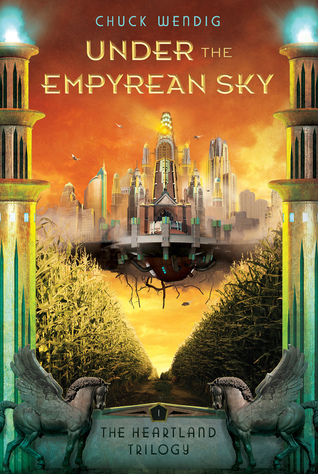
YA Review: Under the Empyrean Sky, by Chuck Wendig


I've been following Chuck Wendig's blog for a long time now, gleaning writerly wisdom and writing prompts for my flash fiction. I've read and enjoyed (and written about) his writing book, The Kick-Ass Writer. Now I've read the first book in his dystopian Young Adult Heartland Trilogy.

17817631
Title: Under the Empyrean Sky (Heartland Trilogy #1)
Author: Chuck Wendig
Publisher: Skyscape, 2013. 354 pages.
Source: I think I picked this one up on a free or cheap day at Amazon.

Publisher's Summary:
Corn is king in the Heartland, and Cael McAvoy has had enough of it. It’s the only crop the Empyrean government allows the people of the Heartland to grow — and the genetically modified strain is so aggressive that it takes everything the Heartlanders have just to control it. As captain of the Big Sky Scavengers, Cael and his crew sail their rickety ship over the corn day after day, scavenging for valuables, trying to earn much-needed ace notes for their families. But Cael’s tired of surviving life on the ground while the Empyrean elite drift by above in their extravagant sky flotillas. He’s sick of the mayor’s son besting Cael’s crew in the scavenging game. And he’s worried about losing Gwennie — his first mate and the love of his life — forever when their government-chosen spouses are revealed. But most of all, Cael is angry — angry that their lot in life will never get better and that his father doesn’t seem upset about any of it. Cael’s ready to make his own luck . . . even if it means bringing down the wrath of the Empyrean elite and changing life in the Heartland forever.

My Review: 
As my regular readers know, I don't do a lot of YA books, and one reason is that they are often more violent and dystopian than I like. In many ways, that was true of Under the Empyrean Sky. But it's also a very well-written book.

Here's what I liked: it's a complex story with plot twists I never saw coming (as well as some I did). Teen angst was minimal, because these teens have real nasty lives to deal with. There is a realistic conflict, or at least tension, between Cael and his father. 

What I disliked: This is dark! The Heartland sucks. And there is a lot of violence in the book. Obviously, none of these things is necessarily bad. They just aren't to my taste so much. A more significant criticism is that, as with so many YA novels, a lot of stuff goes wrong because the adults and teens aren't talking to each other. This may be realistic in some ways, but I think those parents need some lessons in parenting, the way they hide stuff from nearly-grown kids, stuff the kids really need to know!

What intrigued me, and will probably make me read on: There's a lot still to learn about this world Wendig has created. I want to know more about it and how it works--especially what's out beyond the Heartland? I do find that I'm almost more interested in that than in the characters, which is not so good.

Summary:
This is definitely a book for older teens. But I think a lot of older teens will really like it, especially those who are sick of vampires and moony females.

Full Disclosure: I purchased Under the Empyrean Sky, and received nothing from the writer or publisher in exchange for my honest review.  The opinions expressed are my own and those of no one else.  I am disclosing this in accordance with the Federal Trade Commission's 16 CFR, Part 255: "Guides Concerning the Use of Endorsements and Testimonials in Advertising."

Wednesday, April 8, 2015

G: Grand Canyon


Down into more than a valley for the letter G: we're headed down the Grand Canyon!

YA Book Review


Title: Downriver
Author: Will Hobbs
Publisher: Bantam Doubleday Dell. 1991; 204 pages
Source: Thrift shop, years ago

Summary:
Fifteen-year-old Jessie is on an "outdoor education" program (for kids in trouble), and isn't very happy about it. But when they steal the program's gear and "pirate" a run through the Grand Canyon, it is both better and far worse than she expects. Jessie learns a great deal more, and grows up a lot faster, than her father could have expected.

Review:
Okay, Will Hobbs doesn't write great literature. What he does write is exciting stories for and about teens that take place in amazing places, and generally force the characters to do far more than they could ever have believed possible. The river-running scenario for this book does just that. Not only does Jessie find out just how much she can do, she also learns to what extremes some of the other students will go when things take a truly frightening turn.

The writing is fast-paced and smooth. It may be a bit formulaic--I could certainly tell from the beginning which of the boys was trouble, and which worth cultivating--but the book has a clear appeal for kids, and possibly equally for boys and girls. Though I will say that while I liked and could empathize with the female narrator, she definitely struck me as not feeling entirely female (maybe why I liked her--I'm pretty much a tomboy myself and never have exactly thought or acted like a girl). In fact, I think it's one of the nice things about the book--though the female narrator is interested in the boys and is in fact hoping that she can be a couple with one, the book wastes essentially no time on mooning and obsessing about the boys.

I'll give this one a positive mark, both because it was a fun and exciting story and because it ultimately depicts some strong female characters who manage to take charge of their own lives.

Recommendation:
I'm not sure what age to say for this. It feels more YA to me, but it is in fact entirely "clean" and has no inappropriate situations (well, aside from the whole premise that a bunch of high-school age kids could or should steal some boats and run the Grand Canyon without permits or any idea what they are doing). For adventure lovers of whatever age, perhaps.

Full Disclosure: I bought my copy of Downriver, and received nothing from the writer or publisher in exchange for my honest review.  The opinions expressed are my own and those of no one else.  I am disclosing this in accordance with the Federal Trade Commission's 16 CFR, Part 255: "Guides Concerning the Use of Endorsements and Testimonials in Advertising."

###

And now for the obligatory photos, though I have none of the river: I haven't ever been to the bottom of the canyon. But the view from the North Rim: 
North Rim Visitor's Center overlook
North Kaibab Trail. Still only a few miles from the top here, in the side canyon. We hiked about 2-3 miles down and back up.
Sunset over the canyons.
For really great reading about the Canyon, see John Wesley Powell's Exploration of the Colorado River and it's Canyons (1874), and Colin Fletcher, The Man Who Walked Through Time  (1968). Also, of course, Brighty of the Grand Canyon, by Marguerite Henry (1953) for the youngsters and lovers of equines.