Showing posts with label whales. Show all posts

Friday, June 12, 2020

Photo Friday: Antarctica #6

I have struggled a bit with looking at and selecting photos to continue sharing with you all. Not because I don't want to share them--I do. Photos are meant to be shared. It's just kind of hard right now to look at that other life. But I decided I could do it, with less commentary, but remembering the good times. It helps in a way that on most of these outings Dave and I were in separate groups. (For those who wonder, it's because I got ready much faster, and once dressed for outdoors in Antarctica, staying in the ship wasn't an option!)

This was Day 4 along the Antarctic Peninsula, where we spent the morning doing both a landing and a zodiac cruise at Portal Point. This was a whales, seals, and snow morning! I was in the group that landed first, then cruised, and it started snowing shortly after we landed. By the time the zodiac cruise ended, it was raining, and the weather worsened enough we didn't have an afternoon outing. I'll just share the photos with minimal captions and let you enjoy the amazing world that is still out there, somewhere beyond the COVID Curtain.

These guys were the welcome crew by the landing--a pair of crab eater seals, IIRC.

Seals on land are pretty funny!

Big wet snowflakes

As we approached the landing.


X marks the spot... for something? The pattern is from wave erosion suggesting several roll-overs.
We'd seen whales swimming and breaching from the shore, and it didn't take long for a closer look.
My best shot of a breaching whale--a little fuzzy due to excitement and a wobbly boat.
As photos go, this is awful--but I wanted to show the huge splash when the whale came back down!
Today's gratuitous penguins. If we'd returned to Ushuaia as intended, I might have bought one of these!


All images and text ©Rebecca M. Douglass, 2020, unless otherwise indicated.
As always, please ask permission to use any photos or text. Link-backs appreciated!


Friday, May 8, 2020

Photo Friday: Antarctica #6

Portal Point: Seals and Whales

Our 4th day in Antarctica was the only one where we didn't get to do two outings, thanks to the weather. But we did get both a landing and a cruise at Portal Point, and had some special wildlife sightings.

They split the group so only half of us landed at a time (due to constrained space on land), and I was in the batch that got dropped ashore first. This fantastic duo was there to greet us!
Crabeater seals, which do not in fact eat crabs (they mostly eat krill)


Seals are very fast and graceful in the water, but even more so than penguins they are at a disadvantage on land.

Whenever we were ashore, members of the expedition staff went ahead of us with markers to show where we shouldn't go. Sometimes they wanted to keep us away from penguin rookeries or cranky seals. In this case, it was to keep us from the unstable edges of the snowfield, which dropped off 100' or so into the ocean.
Being smart enough to know I don't know everything, I stayed behind the guide.
 Then it started to snow, which was actually amazing and fantastic, even if my camera did want to focus on the snowflakes, making for a lot of photos I had to toss.
 Snow in Antarctica--what could be more appropriate?
I'm not sure who I got to snap this one of me, enjoyed the weather and trying to keep my hood on my head. Note our ship in the background.
Snow made everything more beautiful, and reminded us that a) the weather can turn bad any time of year, and b) it was nearly the autumn equinox, so summer was over.
Snow on the rocks at our landing--I was being very careful!

After an hour ashore, we swapped with those who'd been out cruising, and headed out to look for whales. We'd already seen several from up on the bluff, including one breeching.

We also checked out the ice bergs, which as usual were beautiful.
Waves sculpt the lower reaches of the bergs.
 My husband took the photo below. I include it because it not only shows the color of the ice and water, but also the dirt stripes. The vertical dark stripes show that this berg is lying 90 degrees from how it stood as part of the glacier. The stripes are dirt, laid down in several seasons, perhaps when slopes above the glacier slid and dumped dirt on the ice.
I had to use his photo because most of mine didn't come out. Too much snow on the lens :)
 I'm pretty sure this berg has some history.
The wave-erosion patterns show that the berg has tipped over, probably more than once.
 I promised you whales. This was the only place I saw breeching whales. Apologies for the quality of the photo, but long telephotos on a wildly rocking zodiac make for less-than-perfect photos.
It's also just possible I was too excited to take care with my photos.
 Just for fun--this is blurry, but gives some idea of the splash that thing made when it came back down.
It was kind of loud, too.
Not long after that, we got called back to the ship, as conditions were deteriorating. The snow had turned to rain, and we were getting cold and wet. It was certainly a luxury and a delight to have a hot shower after outings like this. I felt bad for the early explorers, who must have pretty much been cold and wet for weeks at a time (other times they would have dried out, but still been cold).

As the seals had greeted us, the whales waved goodbye.
All humpback whales again.

###
 All images and text ©Rebecca M. Douglass, 2020, unless otherwise indicated.
As always, please ask permission to use any photos or text. Link-backs appreciated!


Friday, May 1, 2020

Photo Friday: Antarctica #5

Zodiac cruise with icebergs--and some wildlife

I'm working my way through the Antarctica photos, and I'm kind of amazed to realize from the post numbering that we've been home for 5 weeks. Still have about 5 more posts to do from Antarctica, and then I can get moving on all the hikes in Patagonia. 

Today I'm featuring our Day 3 (along the Antarctic Peninsula--it was day 6 of the cruise) afternoon zodiac cruise in Andvord Bay. This was the after-lunch outing following my amazing penguin encounters.  

We sailed from Neko Harbor to Andvord Bay while we lunched, and the rain stopped, to everyone's relief.
We sailed past lots of these
And parked about here
 Pile into zodiacs and head out with Rustyn Mesdag at the helm. I snagged the seat by the bows, which can be damp but also allows for some good views.
For obvious reasons, I'm not really sure who was on the boat with me!
 There's not a lot of narration needed for the next 2 1/2 hours, though that doesn't mean I won't add any.
Just like a cartoon!

Some of the ice hunks that come off the glaciers are pretty dirty, while others are sparkling white.
Many of the bergs were amazing shades of blue, above and below the water

It took a little cruising around, but eventually we found the wildlife.
A crabeater seal taking a rest.
Penguin naps
And whales! These are all humpback whales, which was most of what we saw.


And to finish off--a little whale video. It's a bit shaky, because I was in the zodiac and that's not a very stable platform (and maybe because I was excited). If you listen to the sound, you'll hear the whale breathe (and me getting excited).
 

All images and text ©Rebecca M. Douglass, 2020, unless otherwise indicated.
As always, please ask permission to use any photos or text. Link-backs appreciated!

Friday, April 3, 2020

Photo Friday: Antarctica #1

I promised y'all penguins, so I'm jumping over whatever land-based trips I still need to share, and going right to the world's most amazing swimming birds. Okay, and also a landscape that is a bit mind-boggling. And whales....

A bit of background:
In the late afternoon of March 9, we boarded the Oceanwide Expeditions vessel Plancius in Ushuaia, Argentina. On the 12th, we woke up in Antarctica (okay, not a total surprise, and we'd seen the South Shetland Islands the day before as we steamed past). Our ship, a refitted research vessel 89 meters long, carried 114 passengers and 46 crew (including 8 guides for our adventures, and an amazing chef). That makes it a pretty small ship for a cruise, and allows for the kind of special trip this was: one where everyone could participate in all the activities and landings (all covered in the base price, BTW). Those activities included kayaking, zodiac cruises, landings, and various mountaineering activities (participation in some restricted by the need for crampon-compatible boots). It would also have included camping on shore, but weather and snow conditions, alas, sank that plan.

Bear in mind that March is decidedly late summer in the south polar regions, as we approached the fall equinox. However, we were exploring the Antarctic Peninsula, which actually extends pretty far north, so that we were at latitudes comparable to that of Denali in Alaska. The weather when we started was truly perfect.

Here's a bit of map to get you oriented:
This shows Ushuaia and the southern tip of Argentina/Chile, and the northern tip of the Antarctic Peninsula, extending farther south than what we got.

More perspective:
What we visited was the tip of that bit that extends way out from the main continent.
 
Okay, now for the trip.

As we approached the dock for boarding, we got a nice perspective on the different sorts of ships you can take to the polar regions (I presume all were going there; I don't think there are many other places to sail to from Ushuaia). Our Plancius looked pretty small at the dock next to a somewhat larger cruise ship--and wholly overshadowed by one of the giant ones, whose passengers generally can't land anywhere.

Plancius didn't look quite so hopelessly tiny up close.
Note the line of passengers approaching the table on the dock. We did go through a cursory health screening before boarding. It seemed to work; no one had so much as a cold virus.
We set sail just before 6 p.m., heading down the Beagle Channel.
Ushuaia perches on the narrow bit of land between the mountains and the sea, and is actually quite a bit more hilly than it looks here.
We heard a lot of talk about the "Drake Lake" of our crossing. This, believe it or not, is the water we had for most of the way across the roughest bit of ocean in the world. No one aboard had ever seen it anything like so calm. I was grateful not to be testing the ability of my seasickness patch to keep me functional (spoiler alert: I was right to be grateful for the calm).


Late on the second day we were excited to spot land--the South Shetland Islands, the first outliers of the Antarctic Peninsula.
  On the 3rd morning we woke up in Antarctica, at Orne Harbour.

The first adventure was a zodiac cruise (zodiacs are those black rubber inflatable boats) around the Harbour and out into the Gerlache Straight a bit in pursuit of whales.
Okay, the ship looks pretty big from this perspective. The zodiacs held a dozen passengers and one guide to run the engine and talk about what we were experiencing. They were highly professional and in most cases passionate about the animals and landscapes we saw.

I promised you penguins--they were the first thing they took us to see. These are called chinstrap penguins, for reasons you can probably figure out.

We then cruised out into the channel a bit where a humpback whale was more than cooperative, coming up very close to our boats. Unfortunately, we eventually realized that the whale was distressed because we'd gotten (unknowingly) between her and her calf. We moved off and left them in peace, but not before we'd all gotten a thrill.
This isn't really a photo of the whale. It shows you how close it was--almost too close to see from across the zodiac, even standing up.
Photography in the zodiacs was always a little challenging. I lost a lot of my first-day photos because I hadn't set my ISO right. You need really fast shutter speeds to get good photos from a tiny rubber boat bouncing around in the water, even if the subject is holding still (which is wasn't). It is also often hard to get a good shot with 12 other people maneuvering to get photos.
Sometimes, even when you have to peer between your fellow passengers, you get a great view.

By the time we'd seen the penguins and the whales, we all could have gone home happy. But we continued with a swing deeper into Orne Harbour, with some nice icebergs (small ones; later we saw the massive ones).

The glassy seas reflected the grey skies and it all made me feel very far from California!
One little zodiac and 8 even smaller kayaks, exploring among the ice.

This is already unmercifully long--and we haven't even gotten to the afternoon, when we got our turn in the kayaks. That--and lots more whales and penguins--will just have to wait :)

I hope this has been a nice distraction from the constant blast of scary news we're all getting right now. I'll keep posting up about our trip and sharing pictures, in hopes of making someone's day a little better.
###
All images and text ©Rebecca M. Douglass, 2020, unless otherwise indicated.
As always, please ask permission to use any photos or text. Link-backs appreciated!


Saturday, April 4, 2015

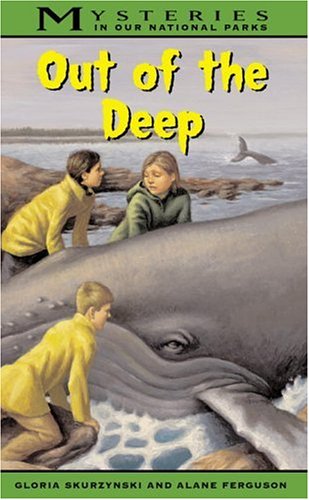
D: Mt. Desert Island and a Middle Grade Mystery

Day 4 of the Challenge, and D is for Mt. Desert Island. That would be Acadia National Park, and am I already messing around with the alphabet? You bet I am! Because even though the island is named for "Mt. Desert" there is no Mt. Desert. The French explorer Champlain called the place "île des monts déserts" or island of the bare (desert) mountains. The largest of those bare mountains is now known as Cadillac Mountain. Are you confused yet? Well, don't let it bother you. It's all just an excuse to bring you a review of Out of the Deep, a mystery for middle-grade readers with an environmental theme.

1037822

Title: Out of the Deep (Series: Mysteries in Our National Parks).
Author: Gloria Skurzynski and Alane Ferguson
Publisher:  The National Geographic Society, 2002.147 pages.
Source: The ever-beloved library

Publisher's Summary: 
(Note: during A to Z I am more inclined than usual just to give you what the publisher uses as a blurb).
Wildlife veterinarian Olivia Landon and her family are in Maine, investigating the mysterious strandings of marine mammals on the rocky beaches of Acadia National Park. With the family is 14-year-old Bindy Callister, a temporary ward who has been bullied by her older brother. Jack, Ashley, and Bindy come upon a baby humpback whale stranded in a rocky tidal pool and barely alive. During the complex rescue operation that follows, no one notices when Bindy wanders off. By the time Jack and Ashley find her, Bindy is acting very strange. She knows who' s causing the strandings but is afraid to tell. Jack and Ashley must get her to talk before more lives are endangered!

Review:
I've been meaning to track down and read some of these National Park mysteries ever since I first saw them in a park bookstore several years ago. I hadn't done it mostly because I rather feared they would be mediocre stories slapped together for a theme. (Well, and because some have rather sensational-literature-style covers). I should have known better. I don't find many bad books in the Parks bookstores. And if this is no great work of literature, it is a well-constructed mystery for kids, with just enough excitement to keep them reading, and some reasonably well-developed characters.

My second fear was that the ecological message would swamp the story. That is always a risk with a book that is written at least in part with a message, and make no mistake, this is a book with a message. But I have to say that the authors--one a recognized writer of adult mysteries, and the other a science writer--handled the material well. A kid reading this will learn a lot about whales and only occasionally may feel that he has wandered into a textbook. Far more often, she will feel like she'd better finish the chapter and make sure they all survive! 

A brief afterword by a whale researcher helps the kids sort out truth and fiction.

Recommendation:
I think this book will appeal to both boys and girls from maybe age 8 or 9 and up. There is some rather real peril before the end, but you never really doubt that the kids will be okay, and I like that they take action themselves in a tight situation. This is a book that has less appeal to adults than children, I think--in other words, it hits pretty squarely on the audience it aimed for.

Full Disclosure: I checked Out of the Deep out of my library, and received nothing from the writer or publisher in exchange for my honest review.  The opinions expressed are my own and those of no one else.  I am disclosing this in accordance with the Federal Trade Commission's 16 CFR, Part 255: "Guides Concerning the Use of Endorsements and Testimonials in Advertising."  


Now for a couple of photos to go with the setting:
The kids rescue a whale that is stranded on, I think, the beach in this photo. At any rate, they turn and see The Beehive behind them, and this is shot from the top of The Beehive!

Waiting for sunset on the bald top of Cadillac Mountain, largest of the "desert" mountains.

I also need to note and apologize here--we are on the road for the next week (getting new photos to share!) so my responses will be limited, as will my visits to other blogs. I'll do my best to catch up whenever I have internet access, though, so please don't give up on me!