Monday, April 8, 2013

G: Dorothy Gilman, Kerry Greenwood


Monday Mysteries!  This time, not a specific book review, but a couple of authors (filed under "G") whose work I have enjoyed a lot.  Also, on reflection, we could call it "Girls Gone Independent" (sorry, couldn't think of a "g" word to finish the alliteration).
First: Dorothy Gilman, author of the Mrs. Pollifax series and a number of stand-alone books.
The Unexpected Mrs. Pollifax  (Mrs. Pollifax #1)

I have to admit it, though it probably marks me as a fogey: I love Mrs. Pollifax.  There she is, 60-something, bored with retirement, so she becomes a spy for the CIA.  Realism?  Check that at the door and get a load of fun instead.  This isn't gritty and hard-core, this is the head of the garden club (and from New Jersey, at that!) stumbling her way through mysterious spy rings and capture by evil-intentioned enemy agents and coming out on top because she doesn't know the meaning of defeat. The Unexpected Mrs. Pollifax, the first book in the series (also the first Gilman wrote, I believe) is my favorite, even though structurally it violates most of the rules.  Fully 1/3 of the book could be called set-up, before the action really heats up.  But what a set-up it is!  And then to see Mrs. Pollifax blithely corrupting communists with ideas about democracy, trusting all sorts of dubious people--and getting them to do exactly what she wants.

Despite the essentially light nature of the Mrs. Pollifax stories, Gilman is no pussycat about hairbreadth escapes and flirting with death.  Mrs. Pollifax does it all, and is no stranger to carving victory painfully from the iron grip of defeat.  In many books, she faces death with a calm born in part of her age: she's been there before, and knows it's only a matter of time.  In fact, on reflection, Mrs. Pollifax is a great role model in several ways.  Heck, she even takes up yoga and karate so that she can be better at what she does.  Plus: taking volunteerism to a whole new height (did I mention she just walked into the CIA and volunteered to be a spy?).

For an extra treat, get hold of the Recorded Books versions of the stories read by Barbara Rosenblatt.


Second: Kerry Greenwood, author of the Phryne Fisher mysteries, set in Australia in the 1920s.  Another female who doesn't follow the rules,  Phryne (pronounced "fry-knee"), the daughter of an English lord, has moved to Sydney, Australia just to get away from a family that would insist she be modest and chaste and marry the man they chose.  She has no plans to do or be any of those things.  Rich now, but from a poor background, she has her own unique take on the world of both the rich and the poor.

Phryne parties hard, sleeps with her Chinese lover (and at times with any other attractive young men she wants to), and drives fast cars to chase the bad guys, all the while dressed to the nines.  Like Mrs. Pollifax, she's not terribly realistic, but she's a lot of fun, and her adventures are fast-paced, entertaining, and occasionally thrilling (I wonder how Phryne and Emily Pollifax would feel about being lumped together this way?  Maybe less upset than you'd think).  However, while Gilman keeps her writing PG, Greenwood definitely embraces an "R" rating.  Not that there's anything wrong with that.
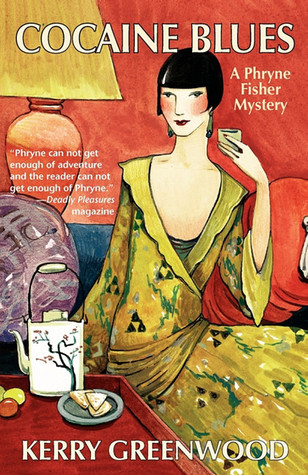
Cocaine Blues (Phryne Fisher, #1)
 Cocaine Blues is the first of the Phryne Fisher mysteries.


************************

Time for another shout-out for the Princelings giveaway from Jemima Pett.  Click the Rafflecopter to enter to win a variety of books--including The Ninja Librarian!

a Rafflecopter giveaway

Friday, April 5, 2013

E: Aaron Elkins (Book Review)


Elkins represents the first in my Monday sequence of favorite mystery writers (and yes, I know this isn't Monday.  Consider it make-up for April 1st when I had other things on my agenda).  I'm not covering all my favorites, by any means, but I did manage to find several who fit the letters for the days!  (And boy, it's been a while since I reviewed a bit of adult fiction. . . feels strange. . . spending too much time among the kids?).
Without further ado, then, Dying on the Vine, a Gideon Oliver (a.k.a. "Skeleton Detective") mystery

Dying on the Vine

As the 17th Gideon Oliver book, I hardly expected Dying on the Vine to have anything shockingly new.  Or maybe I did.  A lot of mystery series that I've liked immensely in the early years have changed over time into something (typically more violent) that I don't like as well.  Elkins seems to have avoided that trap while still managing to come up with inventive new settings and scenes for his stories.  In fact, Dying on the Vine may be one of the least violent murder mysteries I have read, in terms of what happens during the story and to the main characters.  There is, of course, a murder, but it happens off stage and before the book begins, and as we only ever see the corpse as a skeleton, it's pretty sanitized.  Well, okay, there is another murder, also off stage and not very violent.

True confession time: I like mysteries for the puzzle.  I'm not big on blood and gore.  Close shaves and narrow escapes are fun but not essential.  More on that later.  So nice clean skeletons are okay with me, as they are for Gideon himself.

Dying on the Vine takes place in Italy, where Gideon and his wife Julie (along with friend John Lau of the FBI and his wife Marti) have gone for a combination of business and pleasure.  Gideon is leading a seminar on forensic skeletons (my paraphrase), John is attending, and they are all visiting friends who own a vineyard and winery.  The mystery strikes when a local police officer offers the class a real skeleton to contemplate, and (of course) Gideon turns up some inconsistencies between the police findings and the skeletal evidence.  The plot thickens when he realizes this is the skeleton on the step-mother of their hosts--whom the police concluded was killed by her husband in a murder/suicide.  What with one thing and another, and a lot of study of the bones, plus a little intuition and luck, Gideon manages to unravel the truth from a pile of bones, though not before another person is dead (though not anyone we care about, of course).

Best part: Elkins FINALLY let Julie come up with the right answer.  In most of the books, it seems like Julie offers a solution, and is then proven wrong by Gideon, though she is often given credit for giving him a key insight.  This time: she nails it.  Not who did it, the police actually figure that out (!), but how and why.  I like that.  She's gotten squashed too many times.

Now, back to that issue of close shaves etc.  Frankly, though an engaging and pleasant read, the stakes in this book just didn't feel high enough.  We don't develop enough of a feeling for the Cubbiddu family (the Italian hosts with the corpses) to be truly concerned for their futures, nor do they seem terribly under threat.  And at no time does anyone make any effort to stop Gideon, steal and destroy his skeletal evidence, etc.  The story is just too tranquil.  And I do sometimes get the feeling Elkins is a little too into the exotic settings just for the fun of writing about them and especially about the food.  These people spend a LOT of time eating!

Now, Elkins being a really good writer, it's still an enjoyable read.  It's just lacking a certain je ne sais quoi that would change it from "enjoyable read" to "I couldn't put it down."  I don't need to be dodging bullets the whole time (which would be totally inappropriate for Gideon), but a little higher personal stake would be nice.

3.5 stars
***********************

Bonus E word: Elk.  As in what we saw last weekend in Redwood National Park (northern California coast).

Thursday, April 4, 2013

D: Disc World


Reviewing Small Gods, a Discworld novel by Terry Pratchett.

(For the record, yes, I am working hard and stretching a bit to make this alphabet thing work out.  Wanna make something of it?).

Note: Sir Terry Pratchett's Discworld novels are incredible fun and great satire. . . and suitable for young adults and up.  He's also brilliantly irreverent, so if that bothers you, watch out!

For anyone who isn't familiar with the books, Sir Terry Pratchett invented the Discworld, a disc-shaped planet held up by four elephants who stand on the back of the great A'tuin, the giant turtle.  Discworld, being flat, has given Pratchett a great platform for many, many satirical novels which send up everything from Hollywood (see Moving Pictures) to religion (which brings us to Small Gods).

 First, Small Gods is about belief as much as it is about religion, and maybe is best summed up, after nearly a whole book sending up religion (and noticing how seldom real faith happens, and pretty much accusing the leaders of religion of believing in nothing but themselves), by the following passage.  Simony, a cynical soldier who believes in nothing, addresses the god Om, who has just made himself rather obvious and undeniable, about the need to reconstruct the country.

"Will you help?"
VI.  And Brave, Too, To Declare Atheism Before Your God. [responds the god]
"This doesn't change anything, you know!" said Simony.  "Don't think you can get round me by existing!"

I'm tempted to leave my review right there, but I suppose there ought to be more. 

When Pratchett gets hold of the gods, he figures out a few things.  For one, the gods exist to the degree that they have believers, real believers.  In the case of Om, when the story opens, he has exactly one: Brutha, a novice in the temple in Omnia, and apparently a half-wit.  All the other Omnians believe in themselves, and in the usefulness of religion.   As is usually the case, of course, Brutha's half a wit proves better than most people's whole wits, and his faith is strong enough to allow him to disagree with his god, and forge his own way to what is right and good.  He may, in fact, be the only person in all the lands encompassed by the tale who gives a poop about justice and kindness.  This, as the Omnian  religious leaders find out the hard way, makes him a very dangerous man.

Other great characters (including those used to make fun of philosophy and technology) are Didactylos and his nephew (and philosophical apprentice cum engineer) Urn, and Cut-Me-Own-Hand-Off Dhblah, who sells things to the religious tourists.  Much of what he sells is supposedly edible, and "onna stick."  Then there's Om.  Nothing like a Great God who has tried to turn himself into a bull or something, and ends up stuck as a tortoise.  It's really hard to be god-like when you move that slowly, and even worse when you can't manage even a bit of lightning.  And if he can't keep Brutha alive, he's dead, because a god with no believers is done.

One final thought, which is also a "D" thought.  I wonder what my Dad, who was a Presbyterian minister (and taught me an appreciation for irreverence, though I may have taken it a bit farther than he wanted. . . ) would have thought of the book?  I have a sneaking feeling he might have approved.